Contributing Writer
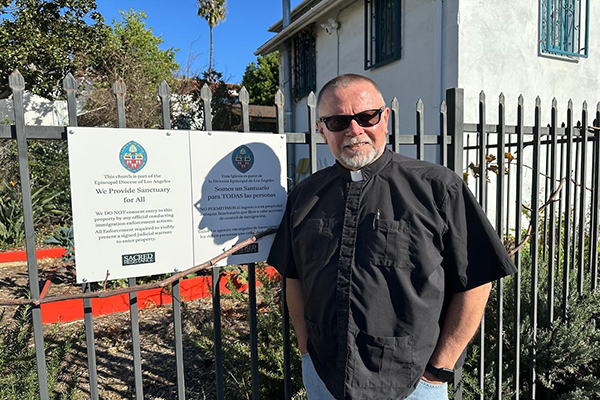
HOLLYWOOD — For Rev. Jaime Edwards-Acton, the story of brutal immigration sweeps targeting communities nationwide began in Los Angeles last year. That’s when 15 parishioners from his own church, all members of the indigenous Zapotec community, were detained.
Pastor Jaime, as he is known to the Zapotec community of Hollywood, has since emerged as a pillar of spiritual and material support.
“Everything we’re seeing in the country started here,” he says, recalling the day in June when Immigration and Customs Enforcement agents carried out a raid in the city’s Fashion District. The operation resulted in 14 detentions.
All were Zapotec, one of a number of indigenous groups from the south of Mexico, and members of St. Stephen’s Episcopal Church in Hollywood, where Edwards-Acton has served for more than 25 years.
“The raid on June 6th dealt a hard and devastating blow to the community,” he said. “A total of 15 people connected to our community Zapotec, and we managed to free 12; but three were deported to Veracruz.”
Edwards-Acton says the targeting of communities by federal agents has scarred members of his congregation, which is 80% Latino. Since then, he has taken an active role in organizing response networks while providing food assistance to impacted families.
“For those who can’t come for their food box because they don’t feel safe, we have volunteers who deliver it,” he said.
Still, according to Edwards-Acton, the harm lingers.
“The detentions… created a lot of trauma for the families,” he noted, recalling a text he received from local leaders about the raid that day. “We saw each other the Sunday after it happened. That was the last time we met in person for a while. People were so scared that we only connected online, like we did during the pandemic.”
It was two months before anyone returned for mass.
“When we did return in person, we arranged with a Jewish congregation to form a kind of patrol with volunteers who walked around the block of our property to watch for ICE,” explained Edwards-Acton. He says they locked the church doors and controlled who entered and left the premises.
In January 2025, the Department of Homeland Security announced that the previous administration’s decision to classify certain areas as off limits to DHS enforcement would no longer be followed.
“Criminals will no longer be able to hide in America’s schools and churches to avoid arrest,” a statement issued by the department said.
At the time, faith leaders stressed that they knew of no cases where churches were being exploited by criminals.
The Council of Bishops of the United Methodist Church issued a letter on the plight of migrants, immigrants and refugees, calling the federal administration’s draconian enforcement efforts a threat to “humanity, livelihood and basic human rights.”
Legal rights advocates explain that ICE agents are free to enter public spaces within churches, but they are still prohibited from entering private areas of the congregation, unless they have a judicial warrant or express permission.
More recently, ICE officials, wearing masks and carrying weapons, entered the North Hills United Methodist Church grounds in Los Angeles on Jan 29, 2026. They later arrested one member of the church. In a Facebook post, church officials said agents “ran throughout the church property among families, children and elderly people while we were serving our food ministry.”
After the raid on St. Stephen’s, Edwards-Acton moved to prevent a similar occurrence.
“We decided that if ICE agents came, we would tell them the church was private property, and they needed a warrant to enter.”
He added, “The plan was to create a safe and secure space and ensure that those who were vulnerable and practicing their religion could feel at ease.”
Of the 14 parishioners detained by ICE in June, 11 were later released on bail with an electronic ankle monitor; three were deported, one of them under false pretenses; another self-deported after deciding he didn’t want to remain in detention, while the third individual fought his case until finally waiving his right to appeal.
In October, another indigenous member of St. Stephens was arrested and released at the end of December.
Two sisters, Jennifer and Citlali Alejo, community organizers from the San Francisco Bay Area, launched a campaign soon after the detentions to free those apprehended in the raid.
“They did an incredible job,” said Edwards-Acton. “They started with a press conference the next morning, which I spoke at, and that kicked off this campaign that received a lot of attention, and they were able to raise a considerable amount of money online through GoFundMe, something like $250,000 to hire lawyers and pay the bail.”
When they were able to meet again in person, Edwards-Acton says it was moving to see families of the detained immigrants surrounded and embraced by congregants to let them know they weren’t alone.
He recalls that the first indigenous worker released from the Adelanto Detention Center, about three hours east of Los Angeles, joined an online Sunday service.
“I simply recognized him and invited him to speak, if he wanted. And he described how the whole experience had been so dehumanizing, from when they were detained, to how they were left chained in a van for about 17 hours without access to a bathroom.”
The worker recounted that when they arrived in Adelanto, it was overcrowded and cold and that sometimes they had to sleep on the floor.
Halfway through his story, Edwards-Acton said the worker broke down.
“It was very sad, very moving, and very brave of him to share what he went through,” Edwards-Acton said.
As for the role that churches and other religious institutions should play at this moment, Edwards-Acton is unequivocal. “It’s part of our calling,” he said. “Nonviolence does not mean being passive. We raise our voices. We don’t hide. We don’t stay silent.”
Araceli Martinez writes for American Community Media.