By Stephen Oduntan
Contributing Writer
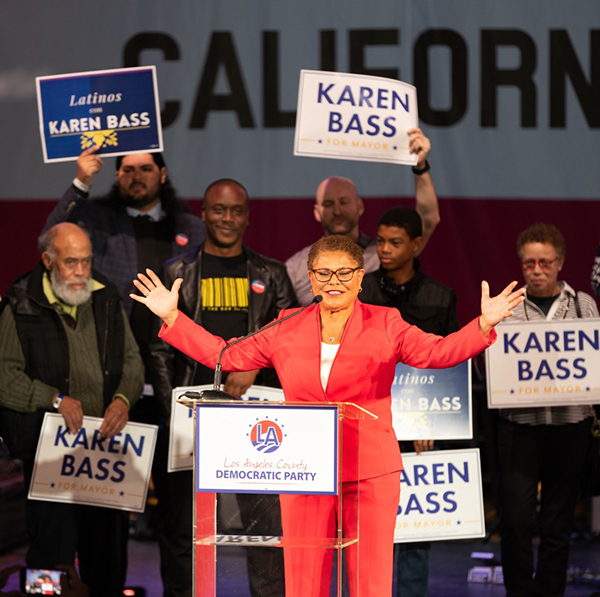
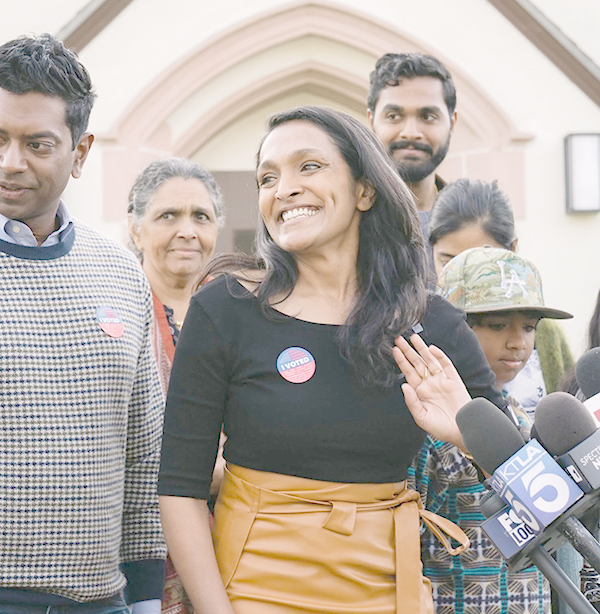
LOS ANGELES — Shortly after 11 p.m. on election night, as the November chill settled over the Greek Theatre plaza, Nithya Raman stepped before a crowd of supporters whose enthusiasm showed little sign of cooling.
“Do you love Los Angeles?” she asked. “Are you ready for an L.A. that loves you back?”
The question drew cheers from supporters who had spent hours watching election returns, dancing and hoping for an upset. But Raman, challenging incumbent Mayor Karen Bass, stopped short of declaring victory.
“There are still a lot of ballots to count, and we’re gonna let that count finish,” she said. “I’m hopeful. I’m very hopeful.”
By early the next morning, Raman had overtaken Bass after trailing in the initial returns. As of 4 p.m. Nov. 14, Raman held a 51-49 percentage lead with Bass trailing by 17,000 votes. Vote counting was expected to continue through at least Nov. 6.
Raman’s election night gathering reflected demands for change in a city struggling with homelessness, housing costs and dissatisfaction with basic services.
Among supporters, hopes for change centered on housing, city services and accountability.
Rodney Leggett of Sherman Oaks said housing construction was central to his support.
“We have to have way more housing built — affordable housing, market-rate housing, both of them,” he said, arguing that increased supply could help working-class residents and artists remain in Los Angeles.
Michael Hobson of Koreatown wanted closer scrutiny of homelessness spending, better street services and changes in police funding priorities.
He said he came to the gathering to witness a potentially historic moment, but recognized that supporting a candidate did not eliminate the need for public pressure.
“When Nithya wins, we will see what the mayor can do, and then we’ll also see where we have to push it,” he said.
Raman credited a coalition of labor unions, housing advocates, environmental organizations and progressive groups with building her campaign. More than 11,000 people registered to volunteer, she told supporters.
Campaign manager Ian Manheimer recalled joining Raman’s first City Council campaign in 2020, when the operation ran from a garage.
“What started in an actual garage with just a couple people has grown into this,” he said.
Among the elected officials supporting Raman were Los Angeles County Supervisor Lindsey Horvath and City Controller Kenneth Mejia.
Horvath acknowledged past disagreements with Raman, but stressed the need for city-county cooperation.
“No more finger-pointing, just problem-solving,” she told supporters.
UNITE HERE Local 11 Co-President Ada Briceño highlighted the struggles of hospitality workers who can no longer afford to live near their workplaces.
Raman pledged to expand housing construction and create good-paying union jobs.

“If you work in this city, you should be able to afford to live in the area,” she said.
She also invoked Los Angeles’ history of migration and immigration, recalling Black southerners fleeing Jim Crow who, in her words, “sought a home that welcomed them,” along with Salvadorans escaping civil war, Iranians fleeing political unrest and Armenians displaced from their homelands. Her tribute extended to the city’s cultural legacy, including the jazz that once flourished along Central Avenue.
But translating Raman’s vision of opportunity into meaningful improvements for Angelenos could prove far more difficult.
Tom Hogen-Esch, a political science professor at Cal State Northridge, pointed to structural limits on the mayor’s authority.
“The mayor has some power, [but] can be checked by the City Council in things like the budget,” he said. “And then the mayor has very little control over the bureaucracy itself.”
He told a reporter that the division of authority between elected officials and independent city departments makes it difficult for any mayor to deliver sweeping improvements.
“People just don’t really have a lot of faith that L.A. city government is going to be working for them,” Hogen-Esch said.
Hogen-Esch also questioned whether replacing Bass with Raman would substantially improve city services, cautioning against expectations of “magical changes” simply because voters elect a different mayor.
Raman thanked her family, volunteers and campaign workers, calling their effort “this little campaign that could.”
She reminded supporters of her promise that there would be dancing, even as the outcome remained uncertain.
The gathering ended without a declared winner. For Raman’s supporters, the question was no longer simply whether she could win, but whether a new mayor could deliver the changes they had come to celebrate.
Stephen Oduntan is a freelance writer for Wave Newspapers.