Wave Staff Report
DOWNEY — For people living with paralysis, the hope of walking again is powerful. The hope of feeling each step is even more profound.
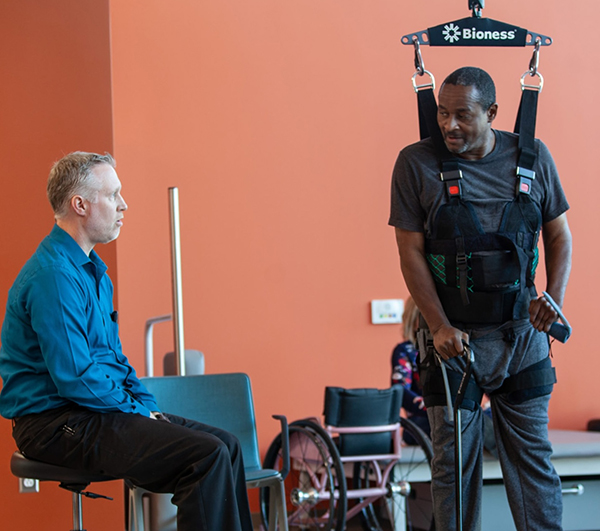
A team of researchers from Rancho Los Amigos National Rehabilitation Center, the Keck School of Medicine of USC, UC Irvine and Caltech has reached a major early milestone toward that future: testing a two-way brain-computer interface that can help control a robotic walking exoskeleton while also sending artificial walking sensations back to the brain.
The study, published in Brain Stimulation Journal marks an important step in the long-term effort to develop technology that may one day help people with spinal cord injuries regain more natural movement. Unlike many existing systems that focus only on movement, this approach is designed to restore two parts of walking: the ability to move and the ability to feel movement.
Dr. Charles Liu, a principal investigator on the study and a leader in neurorestoration research at Rancho Los Amigos National Rehabilitation Center, helped guide the multi-institution collaboration.
“This work is about more than building a device that moves the legs,” Liu said. “It is about reconnecting the brain and body in a way that could one day help people experience movement as something closer to their own. For patients with paralysis, sensation matters. It helps make movement safer, more natural and more meaningful.”
In the proof-of-concept study, a patient who already had temporary brain electrodes placed for epilepsy care was asked to imagine walking. The system decoded those brain signals in real time and used them to trigger steps in a robotic exoskeleton.
The system also sent signals back to the sensory areas of the brain, creating an artificial sense of leg movement. Early results showed the system could decode walking intent with about 92% accuracy and deliver artificial walking sensation with about 93% accuracy.
The research is still in an early stage and has not yet restored walking in a person with spinal cord injury. The study was conducted in a patient undergoing epilepsy treatment, which allowed researchers to test the approach without adding an additional surgical procedure solely for the research. The next phase is expected to focus on carefully designed studies involving people with spinal cord injury.
For Rancho Los Amigos, one of the nation’s leading rehabilitation hospitals, the study reflects the hospital’s long-standing purpose: helping patients recover, adapt, regain independence, and imagine what is possible after life-changing injury or illness.
“Rancho has always been a place where hope, science, and rehabilitation come together,” said Rancho Los Amigos CEO Konita Wilks. “This research shows what is possible when clinical care, engineering, neuroscience, and rehabilitation are working toward the same goal: improving life for patients.”
The project brings together experts in neurosurgery, neurology, biomedical engineering, robotics and rehabilitation. It was supported by the National Science Foundation, including an $8 million grant to advance the technology. Researchers say the goal is to continue refining the system so it can become smaller, safer, and more practical for future clinical use.

While the road from early research to patient care is long, the breakthrough offers a clear and compelling vision: a future where people with paralysis may not only move again with robotic support, but also feel the steps they are taking.
“This is why public rehabilitation hospitals matter,” said Dr. Christina Ghaly, director of Los Angeles County Health Services. “Rancho is not only caring for patients after devastating injuries. It is helping shape the future of recovery.”
Millions of people worldwide live with paralysis from spinal cord injury. For many, the loss is not only the ability to walk, but also the ability to feel the position and movement of their legs. That loss of sensation can affect safety, balance and independence. Researchers believe restoring sensory feedback could be key to making assisted walking feel more natural and more usable over time.
Rancho Los Amigos National Rehabilitation Center is a 158-bed rehabilitation hospital within LA Health Services, Los Angeles County’s integrated public health care system. The system includes four hospitals, more than 20 community health centers, emergency medical services, correctional health services and community programs serving the 10 million residents of Los Angeles County.
Located in Downey, Rancho Los Amigos is one of the nation’s leading rehabilitation hospitals, specializing in care for patients recovering from stroke, traumatic brain injury, spinal cord injury, amputation, and other complex conditions. A Magnet-designated hospital for nursing excellence, Rancho is internationally recognized for innovations in rehabilitation medicine, assistive technology, and patient-centered recovery programs.