By Alanis Thames
Contributing Writer
MIAMI, Florida — Storied historically Black university Florida A&M will take on No. 7 Miami next week while Howard will go to Memorial Stadium to face No. 6 Indiana, the defending national champion. Meanwhile, Tennessee State visits No. 3 Georgia Sept. 5.
The longstanding college football tradition of a big program cutting a hefty paycheck to a smaller school to come play in its stadium — and almost always lose big — continues to fill September calendars. Even as college football’s changing post-season and conference schedules threaten to reshape the market for those matchups — commonly referred to as “money” or “guarantee” games — those matches remain a key part of the sport’s economics.
For historically Black colleges and universities, these games often bring six-figure paydays, national exposure and opportunities to test themselves against major programs. But the role of the once-vital guarantee check has changed for historically Black colleges and universities (HBCUs), as athletic departments develop new revenue streams in hopes of becoming less dependent on outside income sources.
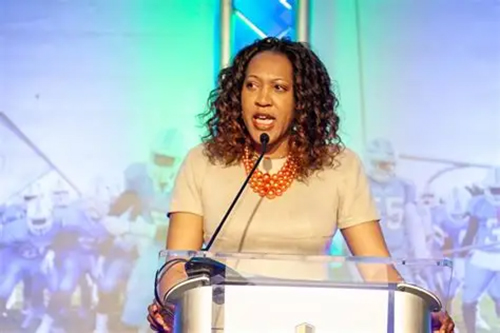
“I think we’re going to move to a space where we’re probably not playing very many of them in the future depending on what the landscape looks like,” said Morgan State Athletic Director Dena Freeman-Patton, whose program plays at Arizona State Sept. 5. “And as we know, that changes all the time. So it’s really an opportunity at this point. It’s not a necessity, in my opinion. And I believe my colleagues across the country are probably in that same space.”
More than 125 Division 1 matchups are scheduled for this season, including more than 20 that involve HBCUs. Some, like Freeman-Patton, have speculated that the market for such matchups could dwindle amid potential expansion of the 12-team College Football Playoff that could make strength-of-schedule critical for teams hoping for berths in the postseason field.
Dave Brown, founder of the Gridiron scheduling software firm, said that time hasn’t come yet for smaller Division 1 schools, which cost far less for major programs to schedule than other Division 1 opponents. That’s also true for HBCUs, where the price for those matchups has mostly remained the same over the years.
High-profile matchups can mean payouts starting around $500,000 for HBCUs. Grambling State last year received $1 million to play at Ohio State, where it lost 70-0. Others make around $250,000 when playing a Group of Six team.
Those sums certainly benefit athletic departments with limited operating budgets, but they’re not as essential to HBCU operations as they were years ago.
“I think it’s evolved in the sense that that was an opportunity for some of our programs that were not funded at a 100% level as far as scholarship allocation to enhance their travel budgets,” said Anthony Holloman, commissioner of the Southern Intercollegiate Athletic Conference and its 15 HBCUs.
“What has happened for us now since we have started to do revenue sharing with our broadcast and our media rights, these games are now more about visibility.”
HBCU football classics — showcase games built around traditional rivalries and often staged as weekend-long cultural events — have become an increasingly viable alternative to the traditional money games for some schools, giving them a chance to play a much more competitive matchup in front of their core fans.
As popularity and support of historically Black schools has increased, classics have generated significant revenue through ticket sales, sponsorships and host-city agreements, with games bringing in anywhere from $300,000 to upward of $600,000.

More dollars for HBCU conferences have come in from the creation of their own streaming platforms, said Texas Southern Professor J. Kenyatta Cavil. The Southwestern Athletic Conference launched its SWAC TV last year, and the Mid-Eastern Athletic Conference began its own streaming network last month.
“Historically, I think HBCUs have been at the vanguard of being innovative,” Cavil said. “And so because of the innovative nature of HBCUs, (they are) finding ways to maneuver in a landscape that may not be as conducive to how they build their programs.”
That has given athletic departments more leverage to weigh the costs and benefits of lopsided Division 1 matchups, where the risk for injury can be higher for their players.
Freeman-Patton, who is in her fourth year as Morgan State’s athletic director, said she still has top Division 1 games scheduled for years in advance, but the school recently changed its policy so that coaches are no longer required to schedule such games to help fund the department.
That doesn’t mean Morgan State is abandoning those matchups. The Bears’ trip to Arizona State offers players new exposure in the American West, where HBCUs aren’t as prominent, and a chance for the school to serve its large donor base in the state.
“HBCUs are in a better space,” Freeman-Patton said. “We’re not as dependent on the guarantee gains for the purpose that they used to serve. We still utilize them. We still can benefit from them, but not for the same reason.”
Alanis Thames writes for the Associated Press.