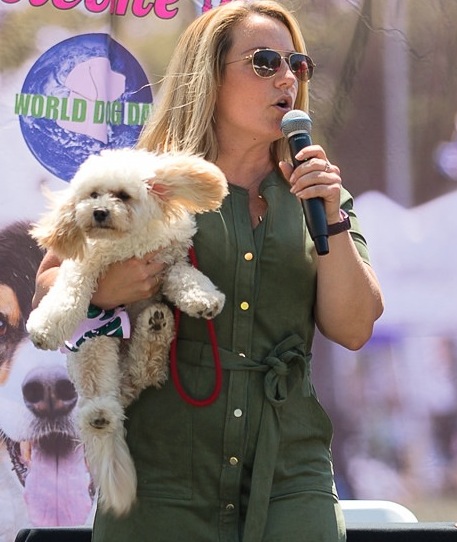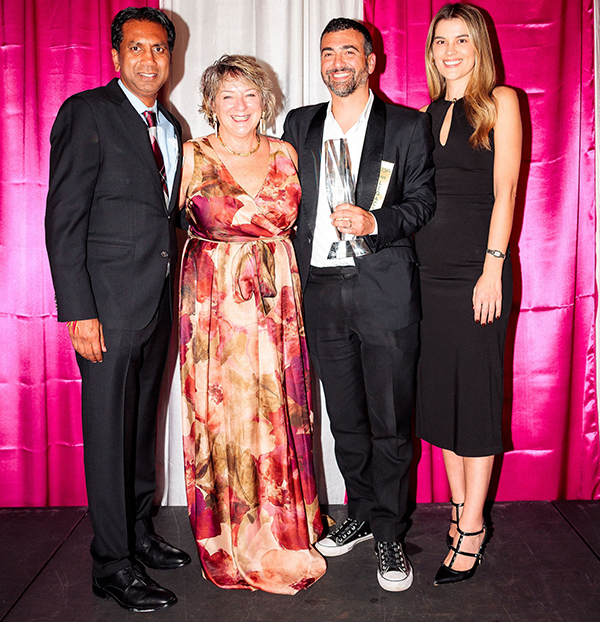
Genevieve Morrill, second from left, president and chief executive officer of the West Hollywood Chamber of Commerce; was honored at the chamber’s Creative Business Awards ceremony Nov. 10. Morrill is stepping down agter leading the chamber for 15 years. With her are, from left, chamber Chair Raja Sannihdi, and John Terzian of the h.wood Group and Christina Overgard, vice president of human resources for the h.wood Group.
Photo courtesy of Willa Cutolo Photography
Wave Staff Report
WEST HOLLYWOOD — The West Hollywood Chamber of Commerce presented its Creative Business Awards for 2025 Nov. 10 at the 1 Hotel West Hollywood.
The h.wood Group received the chamber’s Legacy Award, recognizing its impact on the business and cultural landscape of West Hollywood. Founded by John Terzian and Brian Toll, the h.wood Group has become a global hospitality leader with iconic venues such as Delilah, The Nice Guy, Keys, and Harriet’s.
One of the highlights of the evening came when chamber Board Chair Raja Sannidhi honored Genevieve Morrill, the long-serving president and chief executive officer of the chamber, with the Ray Reynolds Award, a distinction reserved for individuals whose contributions have significantly advanced economic development in the city. Morrill will be stepping down after 15 years of leading the chamber..
During her acceptance speech, Morrill reaffirmed the guiding mission behind her tenure.
“We must not forget what — and who — we are advocating for. Business is not a dirty word. It is vital that our voices are heard and that we unite to fight for fair and just policies.”
Speaking to the challenges facing businesses today, Morrill added, “Our businesses are struggling. We love our employees and are committed to providing fair and equitable opportunities, but we must be able to remain open to do so.”
Other award winners included Alba, which won the Creative Concept Award; The Lot at Formosa, which won the Corporate Innovation Award; the West Hollywood Design District Art Walk, which won the John Chase Art and Design Award; Lucky Break PR, which won the Creative Communications Award for its WeHappy Wednesday Campaign; Athens Services, which won the Innovative Sustainability Award; Dialog Cafe, which won the WeHo Attraction Award; and Trans Can Work, which won the Creative Community Service Award.
Presented by ringmaster sponsor the Beverly Center, the gala celebrated the businesses, innovators, creators and community champions who work to elevate West Hollywood as a leader in creativity and commerce.
This year’s theme was Where Innovation Takes Center Ring. The evening was produced by Chris Isaacson Presents and was hosted by stand-up magician Derek Hughes, with special appearances by Pickle and Captain Tall Tale.
Founded in 1921, the West Hollywood Chamber of Commerce is a nonprofit organization that advocates for business interests, promotes economic growth and provides resources that support and strengthen the West Hollywood business community.
Proceeds from the gala support the chamber’s programming in advocacy, marketing, education and business promotion.