THE HUTCHINSON REPORT: Blacks remain the largest target of hate in L.A. County

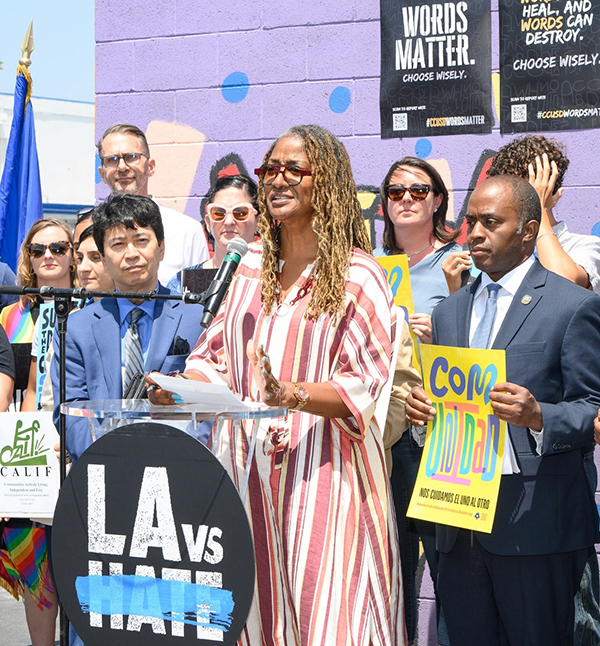
County Supervisor Holly Mitchell speaks at a 2024 news conference regarding a hate incident in Culver City. Columnist Earl Ofari Hutchinson writes that the latest hate crime report once again shows that Blacks are the most targeted when it comes to hate crimes.
File photo
By Earl Ofari Hutchinson
Contributing Columnist
The Los Angeles County Human Relations Commission downplayed it in its annual report on county hate crimes. But what can’t be glossed over or buried in the stats is the brutal reality that African Americans in remain the runaway number one target of hate mongers in the county.
Bear in mind this disturbing truth is nothing new. Year in and year out Blacks have been the favorite target of hate attackers. The checklist of hate abuse is well known. Verbal bashing, name calling, confrontations, racist graffiti on walls and sidewalks, defacing of African American owned burial sites, and physical assaults.
Things are getting worse. In 2024, the number of hate acts against African Americans jumped. There is little doubt as to the cause — President Donald Trump’s fueling white supremacy. The hate crime leap again gave L.A. County the continued shameful distinction as the nation’s runaway leader in reported hate crimes.
The troubling question that officials once more ponder is why Los Angeles County, which by all measures is considered one of the most liberal, multi-ethnic and diverse counties in the nation, has so much hate, at least as measured by the number of hate crimes? The starting point for trying to answer that thorny question is the make-up of the reported victims.
Blacks and Jews are still the prime victims. That pretty much follows the victim pattern that has been consistent for decades.
LGBT persons also make up a significant number of victims of hate attacks. The issue again is as usual religion, gender and sexual preference. However, race is still the prime reason for the hate splurge. And Blacks are both soft and the most visible targets for hate and violence.
There are two daunting problems in mounting an all-out frontal attack on hate crimes especially against Blacks.
One is reporting. It is tough to fathom, let alone prove, that the alleged assailant committed a hate attack solely because of the race of the victim. Some states have loosened their hate crime laws to make bias motivation only one factor in determining what a hate crime is.
The other major problem is the prosecution of attacks that apparently are motivated by race as hate crimes. The great danger in not quickly slapping hate crime charges in those cases is that it minimizes and marginalizes hate violence. Hate crimes, and especially hate crime violence, remain grossly under-reported and prosecuted.
The federal Department of Justice’s Bureau of Justice Statistics tracked hate crime reporting and violence from 2003 to 2011. Its findings were appalling.
The even greater problem is that often when hate crimes are reported as such the perpetrators often evade full punishment. That has nothing to do with the First Amendment, but muddled, confused and outright lax enforcement and prosecution of hate acts.
Even when the FBI and local law enforcement agencies identify individuals for their propensity for violence their hands are still tied.
State prosecutors flatly say that hate perpetrators are more likely to be convicted and get stiff sentences if their crime is treated as just a garden variety criminal case. That makes good legal and political sense — if they are prosecuted locally and if there’s a hate crime enhancement, which is far from assured.
Yet, that’s not the only reason for their hands off on many hate criminals. Except in the highest profile cases, they see those prosecutions as no-win cases with little political gain, and the risk of making enemies of local police and town officials, many of whom hold pronounced racial animus toward Blacks.
Hate crimes may be horrific, but they are seen as common crimes and are treated as such. Few state prosecutors will chance inflaming racial passions and hatreds by slapping a hate crime tag on a case except in the most heinous and high-profile cases.
There’s also the belief that hate crimes are mostly a thing of the past. When they do occur, they are isolated acts committed by a handful of quacks and unhinged young people and that state authorities vigorously report and prosecute the perpetrators of these crimes. That is a myth.
When Congress passed the Hate Crimes Statistics Act of 1990, it compelled the FBI to collect figures on hate violence. But it did not compel police agencies to report them. Record keeping on hate crimes is still left up to the discretion of local police chiefs and city officials.
Many police departments still refuse to report hate crimes or to label crimes in which Blacks are targeted because of race as hate crimes. Still other police departments don’t bother compiling them because they regard hate crimes as a politically loaded minefield that can tarnish their image and create even more political friction.
The county commission’s latest hate crimes report again is a reminder that hate is very much alive and well in America. It’s an even more perilous reminder that Blacks still bear the brunt of hate targeting. And nowhere is that more evident than in L.A. County.
Earl Ofari Hutchinson is an author and political analyst. He is the host of “The Hutchinson Report” Talk Show on Wednesdays at 6 p.m. at kyymgospel.com.