What’s the Black agenda?
Bass, Raman urged to outline plans for Black Los Angeles

By Stephen Oduntan
Contributing Writer
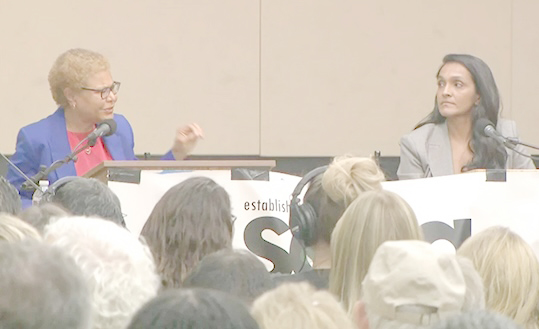
LOS ANGELES — As Mayor Karen Bass and challenger Nithya Raman clash over homelessness, housing and accountability, a coalition of Black community organizations is demanding something more concrete from both candidates: a written plan detailing what the next administration will deliver for Black Angelenos.
The coalition has given both campaigns until Oct. 23 to respond to an eight-page Black Agenda outlining 10 priorities, including homeownership, homelessness, employment, Black-owned businesses, wealth creation, public safety, police accountability, education, health and preservation of historically Black neighborhoods.
Organizers want specific policies, funding sources, implementation deadlines and measurable results, along with an annual public report card tracking progress.
“The Black vote will no longer be taken for granted,” said Najee Ali, senior organizer with Los Angeles Metropolitan Churches.
The coalition also includes the National Action Network, Los Angeles Urban Policy Roundtable and Project Islamic HOPE. Organizers say they are not endorsing either candidate.
“We created the L.A. Black Agenda to ensure that no matter what candidate wins, that Black L.A. wins also,” Ali said.
Neither the Bass nor Raman campaign responded to The Wave’s requests for comment before press time.
The proposal draws on the city’s 2025–26 Workforce Development Annual Plan, which organizers say has not produced promised improvements in communities across Council Districts 8, 9, 10 and 15.
Among its demands are specific targets for reducing Black homelessness, expanding Black homeownership and preventing displacement by 2030.
Black residents account for roughly 8% of Los Angeles’ population but about one-third of its homeless population. The Los Angeles Homeless Services Authority’s 2026 count estimated 45,194 people experiencing homelessness citywide, a 3.4% increase from 2025 that the agency said was not statistically significant.
Ali said reducing Black homelessness should be the next mayor’s most urgent priority.
During a televised debate on NBC4 and Telemundo 52 Oct. 13, Bass defended her homelessness record, citing an 11% reduction in street homelessness and calling for greater city control over the response system.
Raman questioned the cost and effectiveness of Bass’ Inside Safe program, arguing that the city needs stronger financial oversight. She cited a nearly 50% reduction in homelessness in her 4th Council District.
The candidates also disagreed over Measure ULA, the real estate transfer tax intended to fund affordable housing and homelessness prevention. Raman called for reforms, while Bass emphasized her administration’s efforts to accelerate affordable housing development.
Although both discussed issues central to the coalition’s demands, neither explicitly addressed the proposed Black Agenda during the debate.
Cheryl Branch, CEO of Los Angeles Metropolitan Churches, said the initiative reflects frustration among Black entrepreneurs who believe city programs intended to promote economic equity have failed to deliver.
“They have failed to deliver results,” Branch said.
She pointed to the city’s cannabis social equity program, saying Black operators have struggled with high taxes, regulatory costs and competition from unlicensed businesses, forcing some to close.
“Our voices didn’t seem to be in the mix,” she said, explaining why community leaders decided to develop their own policy demands.
Branch called for a city task force to address illegal cannabis operations and examine taxes on licensed businesses. She also raised concerns about gentrification and the displacement of longtime Black residents.
She described the coalition’s challenge as an opportunity for Bass to propose specific solutions, while questioning whether Raman has sufficient experience with Black Los Angeles.
Asked whether candidates take Black voters for granted, Branch replied: “Yes. Absolutely.”
The initiative echoes an earlier chapter of Black political organizing. In 1981, the Rev. Thomas Kilgore of Second Baptist Church helped establish an organization called the Black Agenda to promote economic opportunity and Black-owned businesses.
Pastor Jonathan Moseley, western regional director of the National Action Network, criticized politicians who seek support from Black churches during elections but fail to maintain that engagement afterward.

“We don’t need another chicken dinner. We don’t need to have another fish fry,” Moseley said, arguing that campaign appearances must lead to substantive action.
Earl Ofari Hutchinson, president of the Los Angeles Urban Policy Roundtable, has already been pressing City Hall for results through a campaign against illegal dumping in South Los Angeles.
Hutchinson has documented trash-filled streets and alleys, publicly demanded faster cleanups and criticized the city’s response. A July investigation by The Wave found recurring dumping hotspots among more than 114,000 service requests submitted to the city’s MyLA311 system in 2024.
His campaign illustrates the neighborhood-level concerns behind the coalition’s demands, particularly whether predominantly Black and Latino communities receive adequate city services.
“Black political influence and numbers are dwindling in the city,” Hutchinson said. “That demands special support for initiatives that bolster their status.”
He described Bass’ homelessness record as mixed, crediting her efforts to expand funding and programs while questioning the results.
Raman, he said, must commit to targeted initiatives addressing Black poverty, homelessness, neighborhood conditions and police misconduct, with measurable outcomes.
Hutchinson proposed grading candidates on whether they fulfill their commitments, similar to an NAACP report card.
“The price is no political support in the future,” he said of officials who fail to deliver.
The coalition wants candidates to identify actions for their first 100 days, first year and four-year term, with annual reporting on progress.
Organizers plan to publish the candidates’ responses before the Nov. 3 election and identify any campaign that misses the Oct. 23 deadline.
Ali said the effort will continue after the election, regardless of who wins.
Stephen Oduntan is a freelance writer for Wave Newspapers.