By Darlene Donloe
Contributing Writer
HOLLYWOOD — On a June night, the David Geffen Theater didn’t feel like a museum. It felt like a reunion.
Fifty years after “Car Wash” rolled onto screens, the Academy Museum of Motion Pictures and the Pan African Film Festival parked it back in front of a sold-out, multi-generational crowd for a 4K restoration screening that was less anniversary and more revival.
The 1976 film — Michael Schultz’s episodic, funk-fueled snapshot of one day at an L.A. car wash — isn’t just still funny. It’s still necessary.
“Car Wash” is not just a movie,” said Academy Governor Kim Taylor Coleman. “It’s a cultural touchstone. It still resonates. The movie has a phenomenal ensemble cast and a bangin’ soundtrack by Rose Royce.”
More than a comedy, “Car Wash” endures as a vibrant portrait of community, resilience and the diverse voices that keep shaping American culture.
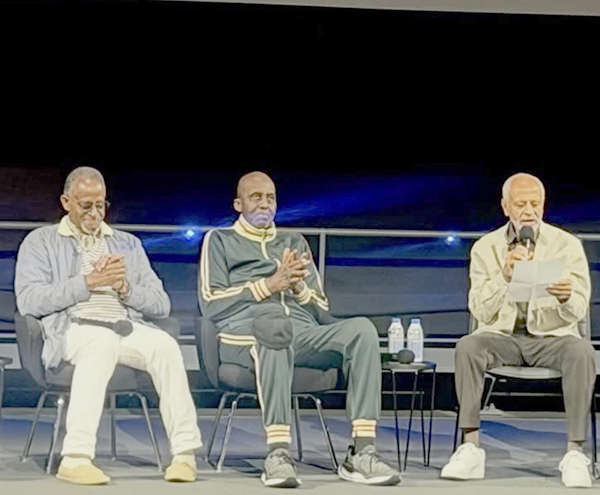
On June 20, that legacy pulled filmmaker Michael Schultz, producer Gary Stromberg, and cast members Bill Duke, Antonio Fargas, Garrett Morris, Melanie Mayron and Pepe Serna back to the stage for a question and answer session moderated by Jacqueline Stewart, professor of Cinema and Media Studies at the University of Chicago and the first African-American host on Turner Classic Movies.
They came to talk about a film that almost didn’t happen.
When Universal first approached Schultz in the mid-70s, “Car Wash” was pitched as a string of “high jinx, comedic stuff” with no center. Schultz nearly passed.
“It didn’t have a serious throughline,” Schultz told the crowd. “But when I was talking to my friend, Suzanne de Passe, who discovered the Jackson 5, and told her I was turning the movie down, she said, ‘Negro, are you out of your mind? This is a Hollywood movie. If this ain’t what you want, take the job and make it what you want.’”
He took it. He called Joel Schumacher, who wrote the script.
“I got with the writer and said, ‘If people don’t come away from this film feeling for the characters, then all the comedy in the world will just disappear.’”
To anchor the laughs, Schultz found the drama in the relationship between Lonnie, the car wash’s assistant manager, played by Ivan Dixon, and Abdullah, the Black Muslim revolutionary played by Bill Duke.
That became the throughline.
“The studio was absolutely apoplectic,” Schultz said, who insisted on shooting the movie in sequence. “They said, ‘You can’t mix comedy and drama.’ I said, ‘Why not?’”
Schultz said he cast from his theatrical roots, pulling in actors he knew and trusted: Fargas, Duke, and later, Garrett Morris, who was simultaneously in the original “Saturday Night Live” cast.
“To be in a film with Richard Pryor and the Pointer Sisters was incredible,” said Morris, who also worked with Schultz on “Cooley High.” “My A-game was to relax and have fun.”
Antonio Fargas, 78, delivered one of the film’s most-quoted lines as the openly gay Lindy: “I’m more man than you’ll ever be, and more woman than you’ll ever have.”
It was a direct clapback to Abdullah’s homophobia, and a moment of on-screen defiance that still draws gasps and cheers.
“I had a Puerto Rican father who couldn’t stomach my gay brother,” Fargas said. “I pulled from that. To be a part of this movie was wonderful. It’s about the relationship.”
Bill Duke, who played the militant Abdullah, said the role hit close to home.
“He was not what was to come,” Duke said. “It was already there. In 1976, we were in a time of rebellion, and the character was somebody I really was. I knew a lot of friends who were that way. We were fighting what we called ‘the system.’ That was it.”
Duke’s goal was to put the humanity in Abdullah.
“If you were rebellious, if you went against the system, you were labeled some violent person without a conscience,” he said. “America, or the system, robbed you of your humanity. But Michael Schultz and the writers wanted to show that these are people — whether you agree with them or not. They are human beings with feelings and commitments. The press was showing angry, dangerous radicals. We showed the rest.”
“Car Wash” was Duke’s first feature film.
The film lasted, he said, because “the problems we faced then still exist.”
The shoot taught him the power of what he calls “edutainment.”
“You can entertain people, but you can also give them things to think about and feel,” Duke said. “That’s what “Car Wash” did for me. I think for a lot of people.”
Melanie Mayron, the car wash’s cashier, remembered the freedom Schultz gave her.
“It was so much fun,” she said. “It was a special time. We all had a ball. It was the first time a director let me do what I wanted to do with the character.”
And Pepe Serna, asked what it was like being the only Latino in the ensemble, didn’t hesitate: “We were all just brothers. That was the beauty of the movie.”

Even producer Gary Stromberg’s origin story sounds like a Schultz scene.
“I had no experience,” Stromberg admitted. “The original idea was to make “Car Wash” a Broadway play. I remember I was at a bar and I jotted down on a napkin, ‘Car Wash.’ The music was done before we set foot on a soundstage. That napkin, I wish I still had it.”
Directed by Schultz and written by Schumacher, “Car Wash” starred Franklyn Ajaye, Sully Boyar, Richard Brestoff, George Carlin, Bill Duke, Ivan Dixon, Antonio Fargas, Garrett Morris, Richard Pryor, Tracy Reed, Pepe Serna, Irwin Corey, Jason Bernard, Melanie Mayron, the Pointer Sisters, and Clarence Muse, the first African-American to appear in a starring role in a major studio film, 1929’s ‘Hearts in Dixie’.
The film was underscored by Rose Royce’s funk anthems — including the title track “Car Wash” — and lifted by the Pointer Sisters’ “You Gotta Believe.”
Schultz’s classic landed as a witty, light-hearted offering from an otherwise tumultuous decade. Yet its humor never undercut its heart. The film found grace notes in labor, dignity in the everyday, and solidarity across race, sexuality and class — all before the final soap suds were rinsed.
Some in the Geffen audience on June 20 had never seen it before. Others had seen it “many times” and came to watch it gleam in 4K. Both groups laughed in the same places.
To close the night, Stewart asked each panelist for one word to encompass the legacy of “Car Wash.”
Fargas: “Love.”
Duke: “Humanity.”
Schultz: “Joy.”
Stromberg: “Soulful.”
Morris: “Togetherness.”
Stewart added her own: “Gratitude.”
Gratitude works. Because 50 years on, “Car Wash” isn’t a relic. It’s a reminder that comedy can carry weight, that a job can be a world, and that a group of people thrown together by a time clock can become a community worth filming.
As Schultz put it, the goal was simple: make people feel for the characters.
Mission accomplished. The car is clean. The crew clocked out, but the film never did. It’s still on the job.
Darlene Donloe is a freelance reporter for Wave Newspapers who covers South Los Angeles. She can be reached at ddonloe@gmail.com.