By Sunita Sohrabji
Contributing Writer
SAN FRANCISCO — The Council on American-Islamic Relations (CAIR) released a report July 27 noting that bias attacks and threats at Islamic places of worship have risen by 183% in the past three months.
Threats of violence, arson, and intimidation are among the bias-related attacks faced by mosques in the US since May.
In Wilmington, North Carolina, a man banged on the mosque door, cursed, and is recorded on video saying, “About to tear this ‘expletive’ down” and “Going to hell in seven years.” The man was already a suspect in a multi-agency investigation, according to the CAIR report.
A man called the Madison Heights mosque in Michigan, and — among other hateful comments — said, “We’re going to come on strong and get rid of you.” Christopher Andrew Lord was subsequently charged with making false threat of terrorism and using a computer to commit a crime.
At the Lakeville Masjid in Minnesota, Jacob Henry Ethington reportedly falsely claimed to be a federal agent investigating the mosque. He was carrying a knife. He had previously yelled swear words and threats while services were going on, noted CAIR in its report.
Two mosques in Connecticut received anonymous racist calls. Four incidents — in Los Gatos, California; Frisco and La Porte, Texas; and Albuquerque, New Mexico — challenged the building of mosques in those towns.
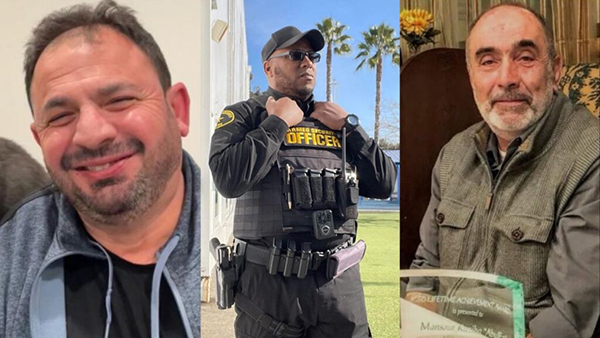
The most heinous incident occurred May 18. Two young men stormed the Islamic Center in San Diego and killed three men. The three victims were identified as Amin Abdullah, age 51, a security guard at the mosque, Mansour Kaziha, 78, and Nadir Awad, 57.
The suspects were identified by law enforcement as Cain Clark, 17, and Caleb Vasquez, 18. Both suspects were found dead in a car near the site of the shooting, in what appeared to be a murder-suicide. They detailed their neo-Nazi motivations for the attack in a 75-page document, “The New Crusade.”
“(Muslims) must be isolated and exterminated,” wrote Cain, noting that he hated the Islamic religion. “I hate seeing them here, invading my country,” he wrote.
“Islamophobia remains an acceptable form of hate in the U.S. American places of worship are too often seen as targets for cheap political smears and violence,” said CAIR Research and Advocacy Director Corey Saylor in a press statement. “It is a duty on community leaders to ensure our sanctuaries remain places for prayer, reflection, and community. Vigilance is a piece of achieving this outcome.”
In a May 26 report for Congress about the San Diego attack, writers Hannah Gais, Cassie Miller, and Rachel Fugardi noted that the tragic shooting came at a time of heightened Islamophobia, fueled in part by political leaders. In their suicide manifesto, Cain and Vasquez cited Vice President JD Vance’s May 14 remarks in Bangor, Maine, in which he stated: “Somali fraudsters are making millions off taxpayer money.”
Members of Congress have introduced nearly half a dozen bills opposing so-called “Sharia law” within the past year, noted the report to Congress. In December 2025, Reps. Keith Self and Chip Roy — both Republicans from Texas — announced the creation of the Sharia-Free America Caucus. In April, Self wrote on X that the caucus had amassed 65 members.

And in March, U.S. Rep. Randy Fine, R-Florida, posted on X, “We need more Islamophobia, not less. Fear of Islam is natural.”
The same month, Rep. Brandon Gill, R-Texas, stated that “Importing Islam will annihilate America as we know it.”
Islamophobia has taken center stage in Texas, noted Mobashra Tazamal, in a February report for the Bridge Initiative at Georgetown University. In November 2025, Governor Greg Abbot called for an official investigation into so-called “Sharia courts,” despite the fact that no such courts exist. He has called CAIR a terrorist organization.
Texas leads the nation in anti-Muslim disinformation, wrote Tazamal. Political leaders have written on social media 279,000 posts promoting themes such as “Muslim invasion theory,” the imposition of Sharia law, calls to investigate Muslim organizations and leaders, and calls to deport Muslims.
In May, CAIR hosted a webinar, titled “Protecting Your Mosques: What Every Mosque Needs to Know and Do,” that featured experts in mosque safety, community security, crisis preparedness, and threat prevention.
Sunita Sohrabji writes for American Community Media.