What’s next for Black L.A.?
With Bass’ defeat, many civic activists wonder who’ll speak for Black community

By Stephen Oduntan
Contributing Writer
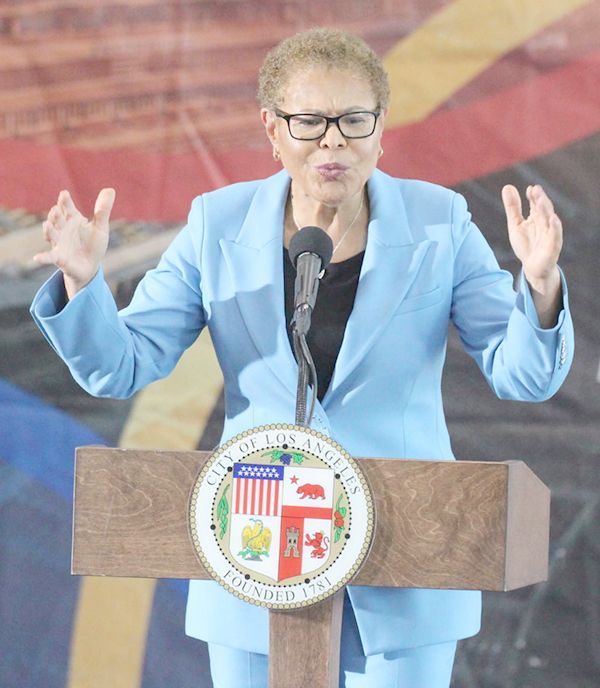
LOS ANGELES — For Karim Webb, Karen Bass’s defeat by Nithya Raman in the Nov. 3 mayoral election was more than an electoral disappointment. It meant losing a mayor whose decades of public service had built relationships and opened doors for Black Angelenos.
“I gave myself 24 hours to wish that the outcome wasn’t what the outcome is, but I can’t change it,” said Webb, a Los Angeles entrepreneur and former president of the city’s Board of Airport Commissioners.
His reaction reflects a question confronting Black Los Angeles following Raman’s victory: How does a community maintain its political influence when it no longer holds the mayor’s office?
Webb pointed to economic opportunities created during Bass’s administration, particularly at Los Angeles International Airport.
In 2025, the City Council approved a five-year, $5 billion airport contracting program involving 31 contractors, including 13 first-time prime contractors. Bass promoted the program as an opportunity for small and local businesses.
“If the mayor wasn’t the mayor, I don’t think as many Black entrepreneurs would have got contracts, certainly not the size of the contracts they got,” Webb said.
Airport records document expanded contracting opportunities but do not establish how much of that work went specifically to Black-owned firms.
Webb acknowledged that Raman could also benefit Black Angelenos.
“It’s a possibility that Nithya Raman would be great for Black L.A.,” he said.
The election also produced an unusual political alignment. Rick Caruso, a former Republican who unsuccessfully challenged Bass in 2022, announced he would vote for his former opponent, although he stopped short of formally endorsing her.
Bass also gained ground among voters who had supported Republican Spencer Pratt in the June primary. An October Berkeley IGS/Los Angeles Times poll found 41% of those voters favored Bass, up from 22% in September.
Yet some of Bass’s longtime allies moved in the opposite direction.
Melina Abdullah, a professor of Pan-African studies at Cal State Los Angeles and co-founder of Black Lives Matter Grassroots and Black Lives Matter-Los Angeles, endorsed Raman despite her longstanding friendship with Bass.
“I don’t think it’s a setback. I think it’s a turning point,” Abdullah said of Bass’s defeat.
Abdullah argued that Black representation requires more than electing officials who share the community’s racial identity.
“I think what you see with Karen Bass is Black folks saying, we want more than descriptive representation,” she said.
Raman’s opposition to mass surveillance and willingness to listen to grassroots organizers helped secure Abdullah’s support.
“I don’t know that she’s with us on everything automatically, but at least the openness of her listening to community was there,” she said.
Abdullah said she has submitted priorities to Raman’s team and that Black Lives Matter-Los Angeles is developing additional demands. Raman also agreed to participate in a community conversation with organizers, she said.
“We want her to work with Black folks, regular Black folks and Black organizers in Los Angeles,” Abdullah said.
Among Abdullah’s immediate priorities is replacing Los Angeles Police Chief Jim McDonnell. Raman pledged during the campaign to replace him, declaring during an October debate, “I want to replace the police chief. I have been very open about that.”
Since winning, however, Raman has spoken with McDonnell about public safety without announcing whether or when she would replace him.
For Tina Sampay, a South Los Angeles journalist with more than 100,000 Instagram followers under the handle @slausongirl, Bass’s defeat was deeply disappointing.
Sampay, a millennial who supported Bass’s reelection, said losing a Black mayor carries particular significance in a city where Black residents make up a relatively small share of the population.
“There always has been this divide in Black Los Angeles, in terms of things like classism,” she said.
Sampay credited Bass with bringing attention to Black homelessness but questioned how much had changed for economically struggling neighborhoods.
“No matter who’s mayor or who’s councilman, it’s like the hood still looks the same,” she said.
She identified housing, employment and services for formerly incarcerated Black men among the needs requiring greater attention.
Other Black Angelenos supported Raman because they wanted a different approach to city government.
Hans Delsoin, a Black resident of North Hollywood, questioned Bass’s management and said Raman’s background in urban planning appealed to him.
“I don’t think Mayor Bass is as good of a manager as she could be,” he said.
The Black L.A. Young Democrats, which endorsed Bass in 2022, backed Raman this year, citing her positions on police accountability, the LAPD budget and affordable housing.
An October Berkeley IGS/Los Angeles Times poll found Raman leading Bass 69% to 15% among likely voters ages 18 to 29, while Bass led Raman 71% to 13% among likely Black voters.
Raphael Sonenshein, executive director of the Haynes Foundation and author of “Politics in Black and White: Race and Power in Los Angeles,” described the generational divide as unusually pronounced.
“I don’t think I’ve seen this in Los Angeles before. It’s really quite remarkable,” he said.
Sonenshein said younger voters gravitated toward Raman across racial and ethnic communities, suggesting that longstanding political alliances are becoming less predictable.
He also pointed to South Los Angeles’ 9th Council District 9, represented by Black elected officials since Gilbert Lindsay’s appointment in 1963, as an example of changing demographics. Once predominantly Black and now nearly 80% Latino, the district is poised to elect its first non-Black council member in more than six decades.
Jose Ugarte holds a narrow lead over Estuardo Mazariegos in the race to succeed Councilman Curren Price. As of Nov. 10, Ugarte led by 156 votes, 19,200 to 19,044, with ballots still being counted.
With Price’s departure, the 15-member City Council will have just two Black members — Council President Marqueece Harris-Dawson and Councilwoman Heather Hutt — for the first time since 1963, excluding temporary vacancies.
Before the election, a coalition of Black organizations called for a Black Agenda for Los Angeles, seeking measurable commitments on housing, employment, economic opportunity, public safety and neighborhood conditions.
Raman presented her own Black Agenda during the campaign. The question now is whether those proposals will become governing priorities.
Earl Ofari Hutchinson, president of the Los Angeles Urban Policy Roundtable, said the coalition has requested a meeting with Mayor-elect Raman to establish a timetable for implementing its priorities.
He called for greater Black representation in appointments to city commissions, department leadership and senior administrative positions.
“That first and foremost means equity in African-American hires and appointments at the top levels of city administrative governance,” Hutchinson said.
He also urged Raman to prioritize illegal dumping in South Los Angeles, describing it as a serious hazard for low-income Black and Latino residents.
Webb urged Raman to begin engaging Black community leaders before taking office.
“Don’t wait till inauguration. Reach out,” he said.
He wants the incoming administration to include people with established credibility in Black communities.
“Who’s in the room that is proven to be trustworthy?” he asked.
In an email response, Raman’s team pointed to her Black Agenda, which commits to placing Black leaders in senior administration positions and involving residents, community organizations, young leaders and members of Los Angeles’ African diaspora in setting priorities and making decisions.
“Black Angelenos deserve a City Hall that listens, delivers, and follows through on its promises,” the agenda states. “This agenda is a commitment to partnership, accountability and results.”
For Webb, the ultimate measure is not simply access to elected officials.
“Political influence for what?” he asked, pointing to Black wealth, homeownership and educational attainment as measures of progress.
Sonenshein said Black candidates could find new opportunities in the city’s shifting political alliances, particularly by connecting with younger voters whose loyalties are less established.
“Things aren’t as fixed as they were before,” he said.
Stephen Oduntan is a freelance writer for Wave Newspapers.