By Marcus Sebastian Mason
Guest Columnist
I have spent most of my adult life walking the halls of the U.S. Capitol and watching history unfold within those corridors — sometimes quietly, sometimes with thunderous consequence.
When I started my career, Georgia Rep. John Lewis occupied a modest office in the Capitol as chief deputy majority whip. Years later, I watched my Omega Psi Phi fraternity brother and mentor, Rep. James E. Clyburn, occupy considerably larger quarters as U.S. House majority whip. Twice.
There is something profoundly American about that progression: Lewis, who risked his life in a “Bloody Sunday” attack in 1965 fighting for the right to vote. Clyburn, a son of the segregated South who rose to become the anointer of presidential hopefuls.
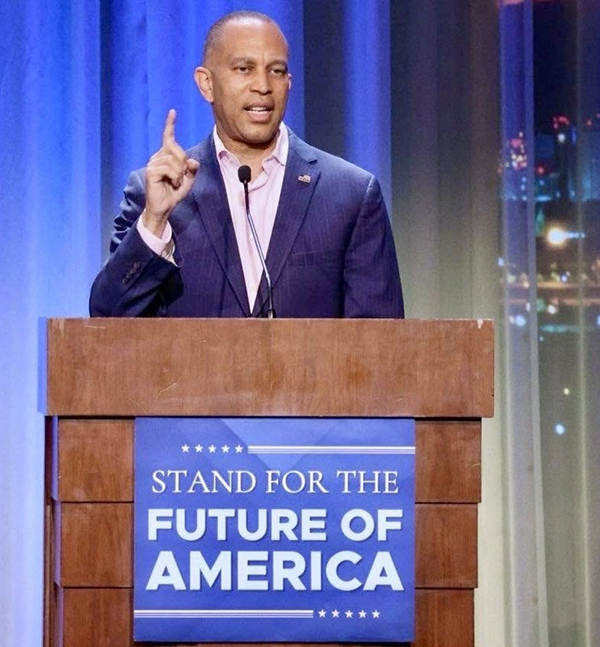
And now Hakeem Jeffries, a son of Brooklyn, is preparing to lead the very institution that once denied Black Americans the full measure of their citizenship. Extraordinary.
But there is another truth that makes this moment especially poignant.
The Capitol was built in part by the hands of enslaved Black Americans. More than 200 years later, insurrectionists stormed its halls in January 2021, desecrating a symbol of American democracy while attempting to overturn the will of voters.
And now, in that same building, a Black man will most likely ascend to third in line of protocol in the U.S. government. As such, he will always be in the room.
The symbolism is remarkable. But the significance runs deeper. America has a way of making history long before it fully understands its meaning.
In 2008, Barack Obama was elected the nation’s first Black president, shattering a barrier many thought would never fall. In 2020, Kamala Harris followed, becoming the first woman and first African American to be elected vice president. Now, Jeffries stands at the threshold of another historic precedent: becoming the first Black speaker of the U.S. House of Representatives.
A president. A vice president. And now, potentially, a House speaker. A political hat trick.
But this moment is about far more than completing a historic trifecta. It is about power, perseverance and the evolving promise of American democracy.
Consider the institution Jeffries is poised to lead. The U.S. Congress once indulged slavery, tolerated segregation, and thwarted legislation that would extend the full promise of citizenship to Black Americans. Its halls have witnessed some of the nation’s most consequential struggles over equality and justice.
Now, a Black man from New York may hold the gavel. Let that sink in.
Jeffries did not arrive at this moment by accident. He has deftly navigated one of the most fractured political environments in modern American history with intellectual discipline, strategic patience and political sophistication.
And his record extends beyond rhetoric. He helped advance bipartisan criminal justice reform through the First Step Act. As House Democratic leader, he played an important role in securing congressional support for Ukraine despite substantial Republican opposition.
In 2026, he helped House Democrats force a vote on extending Affordable Care Act tax credits, proving that even a minority party can exercise meaningful legislative influence. That takes skill.
Finally, he helped lead Democrats through a historic midterm election that overwhelmingly returned the House to their control.
These are not merely political triumphs. They demonstrate an understanding that true leadership demands more than commanding a microphone. It requires knowing when to speak, when to negotiate, when to confront and when to let the moment speak for itself.
Jeffries has also displayed something Black men in positions of authority understand all too well: composure under attack, while others are permitted the luxury of responding with fire — or simply being human.
He has endured insults, personal assaults and name-calling at the hands of a president whose political vocabulary too often substitutes ridicule for reason. Yet Jeffries rarely takes the bait. He doesn’t swing at a pitch in the dirt.
There is a particular discipline demanded of Black leadership in America. Passion is often labeled as anger. Confidence can be mistaken for arrogance. Firmness can be described as aggression. Black men often must navigate a narrower corridor of acceptable behavior than their human counterparts.
Jeffries understands that reality. He carries that burden with a composure that can make its weight almost invisible. Composure should never be confused with weakness. Nor should restraint be mistaken for surrender.
Jeffries has critics, of course, both online and off. And some criticisms may be legitimate. Some observers question his calm approach to leadership, his political calculations and his willingness to challenge competing factions. Others set unrealistic expectations that he simultaneously satisfy every constituency, resolve every disagreement and answer every provocation.
He is not perfect. Neither is the Democratic Party he leads. And neither is the nation he is primed to help govern.
For Black Americans, this moment carries a significance that cannot be measured by a title alone. For generations, Black voters have been among the Democratic Party’s most reliable constituencies. They have organized, marched, registered voters, knocked on doors, financed campaigns, and delivered decisive electoral victories.
Too often, however, our political loyalty has not translated into a proportionate share of institutional power.
Jeffries’ elevation would represent more than symbolism. It would place a Black American at the center of the legislative agenda, congressional oversight, committee leadership and negotiations with the executive branch.
Representation matters. But representation accompanied by authority means even more.
For the country, the significance is equally profound. The speaker’s gavel would rest in the hands of someone who reflects both America’s painful past and its capacity for change. To paraphrase James Clyburn as he quotes French philosopher Alexis de Tocqueville: “America’s greatness is in her ability to repair her faults.”
And for a young Black child watching from Brooklyn, Baltimore, Birmingham, Los Angeles and beyond, the lesson is unmistakable: Institutions that once excluded people who look like you can one day be led by people who look like you.
The real test, of course, will not be the history Jeffries would make taking the gavel this January. It would be the history he helped make while holding it.
Barack Obama opened one door. Kamala Harris opened another. Hakeem Jeffries now stands before a third.
And this time, the door opens onto the floor of the people’s house.
Marcus Sebastian Mason served as chief of staff in the U.S. House of Representatives and a twice-appointed, at-large member of the Democratic National Committee under President Barack Obama and President Joe Biden.