Hussle: Still ‘In the house’
Thousands gather to honor late rapper with street corner Nipsey Hussle Square

By Stephen Oduntan
Contributing Writer
SOUTH LOS ANGELES — The crowd gathered Feb. 28 at Crenshaw Boulevard and Slauson Avenue — the final weekend of Black History Month — struggled to hear him at first.
“Let him speak!” someone shouted.
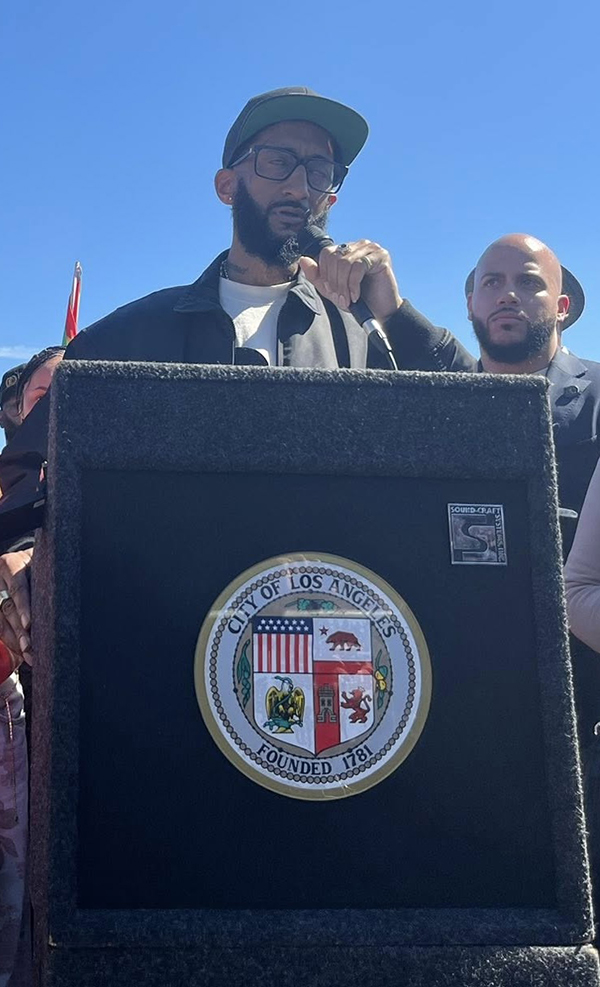
Samiel “Blacc Sam” Asghedom, standing at the corner now officially designated as Nipsey Hussle Square, paused to collect himself. The honor, he said, meant everything to the family.
But for him, this intersection was never just a symbol. It was memory.
“We used to walk from 60th Street,” he recalled. “Catch the bus right here.”
As children, he and his younger brother would clear entire shelves of 25-cent Hot Cheetos at a nearby store, backpacks empty of books but full of ambition. Nipsey — born Ermias Asghedom — would later sell his first mixtapes in the parking lot just steps away from where the new street sign now stands.
“He used to get kicked out of that lot,” Sam said.
Years later, after The Marathon brand had grown, the family returned to open a business there.
But the lot once again became a battleground. Sam said the property had been labeled a “city nuisance,” and police pressure mounted as they tried to operate there. They discussed moving the flagship store elsewhere.
But Nipsey Hussle refused.
“My work has to inspire,” Sam recalled his brother saying. “First and foremost, it has to inspire the people that grow up here.”
Ownership, he believed, meant more than profit. It meant visibility. It meant planting roots where others expected retreat.
Los Angeles City Council President Marqueece Harris-Dawson said the intersection renaming began not at City Hall, but with the community. Within days of Hussle’s death in 2019, more than 10,000 petitions were submitted urging the city to honor him.
“There were some concerns,” Harris-Dawson acknowledged, referencing discussions about Nipsey’s outspoken lyrics and views on policing. But when the motion reached the council floor, it passed unanimously. The mayor signed it into law.
“Forever,” Harris-Dawson said, “when people get off the train at this stop, they’re going to know the story of Nipsey Hussle.”
Assemblyman Isaac Bryan framed the dedication as part of a broader commitment to reinvestment in South Los Angeles.
“The best way to stop violence in our community is to invest resources,” Bryan said. “We have to own it.”
Councilwoman Heather Hutt described the moment as full circle for a son of South Los Angeles who reinvested in the neighborhood that shaped him, highlighting his support of entrepreneurship and STEM education through initiatives such as Vector90.
For Hussle’s father, Dawit Asghedom, the renaming connected South Los Angeles to a deeper history. A participant in Eritrea’s independence struggle, he described his son as “a bridge between cultures,” rooted in Crenshaw and Slauson, yet shaped by a legacy of resistance and self-determination.
“Real change is never a sprint,” he said. “It is a marathon.”
Hussle’s mother, Angelique Smith, urged the crowd to meet adversity with compassion.
“Through your struggles, your setbacks, your challenges — respond with love,” she said.
Actress Lauren London, Hussle’s longtime partner, recalled driving past the intersection years ago when he made a bold prediction.
“One day they gonna name this whole section after me,” she remembered him saying. “And here we are today.”
Perhaps the most poignant remarks came from Kameron Carter, London’s son, who described returning to the corner as difficult.
“It’s always seen as a negative place,” he said. “But seeing everybody here today … it changes the whole perspective.”
“Right here where everything happened is right here where everything will grow.”
For many in the crowd, the renaming carried deeply personal meaning.
Among those in attendance was a man who identified himself as Abios, a resident of the Crenshaw area for about 15 years.
“It means the world,” he said. “He wasn’t glorifying it — he was teaching you a way out.”

Abios described Hussley as “a big brother to everybody,” adding that for some in the neighborhood, he was “like a father figure.”
Erica Jazmeen, who traveled from San Diego to attend the ceremony, said Hussle’s influence extended far beyond Los Angeles.
“He inspired my life,” she said. “All of us coming together like this — that’s a change.”
Her favorite song, she added, is “Dedication,” a track centered on persistence and ambition.
“You have to keep going,” she said. “Everything I do, I do it with dedication.”
Yet, even as the square was dedicated to permanence and growth, reminders of the challenges Hussle often spoke about surfaced once again.
Less than 24 hours later, a celebration was interrupted when gunfire erupted outside the grand opening of Marathon Burger in Long Beach, a new venture associated with the family. One man was killed and two others were injured, according to Long Beach police.
Even so, the message at Crenshaw and Slauson remained consistent: legacy requires responsibility.
Businesses may come and go. Tragedy may leave scars. But the corner once labeled a nuisance is now a permanent landmark — reclaimed not only by ordinance, but by ownership, memory and community will.
And as Sam Asghedom reminded the crowd, the mission is larger than a sign.
“It has to inspire.”
Stephen Oduntan is a freelance writer for Wave Newspapers.
CAPTION
Samiel ‘Blacc Sam’ Asghedom speaks during the dedication of Nipsey Hussle Square at Crenshaw Boulevard and Slauson Avenue Feb. 28 as family members, elected officials and community supporters look on. The Los Angeles City Council voted unanimously to rename the intersection in honor of the late artist and entrepreneur.
Photo by Stephen Oduntan