Grieving mother helps bring justice to those who have lost children


By Darlene Donloe
Contributing Writer
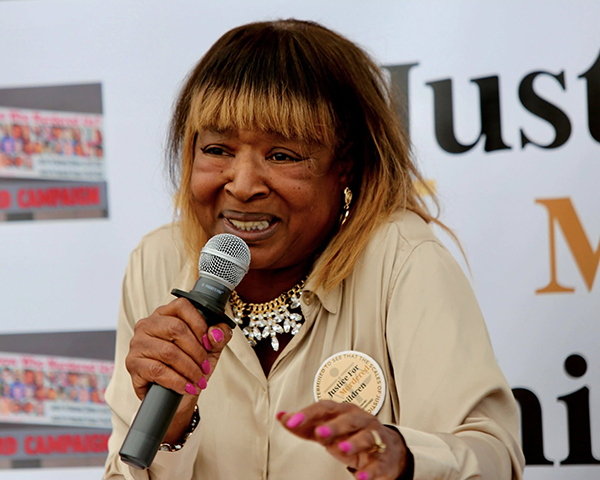
SAN PEDRO — LaWanda Hawkins’ life changed forever on Dec. 6, 1995, when her 19-year-old son, Reginald, her only child, was killed.
The pain of his murder sparked a fire within her, driving her to create Justice for Murdered Children a year later.
With the help of an attorney, Hawkins turned her grief into action, founding an organization that would become a beacon of hope for families shattered by violence.
Hawkins, along with other parents in South Los Angeles who also lost children to murder, found they had an unsettling common denominator. Their cases were often unresolved, and their voices were marginalized within the criminal justice system.
Justice for Murdered Children;s mission is to bring justice and healing to those who have lost loved ones to murder.
The organization’s efforts focus on assisting, empowering, and educating families, as well as bridging gaps between communities and law enforcement.
“I started this organization because I wanted to educate people regarding murder,” said Hawkins, a married Chicago native. “The families feel like they have no power. It’s a shame, but sometimes people blame the murder victims.”
Hawkins’ son’s murder remains unsolved.
“Justice for Murdered Children has the appropriate name,” Hawkins said. “That’s what we want. When I say justice, I mean someone has been arrested, charged, and prosecuted.
“I’m not talking about anyone being a vigilante,” she added. “We just want justice. When it happened, I begged God not to let me or anyone in my family become a vigilante.”
Hawkins’s personal experience has fueled her passion to create a world where no family has to endure the same pain she did.
Hawkins said she channeled her grief through organizations like Loved Ones Victims Services and Justice for Homicide Victims.
“I went to both of those groups all the time,” Hawkins said. “I was persistent. It was hard. It’s not easy. This is not an easy pill. It takes a lifetime. I’m going through it every day.
“There’s not a day that goes by that I don’t think about my son,” she said. “I can go outside right now and hear something or smell something, and it’ll have me in tears. You never actually get through the loss of your child. You learn how to deal with it.”
In 2011, Hawkins experienced another profound loss when her younger sister, Linda Whiting, was killed at the age of 49 in Arizona. The individual responsible was a 17-year-old boy.
“We’re still dealing with that loss as well,” Hawkins said.
Through Justice for Murdered Children, Hawkins and her team work tirelessly to support families, advocate for victims’ rights and reduce gun violence.
“We go to court, assist with billboards, assist with rewards, burials, yoga, baths, breathing therapy, art, and more,” said Hawkins, who also hosts grocery giveaways. “We have wellness going on. We have support group meetings. We’re also starting an all-Spanish support group in May. Our doors are open to everyone and anyone. We don’t judge.”
In addition to her work at Justice for Murdered Children, Hawkins is part of the Los Angeles City Mayor’s Crisis Response Team, responding to traumatic incidents in San Pedro, Wilmington, and Harbor City.
The team, composed of community volunteers, provides immediate crisis intervention, support and referrals to those affected by violence or traumatic events. It works closely with emergency personnel to ensure victims and families receive necessary care and resources.
In 2006, Hawkins established a billboard campaign throughout Los Angeles County by posting billboards bearing photos of murder victims to raise awareness of gun violence and encourage witnesses to come forward and find suspects in unsolved murders.
In 2008, she became a co-signer of Marsy’s Law, which was enacted by California voters. Marsy’s Law empowered victims in California with several constitutional rights.
“When it was on the ballot, we got 54% of the people in the state of California to say, ‘Yeah, you all should have rights,” Hawkins said. “Some people didn’t want us to have rights. They thought that if we had rights, that would offend the rights of the perpetrators. We never said that we didn’t want perpetrators to have rights.

“We’ve been going state to state to get it passed,” she added. “Some people think that victims should not have rights, only perpetrators, and if we give them rights, will that violate the perpetrators’ rights? It doesn’t. Why can’t we both have rights?”
A tireless advocate, Hawkins routinely speaks to San Pedro school children about crime prevention and gun violence, as well as mentors students whose siblings have been murdered. She is also called upon by the Los Angeles Unified School District when there is a school shooting to speak to students about gun violence, grief and healing.
When speaking to children, Hawkins talks about the Love Hug program directed at children.
“We believe that every youth deserves a hug before leaving a home,” Hawkins said. “It’s like a tough love hug, so when you’re hugging that kid before he/she leaves, you rub them down to make sure they’re not going out of that house with a gun. If they have a friend with them, hug that friend, too. We’re checking backpacks and everything. This is all about love.”
Hawkins said there is also a Stop the Bleed program, which is designed to save lives.
“We do the Stop the Bleed program because a lot of our youth have died because they bled out,” Hawkins said. “So we teach people how to stop the bleeding. Basically, we teach you how to pack it with whatever you have, and don’t worry about an infection. Don’t worry about the dirt because that’s an emergency room.
“When they get there, they will deal with that. They just need us to stop the bleeding so that people don’t die. The majority of the people who died from gun violence were due to them bleeding out,” she added.
Like many nonprofits, Justice for Murdered Children faces the ongoing challenge of securing funding.
“People don’t see murder victims’ families as needing funding,” Hawkins said. “They think once the system has buried your child, that’s it. They don’t believe in funding that.
“People need to be held accountable,” she added. “This ‘don’t tell’ mentality, and giving people a second chance. I care less about people telling you, ‘don’t tell, give somebody a second chance.’ No, I’m not for that.”
Justice for Murdered Children work is a testament to the power of turning tragedy into purpose.
“The message I have for families who are going through a similar circumstance is, ‘Don’t give up,’” Hawkins said. “No matter what. Just hold on.’”
Justice for Murdered Children is located at 1722 S. Gaffey St., San Pedro. Phone: 310 547-5362.
Darlene Donloe is a freelance reporter for Wave Newspapers who covers South Los Angeles. She can be reached at ddonloe@gmail.com.