Makeover begins on Baldwin Hills mall
Officials launch groundbreaking on long-awaited plaza overhaul

By Stephen Oduntan
Contributing Writer
SOUTH LOS ANGELES — City officials and developers on March 5 broke ground on the first phase of a redevelopment of the Baldwin Hills Crenshaw Plaza, launching construction that will reshape one of South Los Angeles’ most historically significant commercial sites.
The ceremony marks the beginning of demolition of the former Sears building and site preparation for 92 new residential homes — the first step in a multi-phase plan to revitalize the 42-acre property.
The project is being carried out by the Baldwin Hills Crenshaw Plaza Partnership in coordination with the city of Los Angeles and development partners including Harridge Development Group, Access Industries Inc., Atlas and SilverPeak.
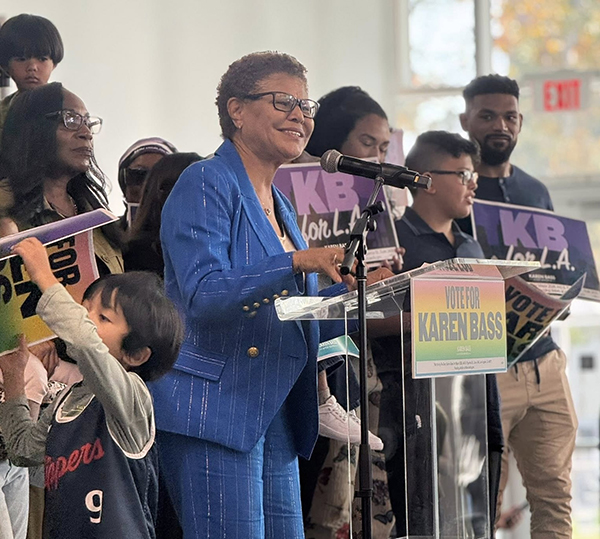
Mayor Karen Bass said the redevelopment represents a major investment in a location long viewed as a cultural and economic hub for the city’s Black community.
“Baldwin Hills Crenshaw Plaza has always been more than a shopping center — it is a cultural and economic cornerstone of South Los Angeles,” Bass said in a statement. “Breaking ground on this redevelopment means moving forward with new homes, new investment and real opportunity while honoring the legacy and importance of this site to the community.”
City Council President Marqueece Harris-Dawson, whose district includes the mall, said the project reflects years of community engagement and planning.
“This moment reflects years of hard work, community engagement and persistence,” Harris-Dawson said. “Phase 1 creates meaningful pathways to homeownership and reinvestment while respecting the history of Baldwin Hills Crenshaw Plaza and the people who have long called this community home.”
For decades, the Baldwin Hills Crenshaw Plaza has been viewed by many residents as more than a retail center.
“The mall is Grand Central Station for our community,” Harris-Dawson said in previous comments reported by The Wave. “It is in many ways the public square where large events that symbolize the culture, the struggle and the strength of our community.”
Built in 1947, the mall was among the first regional shopping centers in the country and has long served as a gathering place for community events, civic organizations and cultural institutions.
The plaza has housed Black-owned bookstores, restaurants and the Museum of African American Art, and it hosts the annual Pan African Film Festival. For generations of South Los Angeles residents, the mall has been both a shopping destination and a cultural meeting place.
But like many traditional indoor malls across the country, Baldwin Hills Crenshaw Plaza has struggled in recent years as major anchor tenants closed and foot traffic declined.
The loss of stores such as Sears and Walmart fueled concerns that the once-thriving center could fall into long-term decline without significant reinvestment.
Plans to redevelop the property have been debated for years, often sparking discussions about community ownership, cultural preservation and the risk of displacement.
Community activists and organizations including Downtown Crenshaw Rising previously pushed for Black ownership of the mall and raised funds in an effort to purchase the property themselves.
Other residents argued that redevelopment — regardless of ownership — was necessary to prevent the mall from continuing to deteriorate.
“The mall is a symbol and substance of potential Black economic strength,” said Los Angeles Urban Roundtable leader Earl Ofari Hutchinson in 2021. “Many deem the mall fight crucial because of the perceived threat that a gentrified major corporate-owned mall in a rapidly gentrifying South L.A. will further dislocate and destabilize the Black community.”
Some community activists remain skeptical about what the new development will mean for longtime residents.
Billion Godsun said some residents worry the project could accelerate gentrification in the historically Black Crenshaw corridor.
“It will bring in a strong wave of gentrification,” Godsun said.
Godsun also questioned whether promises of local hiring and affordable housing will benefit longtime residents.
“The construction efforts of ‘local hire’ have consistently failed our community,” he said, adding that Black workers hired on projects often leave quickly because of racial tension on job sites.

Godsun said that while developers have discussed designating about 20% of units as affordable housing, those units may still be priced beyond the reach of many residents.
“‘Affordable housing’ is based on people with decent-paying jobs being able to spend a third of their income on rent,” he said. “Many of our people have been pushed out of living-wage jobs and will not be able to afford those prices.”
Developers say the current project will bring much-needed housing to a part of Los Angeles that has seen little new residential construction in recent decades.
“There is tremendous demand for quality housing in this part of the city,” said David Schwartzman. “This project begins delivering the new homes that people have been waiting for.”
A spokesperson for the Baldwin Hills Crenshaw Plaza redevelopment team did not respond to questions about affordable housing plans or construction timelines before press time.
The redevelopment also comes as the nearby Crenshaw/LAX rail line improves transit connections between the neighborhood, Inglewood and Los Angeles International Airport.
City officials and project supporters say the combination of housing, transit access and future retail development could help transform the property into a new mixed-use center while maintaining its role as a cultural gathering place.
Construction activity is expected to begin immediately following the groundbreaking ceremony.
Stephen Oduntan is a freelance writer for Wave Newspapers.
CAPTION
Ground was broken March 5 on the first phase of a redevelopment of the Baldwin Hills Crenshaw Plaza. The long-awaited project will bring a new look to the 42-acre property that has long been a hub for Black Angelenos.
File photo