By Erin Aubry Kaplan
Contributing Writer
James L. Jones Jr., 69, a self-described “community pastor” and a tireless advocate for Black communities in Los Angeles, was an enthusiastic supporter of Karen Bass’ mayoral bid in 2022, when she made history as the first woman, and first Black woman, to be elected L.A. mayor.
As Bass seeks reelection, Jones is supporting her again. Despite the political turmoil and criticism she has faced during her first term, Jones, known as Reverend JJ, believes she has a plan for Black progress that may not be evident, but is long range and strategic.
“I believe that in my heart of hearts, Karen’s not one of those people who follows polls,” Jones said. “In the end she’ll do what’s right for the people.”
When Angelenos elected Mayor Bass four years ago, she seemed like the right person to bridge the ideals of the post-George Floyd era and whatever moment was coming next. She was a seasoned politician — a former state legislator, congresswoman and native Angeleno with a history of grassroots organizing and coalition building in a city that was leaning more progressive.
Four years later, the ideals that propelled Bass’ election have taken a beating. Donald Trump’s return to the White House has elevated long-simmering white resentment into federal policy. And the administration has focused special ire on California and Los Angeles, where Bass is in charge of the nation’s largest city currently led by a Black mayor.
As she seeks reelection in the June 2 primary, Bass is leading in the polls, with 30% support among likely voters, according to the latest survey by Emerson College Polling/Inside California Politics. While Bass’ support has jumped 10 points since March, she will have to get more than 50% of the vote to avoid a runoff with the other top vote-getter in November.
Her most formidable challengers in the crowded primary are Councilwoman Nithya Raman, a Democratic socialist to Bass’ left who is campaigning on housing affordability and a host of other progressive causes, and Spencer Pratt, a former reality show star with no political experience who skews conservative and touts cleaning up crime and homelessness.
A former Bass ally, Raman pledges to do better than the mayor on reducing homelessness and increasing new housing production; Pratt decries corrupt leadership and talks chiefly about making L.A. great again, a la MAGA. Pratt and Raman are polling at 22% and 19%, respectively.
Missing from all the criticism of how Bass has fallen short is how or whether her election has benefited L.A.’s Black community. It’s a population that is rapidly continuing to dwindle — to roughly 8% today from a peak of 18% in 1970 — besieged by gentrification, stratospheric housing costs, underemployment and shrinking political representation, all of it aggravated by the racial hostility emanating from Washington.
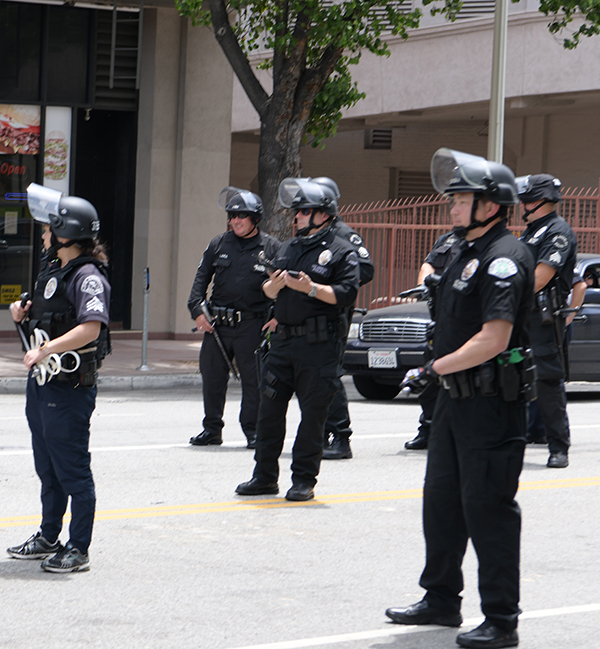
But public assessments of Bass by Black leaders the last four years, including this election cycle, have been muted to nonexistent. The exception is Black Lives Matter Grassroots L.A., which has routinely taken her to task for increasing police funding instead of allocating more resources to social and other services — a core part of the post-George Floyd reforms.
Observers say the reticence among Black leaders is partly due to the fact that Bass has been so inundated with crises, some not of her making — especially the Palisades fire. Then there’s the racism that dogs Black elected officials, women in particular.
“There’s always the bigotry of, ‘We rallied around this Black woman and she hasn’t performed,’” said Genethia Hudley-Hayes, former president of L.A.’s civilian Fire Commission and a Bass appointee who stepped down in March. “She’s not a superwoman. That’s part of the ‘I’m mad’ vote in L.A.”
Homelessness certainly qualifies as a Black concern: 32% of unhoused people in the city are African American, according to the city’s latest count. Bass’ signature program, Inside Safe, which seeks to get people off the street and into temporary housing has made unroads.
But the mayor’s efforts have been hampered by what City Hall observers say is a larger problem of messaging, management and oversight. The scandal involving a subcontractor accused of defrauding the city’s homeless services authority of $23 million is a painful reminder of that.
Hudley-Hayes says that it points to the need for the mayor of L.A. to be a skilled executive, a skill that Bass doesn’t have, at least not yet.
“You need collaboration, which is different from coalition building, different from the activism of Community Coalition,” she said, referring to the grassroots South L.A. organization co-founded by Bass.
But being a better executive wouldn’t automatically guarantee improvements for Black people. Tom Bradley, who was mayor from 1973 to 1993, is venerated both as a coalition builder and astute manager who improved many parts of the city.
But he didn’t do enough for L.A.’s Black populace. While the Black middle class flourished during the Bradley years, in part because Black municipal employment flourished, the larger working class and poor in South L.A. did not.
Hudley-Hayes argues the mayor’s lack of accountability to L.A.’s Black population as a whole is longstanding, and not unique to elected officials like Bradley or Bass. Local branches of civil rights groups like the NAACP and the Southern Christian Leadership Conference — which Hudley-Hayes once led — also play a part in accountability, though they have declined notably over the years. But Hudley-Hayes notes that accountability works two ways.
“Black people have individual agency, but we have to exercise it together,” she said. “We have to pool our experience. It means nothing if we don’t demand what we want.”
Even — especially — in these trying times, and in a city with as much possibility as L.A., problems notwithstanding — those demands should still matter.
Erin Aubry Kaplan examines the persistent barriers to racial justice and opportunities for progress in an era of receding Black presence in Los Angeles and California for Capital & Main, a nonprofit publication focused on inequality. It is published here with permission.
LIFTOUT
Missing from all the criticism of how Bass has fallen short is how or whether her election has benefited L.A.’s Black community.