By Stephen Oduntan
Contributing Writer
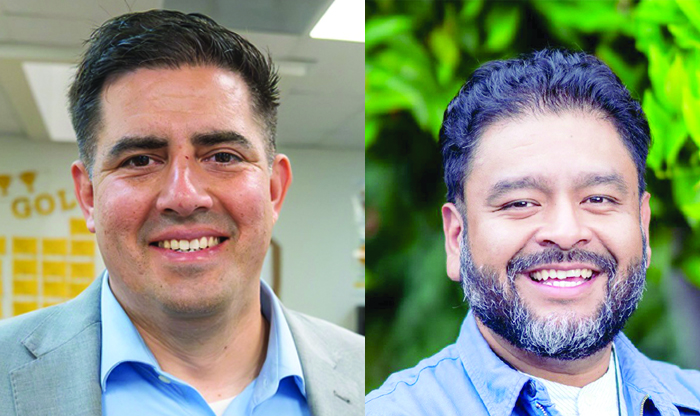
LOS ANGELES — The race to represent the 9th City Council is headed toward a November runoff between Jose Ugarte and Estuardo Mazariegos, setting up a contest that could reshape political alliances in one of the city’s historically Black districts.
With Councilman Curren Price term-limited and still facing corruption charges, the runoff will result in District 9 electing its first non-Black council representative in more than six decades — a symbolic political shift in a district long tied to Black political leadership in Los Angeles.
But both candidates say the future of the 9th District depends not on division, but on the continuation of a Black-Brown coalition shaped by decades of organizing, demographic change and shared economic struggles.
“What voters were saying is they want representation that listens to them, that knows their community, that has been there for them,” Ugarte told The Wave. “People don’t want someone who just shows up during election season.”
Ugarte, who previously worked for Price and spent years inside City Hall and local government, finished first in the primary and framed his candidacy as a continuation of the coalition politics that have historically defined South Los Angeles.
“I’m the only lifelong member of the NAACP,” Ugarte said. “I worked for Black elected officials my entire political career … and now it’s their turn to support someone who has been standing next to us for years.”
Ugarte said Black precincts strongly supported his candidacy and rejected attacks tying him to Price’s ongoing legal troubles.
“We cannot hold someone accountable that has not had their day in court yet,” he said, defending the outgoing councilman against corruption allegations that dominated portions of the race.
Price has denied wrongdoing and has not been convicted of any crime.
Ugarte argued that despite criticism surrounding the scandal, Price helped bring economic development, parks, housing and jobs into the district while preventing the kind of displacement seen in other parts of Los Angeles.
“Our district has not been gentrified like other parts of the city,” Ugarte said. “South L.A. is still one of the cheapest places to rent and buy a home.”
Mazariegos, a longtime tenant organizer and housing activist affiliated with grassroots organizing efforts in Los Angeles, offered a sharply different vision for the district, describing his campaign as a rejection of establishment politics.
“The vast majority of voters voted for somebody that’s not part of the political establishment,” Mazariegos told The Wave. “It’s about change.”
While Ugarte emphasized governing experience and institutional relationships, Mazariegos argued that his organizing background gives him a closer understanding of the daily realities facing 9th District residents.
“He represents more of an establishment position and I represent the everyday 9th District resident,” Mazariegos said.
Mazariegos said housing affordability, displacement and government accountability have become defining concerns throughout the district, which faces high poverty rates and overcrowded housing conditions.
“The solutions need to come out of communities like the 9th District because these are the people suffering the most,” he said.
His campaign has emphasized rejecting corporate money and increasing transparency at City Hall.
Mazariegos contrasted his grassroots fundraising operation with outside business and political interests supporting Ugarte’s campaign, including what he described as corporate-aligned influence in city politics.
“I’m accountable to the people and only the people,” Mazariegos said. “While he is accountable to Airbnb and Lyft.”
Ugarte, however, disputed Mazariegos’ characterization of his campaign as the true grassroots operation in the race, arguing that his own operation drew stronger support from longtime district residents and neighborhood networks.
Describing the volunteer turnout at his campaign office, Ugarte said, “If you came to my office, I had about 100 people every weekend, all Black, all brown, from my community. People that I’ve known since growing up here.”
Political observers say the runoff reflects not only demographic changes in South Los Angeles, but broader tensions inside Democratic politics across the city.
“The more consequential divide in this race is not between Black and Latino Los Angeles, but between competing visions of Democratic politics,” said Sara Sadhwani, assistant professor of politics at Pomona College.
Sadhwani said the race reflects a broader debate over whether voters want to continue working through traditional political institutions or embrace a more left-leaning organizing model associated with groups such as the Democratic Socialists of America.
“District 9 is the latest test of whether that movement can continue expanding its influence,” she said.

The two candidates also diverged sharply over the political impact of the corruption allegations surrounding Price.
Mazariegos argued the scandal weakened the district’s influence at City Hall and contributed to voter frustration.
“People feel really frustrated with the lack of accountability and transparency,” he said. “They’re tired of it and they want to see change.”
Still, both candidates acknowledged the historic importance of Black political leadership in South Los Angeles and emphasized coalition-building rather than racial division.
“To me, it’s always going to be a Black community,” Mazariegos said. “It’s about honoring the Black history and fighting for the Black future.”
Ugarte similarly described the runoff as the continuation of a longstanding Black-Brown alliance.
“What coalition do I think is emerging?” Ugarte said. “Black and Brown coalition.”
Political commentator Earl Ofari Hutchinson said the district’s political transition reflects long-term demographic changes that have been building for decades.
“Rising Hispanic political influence and even control in CD9 and South L.A. was an inevitable demographic shift that had long been predicted,” Hutchinson told The Wave.
“Now the question is whether the shift to Hispanic political control results in a lessening of Black political, social and economic influence,” he said. “Only time will answer that question.”
The winner will represent one of the city’s most economically challenged districts heading into a period expected to bring major development pressure tied to downtown expansion and the 2028 Olympics.
For voters, the central question now is who they trust to lead the 9th District into that future — an experienced insider promising continuity or a grassroots organizer promising reform.
Stephen Oduntan is a freelance writer for Wave Newspapers.