Wave Wire Services
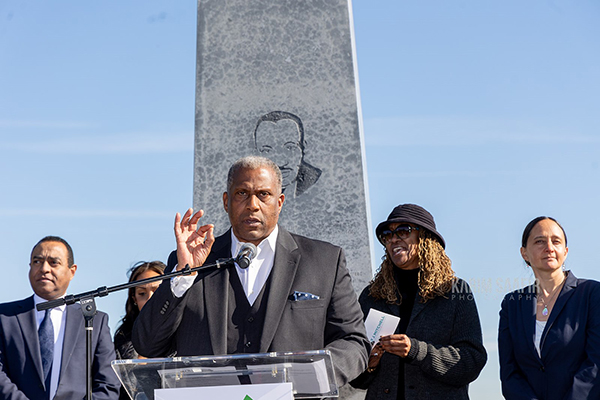
LOS ANGELES — City Councilman Hugo Soto-Martinez launched a campaign June 9 to allow noncitizens to vote in Los Angeles elections.
The proposal is one of multiple potential City Charter amendments being finalized by the council’s five-member Rules, Elections and Intergovernmental Committee for recommendation to the full council. Any approved proposals by the council would be placed on the November ballot for voters to consider.
Soto-Martinez, who represents the 13th Council District, is working with some residents and community organizations to advocate for allowing noncitizens to vote in local elections such as those involving the Los Angeles Unified School District and the city of Los Angeles, including for mayor, City Council, city controller and other offices.
“My own parents spent decades working, paying taxes and raising their children in Los Angeles without the right to vote,” Soto-Martínez said during a news conference. “Their story is the story of hundreds of thousands of Angelenos who contribute to this city every day and deserve a voice in the decisions that affect our community.”
If the charter amendment is approved by voters, it would authorize the City Council and mayor to create a so-called “residential voting program” through an ordinance.
The program would not be immediately implemented, but approval by voters in November would mark the start of a public process to establish specific requirements, registration procedures and safeguards, Soto-Martinez added.
Noncitizens would not be permitted to vote in state or federal elections, which is prohibited by law.
To qualify for the November ballot, the proposed amendment must be approved by the City Council by June 17.
Critics of the proposal argue that allowing noncitizens to vote could lead to foreign influence in American elections, discourage noncitizens from seeking citizenship, and is basically unfair to those who waited their turn and went through the arduous process of seeking and obtaining citizenship.
Soto-Martinez said all immigrants deserve the opportunity to vote in local elections because they raise families, support local businesses, pay taxes, and contribute to their communities. One in three city residents is an immigrant, according to Soto-Martinez’s office.
“I’ve lived in Los Angeles since 2002. I work here, I pay taxes here, and for more than two decades I’ve cared for some of our city’s most vulnerable residents as a caregiver,” said Grace McManus, a legal permanent resident and member of the Pilipino Workers Center.
“Like so many longtime residents, I contribute to this city every day, yet I’ve often felt invisible and unheard. Residential voting is about making sure people like me have a voice in the decisions that affect our families and our communities,” McManus added.
Fernando Guerra, a professor of political science at Loyola Marymount University, said polling consistently shows that Angelenos value the contributions of longtime immigrant residents and support policies that help them participate more fully in civic life.
“Based on the data, I believe voters would give serious consideration to this proposal if it appeared on the ballot,” Guerra said. “City Council should give Angelenos the opportunity to decide this important question for themselves.”
San Francisco and Oakland approved charter amendments in 2016 and 2022, respectively, which were approved by voters, to allow noncitizen residents, who are the parents, legal guardians or legal recognized caregivers of a child in their school district, to vote for members of the school board.
Some towns and cities in Maryland and Vermont also allow noncitizens, age 18 and older, to vote in their local elections.
Eighteen states explicitly prohibit noncitizen voting in their state constitutions, including Arizona, Colorado, Louisiana, Ohio, Texas and South Carolina.