By Stephen Oduntan
Contributing Writer
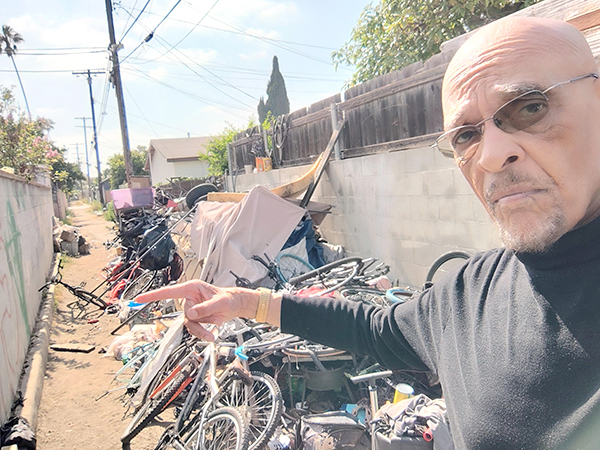
SOUTH LOS ANGELES — A burned couch sat beside a mound of broken furniture, construction debris and discarded household trash stretching along the curb near Vermont Avenue and Florence Avenue. Just a few feet away, charred debris marked the remains of what community advocates say was yet another fire fueled by illegally dumped waste.
Scenes like this have become increasingly common across parts of South Los Angeles, where residents, community leaders and elected officials say chronic illegal dumping continues to plague neighborhoods despite repeated cleanup efforts and calls for stronger enforcement.
Now, veteran civil rights activist Earl Ofari Hutchinson is demanding the removal of Los Angeles Sanitation & Environment’s top administrator, arguing the city has failed to provide South Los Angeles with the same level of service residents expect elsewhere.
“I live in the area. I take pride in it. And I am deeply offended by the wreck, ruin and deterioration that has resulted from escalating garbage street dumping,” Hutchinson said.
His criticism comes as a reporter analyzed 114,268 illegal dumping pickup requests submitted through the City’s MyLA311 system during 2024, identifying recurring illegal dumping hotspots across South Los Angeles.
The analysis found that while complaints were reported citywide, illegal dumping was concentrated at a relatively small number of addresses that generated repeated cleanup requests throughout the year, suggesting some locations remain chronic dumping sites despite repeated city intervention.
To better understand where illegal dumping occurs most frequently, a reporter analyzed every illegal dumping pickup request submitted through MyLA311 during 2024. The review identified addresses that generated repeated cleanup requests throughout the year.
The three locations that had the most requests for cleanup were all in South Los Angeles. Two, on South Hill Street, were within a block of each other. The third, on West 32nd Street, was blocks away. All three sites had more than 50 cleanup requests, at least one per week.
The review also found that South Los Angeles council districts accounted for many of the city’s illegal dumping complaints.
Council District 8 recorded the highest number of illegal dumping requests in the city during 2024, followed by Council Districts 6, 9 and 10, highlighting the concentration of reported illegal dumping in and around South Los Angeles.
The 8th Council District had 16,512 requests for cleanup, the 9th District had 11,806 cleanup requests and the 10th District had 9,258 requests.
Although the city records document where residents requested assistance, community advocates say they do not fully capture the scope of the problem.
William Taylor, a longtime Watts resident, said many residents have grown discouraged after years of seeing dumping occur in the same locations.
“People don’t complain in the hood,” Taylor said. “A lot of people have stopped calling because they don’t think anything is going to happen.”
Taylor said recurring dumping sites near Jordan Downs, Wilmington Avenue, Grandee Avenue and neighborhood alleys remain persistent quality-of-life concerns despite periodic cleanup efforts.
Hutchinson offered a similar assessment, arguing that many residents have repeatedly contacted the city without seeing lasting results.
“I get mountains of complaints from residents who say they call 311, their council member or even the mayor’s office and nothing happens,” Hutchinson said. “They all can’t be lying.
“They pay taxes. It’s the city’s responsibility to provide those services, not theirs,” he said.
Hutchinson called for dedicated cleanup crews assigned to South Los Angeles, stronger enforcement against illegal dumping and a publicly announced strategy to eliminate chronic dumping sites.
City officials, however, say they have expanded cleanup efforts while acknowledging illegal dumping remains a persistent problem. Among those efforts is Council President Marqueece Harris-Dawson’s Clean and Safe Streets Initiative, which encourages residents to use MyLA311 to report illegal dumping, graffiti, bulky items and other neighborhood concerns.

The initiative argues that increased reporting helps direct additional resources into underserved neighborhoods. The Wave asked Harris-Dawson’s office whether the initiative has resulted in additional sanitation resources for Council District 8 and how its effectiveness is measured. The office did not respond before publication.
Councilwoman Heather Hutt’s office also acknowledged that illegal dumping remains a persistent challenge but said the district has taken a proactive approach to reducing it.
The councilwoman said her office recently introduced a motion to establish an additional Rapid Response Team dedicated to Koreatown and continues to organize neighborhood cleanups, waste collection events and public education campaigns aimed at reducing illegal dumping.
City Councilman Tim McOsker’s office also described illegal dumping as a persistent citywide problem and said addressing it has become a daily priority within Council District 15.
“We operate our Clean 15 Team, which consists of two full-time staff who oversee two field teams working five days a week throughout the district, including a team focused specifically on Watts and Harbor Gateway, responding to illegal dumping and bulky item removal,” Communications Director Sophie Gilchrist said in a statement.
Gilchrist acknowledged that enforcement remains one of the city’s biggest challenges.
“Too often, those responsible for illegal dumping face little accountability, resulting in repeat offenses at the same locations,” she said. “Continued investment in cleanup alongside stronger enforcement, including prosecution, for illegal dumping will be essential to making lasting progress.”
She also emphasized the importance of public reporting, saying it is difficult to evaluate response times or improve service at locations that are never reported.
A reporter asked Los Angeles Sanitation & Environment to respond to Hutchinson’s criticism, explain the department’s staffing, cleanup response times, enforcement efforts and whether South Los Angeles receives additional resources to address illegal dumping. The department did not respond before publication.
The Mayor’s Office also was asked about illegal dumping investments included in Mayor Karen Bass’ latest budget, progress made since the Better Watts Initiative’s “Toxic Tour” of Watts and the administration’s broader strategy for addressing illegal dumping in South Los Angeles. The office did not respond before publication.
Whether measured through city data or neighborhood experience, illegal dumping remains one of South Los Angeles’ most persistent quality-of-life challenges. For residents living near the city’s recurring dumping hotspots, success will be measured less by the number of cleanup requests completed than by whether the same piles of debris stop returning after city crews leave.
Stephen Oduntan is a freelance writer for Wave Newspapers.