By Darlene Donloe
Contributing Writer
SOUTH LOS ANGELES — AC Bilbrew was the first Black woman to sing on Los Angeles radio. Most people have never heard of her.
Now, in the library that bears her name, Black women and girls are getting their verse.
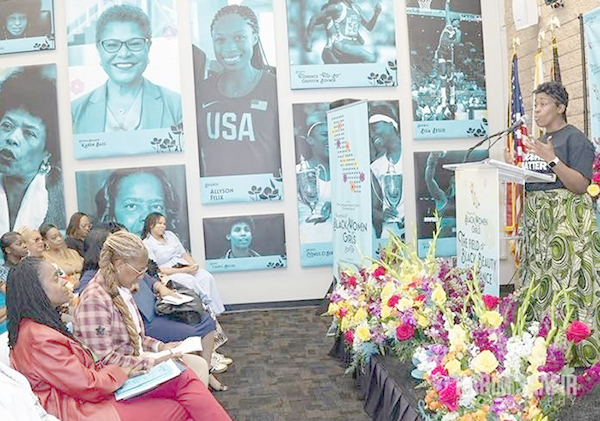
The “Museum of Black Women & Girls Pop-Up: The Field of Beauty & Brilliance” runs through at the Black Resource Center inside the AC Bilbrew Library.
The exhibit honors the resilience, history, and transformative power of Black women in California.
A project of the California Black Women’s Collective Empowerment Institute, it argues that the state itself was built in harmony with voices like theirs.
The exhibit is filled with California history told through the lives of more than 300 Black women and girls, from Queen Califia to Kamala Harris, from Biddy Mason to the teenager who might walk in tomorrow and add her auntie’s name to the wall.
It is one of the most significant free African American cultural events in Los Angeles this summer. It is also an act of defiance.
“I wanted it to become a love letter to Black women whose courage, sacrifice, and brilliance created the path we walk today,” said Kellie Griffin Todd, president and CEO of the California Black Women’s Collective Empowerment Institute, which curated the exhibit with the Los Angeles County Library Black Resource Center. “I wanted every visitor to experience pride, joy, and a deeper understanding of the extraordinary legacy that surrounds us.
“More than an exhibit, I wanted it to be a place where Black women and girls feel seen, celebrated, and reminded that they have always been architects of history,” Griffin Todd added.
The exhibit unfolds across four pillars — Historic Trailblazers, Political Powerhouses, Arts, Letters & Ideas, and Athletes & Champions. Some of the women highlighted include Mary Ellen Pleasant, Maxine Waters, Karen Bass, Hattie McDaniel and Allyson Felix.
There is also Vaino Spencer, the first Black woman judge in California, and Alice Coachman, the first Black woman to win Olympic gold, and others whose names rarely make textbooks but whose work made California.
“This exhibit celebrates more than 300 remarkable Black women whose lives have shaped California and the nation,” Griffin Todd said. “Some visitors will recognize familiar names, but many will discover women whose contributions have too often gone untold. I hope that people leave overwhelmed not by the size of the exhibit, but by the magnitude of Black women’s impact.”
Their stories are told through intimate storytelling, archival photographs, and curated text panels printed not on sterile white but on deep, warm hues that Black Resource Center librarian Sharol Caw, 42, calls “cocoa, plum, gold.”
The palette is intentional. So is the location, the AC Bilbrew Library, founded in 1978.
“AC Bilbrew was a phenomenal woman,” said Caw, a mother of one and a former history teacher. “Her work with Kenneth Hahn. Her work in general. Many thought she was a man. Hosting this, she’s another one of those flowers in the garden we often overlook. It’s a story to share with the public.”
Caw said the exhibit also includes a collection of Black Barbies.
“See us in all our glory,” Caw said. “Us without having to hide. Barbie was created by a Black woman from Mattel.”
Caw said the exhibit is just what Black people need.
“Everyone should see the exhibit,” she said. “But for us, it’s the pick-me-up we needed. We’ve been taking some hits. For other races, they see us and gain a better understanding of who we are.”
In a year when public libraries have become battlegrounds, the Black Resource Center chose to mount a three-month, free, unapologetically Black exhibit.
“I always tell folks, think about it, back in the day it was illegal for us to read,” Caw said. “This is us screaming, ‘we are not going anywhere. You’ve done everything in your power to take us out.’”
So the exhibit screams back — in living color.
The most radical thing in the room isn’t on the wall. It’s the microphone.
Throughout the summer, “Beauty & Brilliance” is collecting oral histories on site. Visitors can record memories of their mothers, aunties, mentors — the women who never made a panel but made a life possible. A QR code on the library’s website extends the invitation beyond the building.

“Often the story that is silent is the Black woman,” Caw said. “With an oral history collection, it’s like, share the story with us. They can do it here, or there is a link on our website.”
The point, Griffin Todd said, is to collapse the distance between history and household.
“I also want every visitor, especially Black women and girls, to see themselves reflected throughout the experience and recognize that there is no limit to what they can become,” she said.
The throughline from the California Black Women’s Collective Empowerment Institute economic work to a museum is direct, Griffin Todd said.
“Our vision is to improve the lives of Black women and girls throughout California, and that begins by expanding what they believe is possible,” Griffin Todd said. “Economic power is rooted in confidence, aspiration, and opportunity.”
Griffin Todd said the exhibit places Black women’s excellence at the center of the story, revealing leaders, innovators, entrepreneurs, artists, educators, and change makers who transformed communities and industries.
“When we can see ourselves reflected in every corner of achievement, we begin to imagine new futures for ourselves,” she said. “We have always believed that you cannot become what you cannot see, and this exhibit ensures that generations of Black women and girls will see limitless possibilities staring back at them.”
Ask Caw what she wants that 10-year-old to carry out of Bilbrew, and she doesn’t hesitate.
“You’re beautiful,” she said. “Your cocoa skin shines in the sun.”
Griffin Todd’s answer is a mirror.
“I hope she leaves with an unshakable belief in her own possibilities,” she said. “I want her to see herself in every name, every accomplishment, and every image, understanding that greatness is not reserved for someone else. It belongs to her, too. If she walks away believing that her voice matters, her dreams have value, and her story deserves to be written, then this exhibit has fulfilled its purpose.”
“Museum of Black Women & Girls Pop-Up: The Field Beauty & Brilliance,” runs through Sept. 30 at the Black Resource Center at AC Bilbrew Library, 150 E El Segundo Blvd. The exhibit is free and open to the public. Oral history appointments are available on site and online.
Darlene Donloe is a freelance reporter for Wave Newspapers who covers South Los Angeles. She can be reached at ddonloe@gmail.com.