By Corey Williams
and Laura Bargfield
Contributing Writers
GARY, Ind. (AP) — Things became all-too familiar for Kimya Williams after storms rumbled through town earlier this month, leaving big chunks of her mostly Black city in the dark for two weeks.
The power outage reminded the 50-year-old of what she experienced in New Orleans in 2005 when Hurricane Katrina knocked out electricity to many.
Williams’ home was one of more than 38,300 homes and businesses in Gary to lose power from the Aug. 11 storms. She initially tried to stick it out and stay put, but the darkness got the best of her and Williams’ left for Indianapolis to stay with her children.
“It was too triggering. It was too dark,” Williams said.
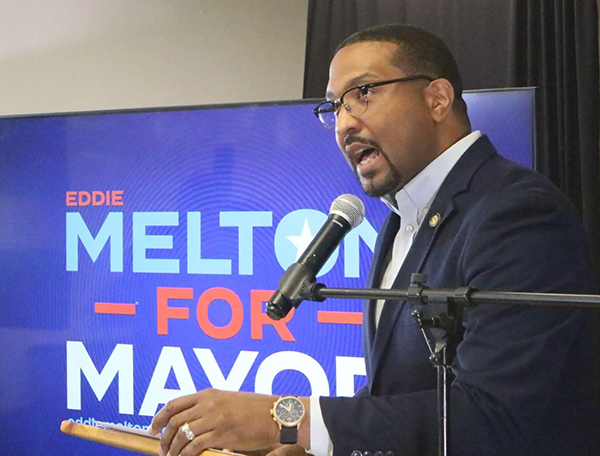
On Aug. 24, one of the poorest and blackest cities in America still had no power. The day before, Gary Mayor Eddie Melton called the pace of restoration “unacceptable.”
“We’re at day 12 and 12 days is too long for families to be without power, 12 days is too long for parents to worry about their children and for businesses to lose revenue,” Melton said in an update to the community.
Northern Indiana Public Service Co., the area’s electricity provider, said that more than 370,000 customers lost power and that more than 364,000 have had their service restored. The remaining customers should have power back by Aug. 25, officials said.
“Our teams are assigned to outages large and small, and we remain committed to reaching every affected customer in all of our communities,” the company said. “No outage is being overlooked, and no customer will be left behind as we continue this restoration effort.”
As the Indiana residents awaited restoration of their service, roughly 34,000 customers in the majority Black city of Memphis were still without power as of late afternoon Aug. 24, after storms swept through the city on Saturday, according to information on Memphis Light, Gas and Water’s website. The utility said that figure represents less than 8% of its customers.
Some residents were comparing the situation to Gary and parts of northwest Indiana, where residents in neighboring Porter County filed a lawsuit in state court last week accusing NIPSCO of negligence and requesting a class action for residents of Indiana who have suffered as a result.
Experts have noted that in cases of severe weather, natural disasters and especially extreme heat, the poor are most vulnerable.
Gary, like many northern rust-belt cities, has suffered for decades from disinvestment following decades of so-called “white flight” from the inner city and the scaling back of thousands of jobs and closures of steel factories. contributed to decades of disinvestment. About 80% of the city’s 69,000 residents are Black, with more than 29% of the population living in poverty, according to the Census’ 2024 American Community Survey.
The poverty rate for Indiana is about 12%.

Gary’s estimated median household income of about $40,752 was far below the $71,959 for the rest of the state.
The more well-off a person is financially, the more options they have when faced with severe weather and natural disasters, said Stephen Pantano, senior vice president of market transformation for the Urban Land Institute’s Impact Lab.
“Some people don’t have the luxury of owning a car to drive somewhere else or having access to a place to go that’s outside of their immediate community where there might still be power,” he said.
The problems likely will grow as climate risks grow, experts say.
“It’s a matter of where the lightning strikes on any given day as to which specific community is hit,” Pantano said. “Gary’s number came up this time, but it’s going to be another city next time.
“And the problem with aging infrastructure and disinvestment tends to accentuate the impact [of storms and lightning] when they hit communities that have been experiencing those problems for a long time,” he added.
Corey Williams and Laura Bargfield write for the Associated Press. Associated Press writer Hannah Fingerhut also contributed to this story.