By Selen Ozturk
Contributing Writer
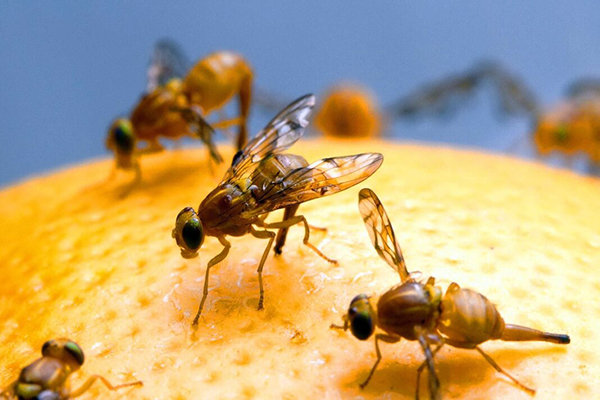
SAN FRANCISCO — California agricultural officials are urging residents to stop shipping or carrying fruit into the state as two Mexican fruit fly quarantines hold in San Diego County.
The warning comes as peak summer travel continues and e-commerce and personal shipments create hard-to-prevent pathways for invasive pests to enter California.
Unlike native species, invasive fruit flies — including the Mediterranean, Mexican and Oriental varieties — have no natural predators in California and can damage more than 250 types of produce from the inside out, threatening a state that grows more than 400 types of commodity crops — over three-quarters of the nation’s fruits and nuts and one-third of its vegetables.
California faced the largest outbreak in the century-old history of its Department of Food and Agriculture in 2023, when seven simultaneous quarantines stretched state, county and federal response resources. Now, officials warn that the threat is far from over.
Although two quarantines remain active across roughly 111 square miles in San Diego County, at least two separate quarantined infestations have already been eradicated this year.
Regarding efforts in San Diego, “We are winning,” said Victoria Hornbaker, state Department of Food and Agriculture plant health and pest prevention services director, at an Aug. 18 briefing held by American Community Media. “They continue to come at us, but between the CDFA, the USDA and the counties, we continue to eradicate those fruit flies.”
The flies typically arrive in three ways: travelers carrying fruit or plants in luggage, purchases through unverified online marketplaces and produce shipped between states or countries, including fruit sent by relatives and friends from home gardens.
Hornbaker said the state’s strategy emphasizes preventing pests from entering in the first place, by maintaining a statewide network of inspectors and more than 100,000 traps, backed by 16 state-run border protection stations along the Oregon, Arizona and Nevada lines.
At the international level, the state Department of Food and Agriculture teams with the U.S. Department of Agriculture’s “Beagle Brigade” — a team of detector dogs and handlers stationed at airports and the California-Mexico border, screening travelers’ luggage for fruit and plant material.
Invasive pests cost the United States roughly $40 billion and California more than $3 billion annually in crop losses, native plant damage and control or eradication efforts.
“If fruit flies become established in California, it’s going to be devastating to California’s agriculture and can have irreversible impacts to our home gardens,” said Hornbaker, noting that an established infestation could mean higher food bills and less access to fresh produce for everyone. “We’re not just talking about protecting commercial agriculture.”
The volume of e-commerce and personal shipments into California make prevention particularly difficult.
Jordan Petersen, deputy agricultural commissioner and sealer at the Los Angeles County Department of Agriculture, said an estimated 8 million packages enter California each day, “and finding that relatively small number that may contain agricultural material can be a bit like trying to drink from a fire hose.”
L.A. County, home to nearly 10 million residents and a major hub for international travel and shipping, employs 75 inspectors who place and check pest traps year-round.
The county also operates six detector dog teams that screen parcels at facilities like FedEx, UPS and the U.S. Postal Service. The dogs don’t detect the insects themselves; instead, they alert handlers to packages with fruit or plant material, which inspectors then open and examine.
“It’s about finding that invasive pest while it’s still inside the package before it has the opportunity to reach our communities,” Petersen said, adding that her teams have intercepted pests hiding on mangoes, guava, grapefruit, pineapple and truffle plants, “just to name a few.”
In Alameda County, agricultural biologist and canine handler Lisa Sampson said her dog Tank has detected 19 invasive fruit fly finds since the two were paired in 2023, “which is pretty high. It definitely shows a trend in changes that I’ve seen throughout the program in my time since 2011, where we didn’t see as many fruit flies. It was pretty rare. It’s becoming pretty common.”
The dogs work for treats rather than toys, she added, a deliberate choice given how often they encounter marked, legal produce they have to ignore.
Handlers and dogs train together at the National Detector Dog Training Center, where every dog is tested on five fruit odors before entering the field to work on parcel terminals for a year and then being cleared to work post office bins.
The dogs “have to be 90% or better field certified” annually, Sampson said. “You need a high energy-dog. … They usually calm down in their work environment.”
When a fly is detected by an inspector or trap, the response escalates in stages, said Abraham Lopez-Zuniga, the state Department of Food and Agriculture emergency response team lead.
A single fly can trigger “delimitation,” in which officials deploy additional traps and inspectors to the site of the fruit to determine whether the incident is isolated. Multiple detections can lead to eradication, which includes organic bait stations that lure male flies, and, in some cases, removal of all fruit around the site.

Enough detections may trigger a quarantine, which generally lasts through three life cycles of the fly: several months in summer and more in winter.
For Californians under quarantine Lopez-Zuniga said one important rule is not to give away fresh fruit and vegetables — but “You can process the fruit, you can juice the fruit, you can bake the fruit, and then you can give it away.”
Fruit showing signs of infestation should be disposed of double-bagged in the regular trash rather than the green bin.
Residents can also report suspected infestations to the state hotline, at 800-491-1899.
When quarantine rules are violated, counties can deny entry to noncompliant shipments and destroy infested products, usually by deep-freezing, and notify buyers through a formal notice, Petersen added.
Under a quarantine, the state Department of Food and Agriculture also places compliance agreements on local nurseries and growers and hold notices on properties where the invasive pests are found.
Huong Dang, an Orange County gardener who also works in administrative support for the county’s agricultural commissioner office, warned that growing demand for exotic plants and fruit trees — particularly among Vietnamese-speaking gardening communities — has pushed buyers toward unregulated sellers on Facebook Marketplace and Etsy rather than formal nurseries and growers.
“Some people receive something totally different from what was advertised, and many of the plants are not suitable for the conditions of growing here,” she said.
“Fellow gardeners, better contact your local nursery. If they don’t carry it, they can special order for you,” Dang added. “The plants are certified pest- and disease-free.”
One of the most important defenses against “the pest pressure that’s coming into California” is what Californians bring home, Hornbaker added.
“We always want to stress: Don’t pack a pest. We don’t want people bringing back fruits, vegetables, plants and natural materials into California.”
Selen Ozturk writes for American Community Media.