Police killings of two local men under fire
Video footage of each incident ‘difficult to watch’ Mayor Bass says

By Stephen Oduntan
Contributing Writer
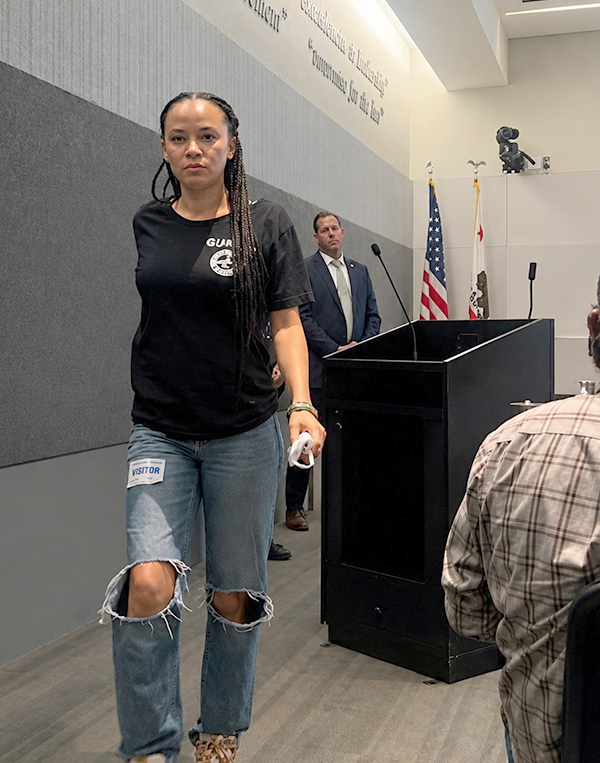
LOS ANGELES — Sheila Bates was already making her way toward the door when the Los Angeles Police Commission ordered her to leave.
“I’m walking towards the door,” the Black Lives Matter activist shot back as the exchange escalated during the Sept. 1 meeting. “That means I’m leaving.”
Bates kept talking anyway.
By then, profanity was flying across the meeting room, commissioners were trying to restore order and Bates was invoking what she described as the arrest of another activist at the previous week’s meeting as she headed for the exit.
It was the second consecutive week Bates said she had been removed from a meeting of the civilian body charged with overseeing the Los Angeles Police Department.
And she was not the only one who was angry.
Michael Williams, a longtime Black Lives Matter organizer, told commissioners that activists do not spend their Tuesday mornings at LAPD headquarters because they enjoyed the confrontations.
“Nobody wants to be here,” Williams said. “Nobody wants to sit here and see y’all faces.”
He said it took “the strength of a thousand men” to return each week, arguing that activists felt compelled to challenge official accounts of police encounters.
“Someone has to put on public record what the truth is,” Williams said.
For all the fury over meeting rules and removals, however, the confrontation inside LAPD headquarters was rooted in something more consequential.
Two men were dead.
Jose Carlos Hoyos-Munoz died in LAPD custody July 15 after detention officers repeatedly used force against him inside the department’s Valley Jail Section. Alejandro Luis Garcia, 33, was fatally shot by LAPD officers two weeks later as he approached them carrying a baseball bat beneath the Santa Monica (10) Freeway.
Mayor Karen Bass cited both deaths while raising concerns about what happens when people experiencing behavioral-health crises encounter law enforcement in a statement she issued Aug. 28.
After LAPD released video of the encounters, Bass called the footage “incredibly difficult to watch” and said decades of underinvestment in community-based mental and behavioral-health services have left people without access to timely care, increasing the likelihood that crises become police encounters.
“LAPD officers do not enter the force to become first responders to mental health crises and are not equipped with the proper training to do so,” Bass said.
Bass announced plans for an executive directive calling for an independent evaluation of officer-involved deaths and serious injuries, particularly those involving possible mental-health crises. The review will examine systemic gaps, policies and training while looking at ways to expand civilian crisis response and police-clinician teams.
Bates said meaningful change would require going much further.
The department, she said, would need to be “replaced with systems of care that actually address the needs of community.”
Hoyos-Munoz’s encounter with LAPD began July 13 when officers responded to a Chatsworth home after police said he stabbed two family members, causing minor injuries. After an eight-hour standoff involving crisis negotiators and SWAT, officers deployed tear gas and took him into custody.
Two days later, detention officers repeatedly used force against Hoyos-Munoz while attempting to fingerprint and control him, according to LAPD and video released by the department. Footage shows him restrained and later held facedown on a bunk by several officers. He was subsequently found unresponsive and pronounced dead. His cause and manner of death had not been announced when LAPD released the footage.
Jason Reedy, a longtime police-accountability activist and organizer with People’s City Council, challenged commissioners Sept. 1 over what he characterized as the gap between expressions of concern about the footage and meaningful accountability.
He also raised Garcia’s death.
Garcia was shot July 29 after officers responded to reports of a man armed with a bat smashing vehicle windows and possibly threatening people near Normandie Avenue and the 10 Freeway.
LAPD initially said Garcia was “swinging” the bat when officers opened fire. But video released by the department appears to show him approaching officers while grasping the bat with both hands immediately before the shooting, raising questions about the department’s initial account.
Bass’s assertion comes after years of LAPD efforts to improve how officers handle mental-health encounters.
The department operates the Systemwide Mental Assessment Response Team, or SMART, which pairs specially trained officers with county mental-health clinicians. LAPD also offers a 40-hour Mental Health Intervention Training course focused on crisis communication and de-escalation. By March, more than 6,400 LAPD personnel had completed the training.
Yet, Bates argues that training has not translated into the response people experiencing mental-health crises need.

“It’s better when we have people who are actually trained and experienced and went to school to deal with people with mental health crises to respond to it,” she said, “as opposed to somebody with a badge and a gun.”
Bates said the issue also resonates in Black communities that have experienced their own history of deadly encounters involving people in crisis.
“Unfortunately, we see all too often that this is the response,” she said. “Somebody calls for help or needs help, and they’re met with violence.”
Los Angeles has increasingly tested an alternative approach. Its Unarmed Model of Crisis Response program diverts certain nonviolent behavioral-health calls away from traditional emergency responders. By May, the program had diverted more than 22,000 calls from LAPD, with fewer than 5% requiring backup or redirection.
The July encounters were more complicated. Both involved reports of weapons or violence, circumstances different from the nonviolent calls the unarmed program was designed to handle. Bass acknowledged that law enforcement will continue to be called upon when violent behavior is involved while calling for civilian alternatives to be expanded for people in crisis who have not exhibited violent behavior.
Her proposed evaluation will also join existing layers of scrutiny. The Office of the Inspector General independently reviews LAPD investigations of serious uses of force, including officer-involved shootings and deaths in custody, while the department’s Force Investigation Division investigates those critical incidents.
What Bass’s evaluation will add — including who will conduct it, when findings will be released and what authority its recommendations will carry — remains unclear.
Those questions followed activists into this week’s Police Commission meeting.
Bates said much of the anger at the meeting had carried over from the previous week, when tensions over police accountability and the treatment of public commenters also boiled over.
During that Aug. 25 meeting, Bates challenged commissioners over what they considered the community’s greatest public-safety concerns.
“Week after week, community right here in this room voices concerns about murders by police,” Bates told them.
One week later, she was back.
For Bates, the problem was larger than meeting rules or decorum.
“How many reviews have they done?” she said. “The community can’t wait for another review.”
Stephen Oduntan is a freelance writer for Wave Newspapers.