
By Darlene Donloe
Contributing Writer
BELL — At 4 a.m., while most of Los Angeles is asleep, the lights are already on in a 30,000-square-foot warehouse here.
The bobtail trucks are rolling, six of them with 22 workers. By 5 a.m., they’re pulling into the wholesale produce terminal a few miles away — the beating heart of California’s food chain — to pick up what the market was about to throw away.
This is Wholesale Recovery at Food Forward, and it is not a small operation anymore.
“I have the comfort of working remote,” said Amir Zambrano, 49, the managing director of Wholesale Recovery. “Our team, drivers and warehouse crew start at 4 a.m. to receive and distribute product. By five or six o’clock, folks are ready to go.”
On any given day, Zambrano’s team will move 300,000 to 350,000 pounds of fresh produce, enough, every single day, to give more than 300,000 people their daily recommended servings of fruits and vegetables.
To date 628,478,424 pounds of food have been recovered; 533,000 metric tons of carbon dioxide-equivalent emissions have been prevented.
And it all started with fallen fruit on a curb.
In 2009, Rick Nahmias, founder of Food Forward, was walking his dog when he noticed something he thought was absurd: tangerines, lemons and oranges rotting on sidewalks and hanging untouched from backyard trees — while food pantries a few miles away couldn’t meet demand.
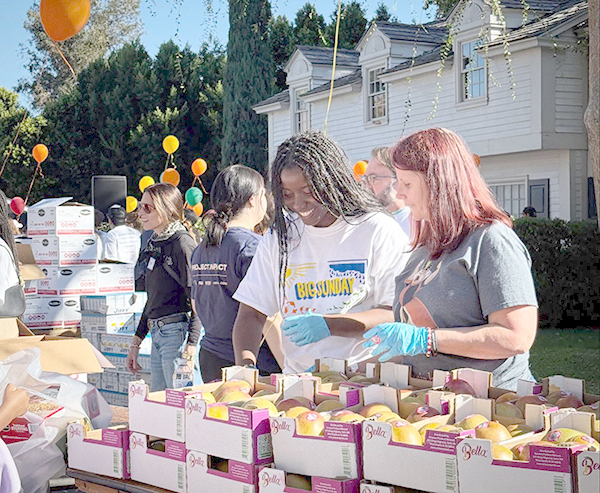
He posted something on Craigslist. A handful of volunteers showed up. They picked 85 pounds of tangerines. And Food Forward was born.
What began as the Backyard Harvest Program — volunteers harvesting citrus in the San Fernando Valley with permission from homeowners, parks and churches — became a model. Then came farmers markets.
Today Food Forward gleans at 20 markets a week out of more than 200 across L.A. Then, in 2014, they tried something bigger.
“We began going to the wholesale market to see what donors there had in terms of product that they weren’t going to be able to sell and most likely trash,” Zambrano said.
They took one stake bed truck. They thought they would rescue a million pounds that first year. They rescued six million.
Zambrano knows produce. Before Food Forward, he was at Yahoo.
Before that, restaurants. He grew up in Los Angeles in a Colombian household where, he says, “my parents were cooking constantly. I learned to cook in their kitchens. Food was central to my existence.”
He started at Food Forward in May 2013, left for a brief consulting stint when his son was born from 2017 to 2019, and has led Wholesale Recovery for the last four years.
Zambrano, a married father of two, took the job for a simple reason:
“I wanted my work to make a difference and have an impact,” he said. “Food Forward came along at the right time.”
His biggest job: oversight of the Bell warehouse and the national supply chain that now flows through it.
“It’s kind of a national supply chain,” said Zambrano, who has a business degree from USC. “Eighty to 90% of our produce is coming from L.A. County. California is where we are receiving product from — the wholesale market terminal and that four- or five-mile radius area. That is all produce warehouses, plus some from the Central Valley, Salinas, San Joaquin Valley, Santa Barbara, Santa Maria, that whole area.”
When a donor sends a truckload — 24 pallets of one product — his team inspects it. If more than half is bad, they refuse it.
“One of the huge benefits we provide to these donors is that they’re not absorbing that cost of landfilling that product, especially if they’re getting rid of it on time when it’s still viable for human consumption,” he said.
And waste? It’s almost zero.
“We have good quality inspection,” he said. “We work with companies that do compost and animal feeding. We are landfilling minimally. Less than 1% of the total that’s coming in is being wasted. The majority of what we can’t use goes to animal feed mostly, or compost as a last option.”
Food that is good goes out fast — to a network that includes food banks, churches, soup kitchens, the Salvation Army, Hunger Action LA, Hollywood Food Coalition, and the YMCA, plus hundreds of smaller pantries from South L.A. to the Antelope Valley.
Zambrano is clear on where the need is most acute, and he doesn’t hesitate.
“The most underserved regions of L.A., like South L.A., have forever been an area that is underserved,” he said. “Not enough food markets close enough within an eight-mile radius. There’s a lot of poverty. We are looking at these areas.”
It’s a statistic that still shocks him. A recent USC study found one in four families in Los Angeles experiences food insecurity.
“For a city like L.A. with extremes like poverty and riches, we are not able to put our minds to it and figure it out,” he said. “We shouldn’t suffer with food insecurity. That gap is shameful.”
Food Forward operates like a major distributor — 200-plus varieties of fruits and vegetables, a fleet, a warehouse, deadlines on both donor and agency sides — but funds itself like a nonprofit.
“The majority of the funding is coming from philanthropic organizations and some corporate sponsorships,” Zambrano said. “It’s all grants.”
Zambrano said people often overcomplicate hunger.

“The mission was simple,” he said. “It was common sense. We have fruit in the backyard, and we’re not using it. Let’s connect the dots. That made a lot of sense to me.”
Since COVID, he thinks the public gets it more because people saw the lines at food banks.
“People realize it’s about changing our habits,” he said. “There has to be a commitment to stop overconsumption. We’re buying too much.”
If L.A. gets this right, Zambrano talked about what it could look like in five years.
“If we were able to narrow some gaps, one, we would have a healthier population,” he said. “They have gone to school and aren’t hungry. They can focus on their studies. We’ll have the capacity to do more.
He pauses.
“Food is such an important, foundational aspect of culture, of sharing space and time,” he said. “I think there is an empathy that can come from people not struggling for food. When everybody is at least on that same playing field of not being hungry, not missing food, not having to worry about putting food on the table, instead I can focus on my rent or education. It’s one less worry.”
And there is a health dividend, too.
“If we’re all eating healthy, there are fewer doctor visits, less diabetes, less high blood pressure,” Zambrano said. “That has an economic impact.”
Asked if he can imagine a day when Food Forward isn’t needed — when he can be happily unemployed — you can hear the smile in his voice.
“That’s the dream,” he said. “If we could meet that goal of obliterating that gap, I’d be happy enough to be unemployed. The reality is that there will always be waste because of the way things are produced.”
Until then, the trucks will roll at 4 a.m.
Eighty-five pounds of tangerines became 628 million pounds.
The tree in the backyard became a warehouse in Bell.
And a Craigslist post in the Great Recession became a lifeline for a city that still has one in four families wondering where their next fresh meal will come from.
Darlene Donloe is a freelance reporter for Wave Newspapers who covers South Los Angeles. She can be reached at ddonloe@gmail.com.


