By Stephen Oduntan
Contributing Writer
LOS ANGELES — Ulises Parias struggled through tears as he described the year his family has spent without his father, a South Los Angeles community journalist shot by a federal immigration officer and still being held in detention.
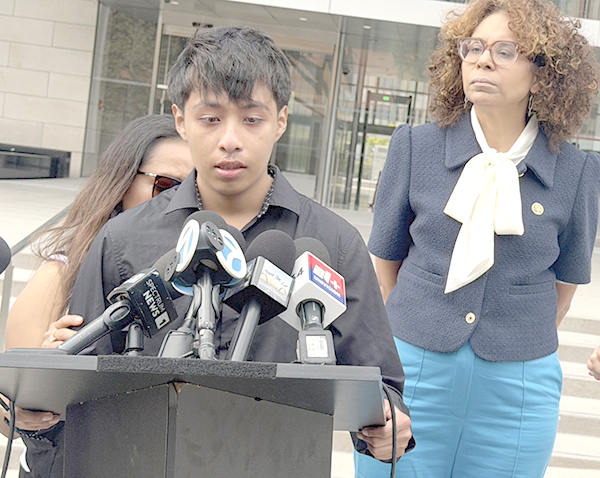
Standing outside a downtown federal courthouse Oct. 21, Ulises recalled the ordinary moments he missed with his father and younger sister. He described seeing his father’s injured hand, its muscles deteriorating, and the pressure of trying to remain strong for his family.
His father, Carlitos Ricardo Parias, known as “Richard LA,” was shot on Oct. 21, 2025. Exactly one year later, civil rights attorney Denisse O. Gastélum announced a $50 million administrative claim against the federal government, alleging excessive force, inadequate medical treatment and the loss of Parias’ livelihood.
U.S. Rep. Sydney Kamlager-Dove, D-Los Angeles, joined the family and attorneys, demanding answers about the shooting, his continued detention and the government’s handling of his medical care.
“And what is the cost of that?” Gastélum asked, describing the family’s losses. “The claim is for $50 million.”
The claim, presented under the Federal Tort Claims Act, is a preliminary step toward a federal lawsuit. Gastélum said the government has six months to respond before the attorneys can proceed to court.
But the family’s demands extend beyond compensation to questions about the circumstances of the shooting and whether the officer responsible has faced consequences.
“We want answers,” Gastélum said. “We don’t know his name. We don’t know if he was disciplined.”
The officer’s identity has not been publicly disclosed, according to the family’s attorneys. Gastélum said they also want to know whether he remains on duty.
Parias had gained a following documenting immigration enforcement operations in Los Angeles. On the morning he was shot, federal agents surrounded his vehicle in the 400 block of East 20th Street.
Federal authorities alleged that Parias rammed law enforcement vehicles during an attempted arrest. His attorneys dispute that account.
Gastélum said body-camera footage shows Parias inside his stationary vehicle with his hands raised as an agent repeatedly struck a window before firing into the vehicle, hitting Parias in the left elbow. A deputy U.S. marshal was also injured.
The administrative claim alleges the shooting was unjustified. It also describes a separate June 2025 encounter in which a federal agent allegedly struck Parias with a vehicle while he documented immigration enforcement.
The case has raised concerns among press freedom advocates, but whether Parias was targeted specifically because of his journalism remains an unanswered question.
Asked by The Wave whether Parias was targeted because he was a journalist, Gastélum offered a broader explanation.
“I think he was a brown man in Los Angeles and in this country during this time,” she said. “That’s why.”
Later, Gastélum described the Adelanto detention facility as a modern-day “concentration camp,” arguing that immigration enforcement disproportionately targets Latino communities.
“And that group of people is brown people, Latino people,” she said, emphasizing that detainees retain constitutional protections regardless of immigration status.
The concerns about Parias’ treatment have also drawn the attention of Kamlager-Dove, who said she visited him at Adelanto in May and again this month.
“I went in May, I just came back in October, and we were given the runaround,” she said.
The congresswoman questioned whether Parias was receiving appropriate medical treatment for his gunshot injury and raised concerns about alleged retaliation and a possible transfer that could complicate contact with his attorneys and family.
“No one should be subjected to government violence on the streets or in government facilities,” she said.
The family’s claim alleges Parias has suffered muscle deterioration, reduced movement and possible nerve damage in his injured arm.
Federal immigration authorities dispute allegations of medical neglect. The Department of Homeland Security previously told LA Public Press that Parias’ wound had been surgically repaired and that he received pain medication, a brace, a sling and physical therapy.
DHS reported 10 medical evaluations between December and mid-June, acknowledging that pain and swelling persisted. Medical records independently reviewed by NPR documented continuing pain, reduced mobility and delays in therapy.
Kamlager-Dove said the family’s struggle for answers extends beyond one case.
“No one can fight it alone, but we can be successful when we are standing together in a coalition like this demanding answers,” she said.
Despite the continuing dispute over his medical care, Parias remains in immigration custody even after a federal judge dismissed the criminal case against him.

U.S. District Judge Fernando M. Olguin dismissed the charges with prejudice last December, finding constitutional violations related to government-created obstacles to his communication with defense attorneys.
Federal prosecutors appealed. Oral arguments before the Ninth Circuit Court of Appeals are scheduled for Oct. 30. The dismissal did not end Parias’ separate immigration detention.
“He should not still be detained,” immigration attorney Carlos Jurado said.
Jurado accused immigration authorities of repeatedly failing to obtain the fingerprints necessary to advance Parias’ U visa application, an immigration benefit available to certain crime victims who assist law enforcement.
“I will fingerprint him myself,” Jurado said he told officials, but the offer was rejected because the government insisted on using its own procedures.
“When we go through their process, they just don’t do it,” he said.
Jurado said he believes Parias is protected in the United States as a U visa applicant and warned that continued delays could jeopardize his application.
“Every step of the way, there’s a roadblock, and it should not be that way,” he said.
While the legal proceedings continue, Parias’ wife, Gabriela Hernández, has been raising their children without the family’s primary breadwinner.
Speaking through a Spanish-language interpreter, Hernández said their 6-year-old daughter fears that even a trip to the supermarket could end with her mother being detained and deported.
Ulises described trying to remain strong for his mother and younger sister while struggling with his father’s absence.
For Gastélum, the $50 million claim is only the beginning of the family’s effort to establish accountability.
One year after the shooting, the family still wants to know who will be held responsible — and when Parias can come home.
Stephen Oduntan is a freelance writer for Wave Newspapers.