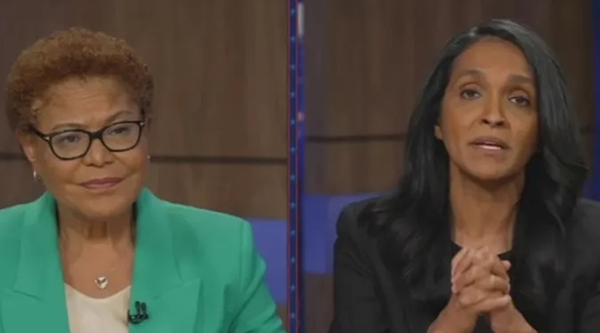
L.A. MAYOR’S RACE: ‘It’s too close to call’
Winner may not be known for days, election officials say

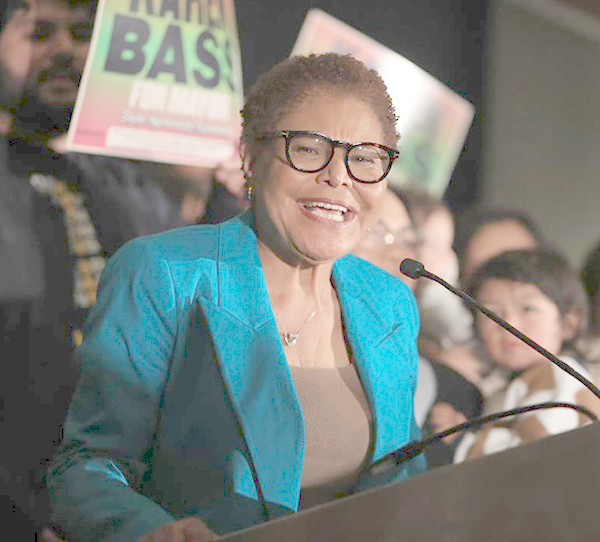
Wave Wire Services
LOS ANGELES — City Councilwoman Nithya Raman led Mayor Karen Bass in the race for mayor Nov. 4 as ballots continued to be counted.
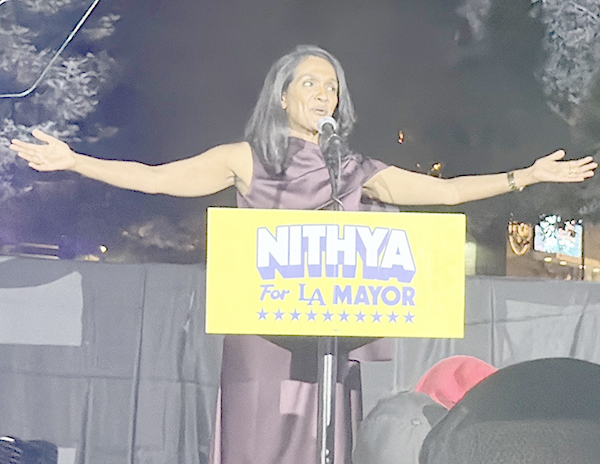
Photo by Stephen Oduntan
The latest figures released by the Los Angeles County Registrar-Recorder/County Clerk’s Office showed Raman with 405,193 votes, or 51.67%, compared with 379,069 votes, or 48.33%, for Bass.
With ballot-counting expected to continue through the week and coming weeks, the winner of the race could remain unknown well into the month.
Some pundits speculated that Bass’ narrow early lead election night could prove problematic for the incumbent. They noted that Raman’s primary support base of younger voters tends to cast ballots closer to Election Day and that she could overtake Bass as vote-counting continues.
Bass, however, remained defiant as she spoke to supporters in Hollywood election night. She hailed Democratic victories across the country and spoke positively about the future of Los Angeles.
“Four years ago, you gave me the honor of a lifetime to serve as the mayor of the city that raised me, the city my parents chose to build a life in, and the city I have spent my entire life fighting for,” Bass said. “And every single day, I have carried that responsibility with me.”
She touted her work to recover from last year’s wildfires, oppose federal immigration raids in the city and reduce homelessness.
“I have seen communities come together to stand up for one another, and I have seen people refuse to give up on the city, even when challenges before us seemed overwhelming,” Bass said. “That is the Los Angeles I know. That is the city that I love, and this is the Los Angeles that I will never stop fighting for.”
At her election night party at the Greek Theatre in Griffith Park, Raman maintained a hopeful outlook as ballots remained to be counted. She emphasized that voters demanded change.
“They are angry about a broken status quo and the politicians who failed them over and over again. But change feels good, doesn’t it?” Raman said. “We have so much to celebrate tonight here in Los Angeles. This election is about change, too, a city that was engineered over the last few decades to resist change, and the people right here who said enough is enough, because for too long our broken and unjust status quo has convinced Angelenos that this is the best that we can do.
“Our City Hall became a place where we became so used to saying ‘no,’ we forgot how to say ‘yes,’” Raman said.
Raman thanked her supporters for refusing to give up and supporting her campaign.
“You saw hopelessness and you chose hope because you know that Los Angeles is a city with hope in its soil, a city built on dreams and ambition and a refusal to accept the status quo. The city is the most incredible place in the world,” Raman added.
Bass, who is seeking a second term leading the second-largest city in the nation, had been running neck-and-neck with Raman in terms of voter support late in the campaign, according to a UC Berkeley Institute of Governmental Studies poll, co-sponsored by the Los Angeles Times and released last week.
The poll found that both mayoral candidates had 40% support from likely L.A. voters, with 19% of voters still undecided.
For Bass, the poll came as a positive sign after a September poll conducted by the institute had Raman ahead by 11 percentage points, with 39% support among likely voters compared with 28% for Bass.
In recent weeks, Bass and political action committees, which are supposed to be independent from the candidates, attacked Raman. Those attacks focused on public safety, specifically Raman’s call to oust Los Angeles Police Chief Jim McDonnell, and portrayed the councilwoman as too inexperienced to run such a large city.
Raman faced further scrutiny in early October after her campaign team shared a video that featured the councilwoman and a leftist influencer. In the video, Raman urged people to “stop fascist liars,” followed by photos of Bass and McDonnell.
During a televised mayoral debate, Bass pressed Raman over that video. More issues followed after Raman said the LAPD was at a “gold standard” under former LAPD Chief Daryl Gates.
Gates oversaw the department when LAPD officers beat and arrested Rodney King on March 3, 1991. In the aftermath, residents criticized the department and called for Gates to resign. Then-Mayor Tom Bradley urged Gates to resign, which he refused to do.

Gates later announced his intention to resign on July 13, 1991, but he would not step down until nearly a full year later.
On April 29, 1992, rioting erupted in Los Angeles following the acquittal of four LAPD officers — three white and one Latino — accused of beating King.
The 1992 L.A. Riots ended six days after the arrival of the California National Guard and federal officers. Gates left the LAPD on June 28, 1992, and was replaced by Willie Williams.
Bass accused Raman of not understanding the city’s history and being an outsider. Raman defended herself, saying she was referring to the LAPD’s Special Order 40, which was implemented during Gates’ tenure. The directive mandates noncooperation related to immigration enforcement and prohibits city officers from stopping residents based on immigration status.
Raman later apologized for her comments. She said she was running for mayor to fix a “broken city” under Bass.
Raman has criticized Bass for pursuing budget-busting contracts and projects, such as a billion-dollar agreement to raise salaries for police officers and a costly effort to modernize the downtown convention center.
Raman has shared plans to improve basic city services, bolster housing production, reduce the cost of living and support the entertainment industry, among other issues.
Bass asked voters for four more years to continue progress on homelessness, housing, affordability, public safety and other issues. Her campaign took more aggressive tactics in an attempt to dissuade voters from electing Raman, whom Bass says is “not ready for prime time.”
The two have sparred over homelessness, public safety and housing.
Both candidates targeted undecided voters in the closing days of the campaign.
According to the Berkeley poll, Bass received more support among voters who backed reality television star Spencer Pratt, compared with Raman, who is more progressive and received support from the Democratic Socialists of America’s Los Angeles chapter.
In the June primary, Raman overtook Pratt and moved on to challenge Bass in November.