Wave Wire Services
LOS ANGELES — After two straight years of decreases in homelessness, the number of unhoused people in Los Angeles County and the city rose 1.2% and 3.4%, respectively, while progress stalled as economic hardships pushed more residents from their homes, officials announced July 24.
Overall homelessness across L.A. Continuum of Care — which includes all but three cities in Los Angeles County — increased slightly by 1.2% to an estimated 73,040 people. In the city of Los Angeles homelessness increased by 3.4% to an estimated 45,194 people, according to figures from the 2026 Greater L.A. Homelessness Count.
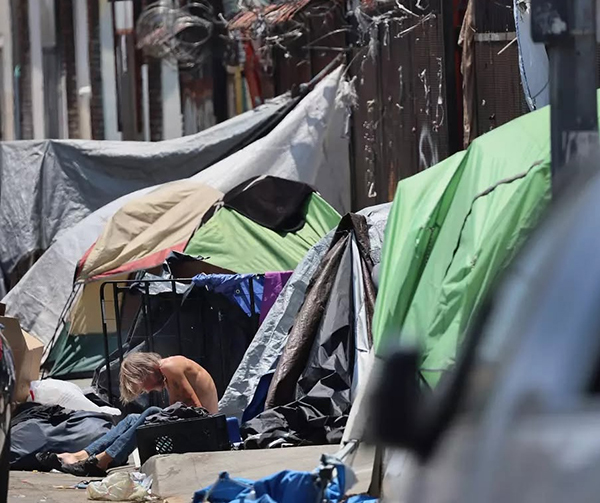
Unsheltered homelessness, or people living in encampments or in vehicles — increased by 3.3% in the county, and by 7.9% in the city, the data showed.
The Los Angeles Homeless Services Authority conducted the count over a three-day period in late January.
“While statisticians do not consider these shifts statistically significant, we know that these numbers represent real people — real people striving for a permanent home in our region,” said Gita O’Neill, interim CEO of the homeless authority during a media briefing on the count at the agency’s downtown headquarters.
“This may not be what people want to hear, but the good news is thanks to LAHSA’s administrative data, we have clear visibility into why our progress has stalled, and what it will take to get back on track,” O’Neill added.
O’Neill attributed the increase in homelessness to economic hardships, in particular the cost of living in Los Angeles. She noted the region’s social safety net must do more to keep people in their homes.
Officials explained there were critical changes to time-limited subsidies, a housing resource, which was a significant driver of this year’s increase.
Paul Rubenstein, the authority’s chief of staff, emphasized that the homeless count is not a useful measure of neighborhood-level homelessness, but rather it is designed to provide a snapshot of homelessness across the region.
He explained that time limited subsidies is a low-barrier, short-term rental subsidy that helps people experiencing homelessness secure housing. Losses of funding for time limited subsidies forced a reduction in available slots.
“As a result of these shifts, the system caused new [time limited subsidies] move-in starting in April 2025,” Rubenstein said. “The number of new [time limited subsidies] movements in 2025 dropped to below 2022. That drop contributed to more than 5,000 fewer people receiving permanent housing.”
Rubenstein noted the increase in the unsheltered homelessness count was driven by the rise of more people living in recreational vehicles on the streets.
“While the pause on new [time limited subsidies] enrollments is a major contributor to this year’s results, we know that economic factors are consistently a leading cause of homelessness,” Rubenstein added.
Long Beach, Pasadena and Glendale — which conduct their own counts and are separate from the county Continuum of Care — experienced a 3.5% increase in unsheltered homelessness, according to the reports. Last year, those three cities experienced a 4% decrease in homelessness and a 10% decrease in unsheltered homelessness.
Los Angeles Mayor Bass blamed the Trump administration for the increase in homelessness, saying federal policies have driven up the cost of living while reducing federal funding for safety net programs. She noted that reductions in state funding for homelessness have also impacted the city’s ability to respond to the crisis.
The mayor also criticized L.A. County for a “lack of adequate services,” which she said was a contributing factor to people cycling in and out of homelessness. The county provides cities with services such as mental health and substance-abuse counseling.
“Despite these headwinds, we have reduced homelessness in Los Angeles by double digits since 2023 — placing tens of thousands of Angelenos in interim housing, moving 6,000 people off the streets through Inside Safe, and housing more than 1,000 homeless veterans,” Bass said in her statement.
While Bass has defended Inside Safe, her signature program for encampment resolution, a Los Angeles Times analysis found that in roughly four years since the program began, about 41% of unhoused people who participated in the program had returned to homelessness.
L.A. County Supervisor Hilda Solis said in a statement the homeless count reflects the challenges communities face everyday.
“Addressing homelessness requires commitment from every level of government,” Solis said in her statement. “We cannot solve this crisis by cutting investments or stepping away from programs that help people find stability.
“Los Angeles County will continue leading this work, but our state and federal partners must provide the sustained support necessary to ensure every resident has a safe place to call home.”
Supervisor Holly Mitchell called the rise in homelessmess “a sobering reminder that cuts to funding … can quickly undermine the progress we’ve made in addressing homelessness.”
“The reality is that for every person we house, two more fall into homelessness,” Mitchell added. “Ending this crisis requires sustained collaboration and investment at every level of government.”

Sarah Mahin, director of the county’s Department of Homeless Services and Housing, said the results were disappointing, but not surprising.
“Everyone in L.A. County deserves a safe, stable place to call home, and we remain committed to that goal,” Mahin said in a statement.
While the homeless authority is working on providing more specific data to supervisorial and City Council districts, some elected officials such as Councilwomen Ysabel Jurado and Traci Park touted marks of progress in their respective areas.
Jurado said in her 14th District, covering downtown and East L.A. neighborhoods, there was additional 622 more people moved into interim housing compared to last year’s count. Park, who represents the city’s coastal neighborhoods, touted a 33% decrease in homelessness, which she cited were the result of outreach, expanded access to shelter and housing, and the enforcement of L.A.’s anti-camping law.
L.A. city and county officials have repeatedly touted a 17.5% decrease in unsheltered homelessness over the last two years.
L.A. County Supervisor Lindsey Horvath told the Los Angeles Times the homeless count serves as one data point and “not the whole picture.”
“People experiencing homelessness — and the communities impacted by this crisis — care less about esoteric debates over the numbers,” Horvath told The Times. “They care more about what they see on our streets — whether people are getting into housing, … and being accountable for how their tax dollars are being spent.”
The homeless authority has faced significant challenges as L.A. County diverted more than $300 million and members of its workforce to establish a new department of homelessness, which began July 1. City officials are also working on a plan to
separate itself from the agency.
The joint city-county agency, established in 1993, has been criticized for its failure to properly track millions of dollars, and ensuring taxpayer money was being used effectively. The authority has stated it has implemented new procedures, protocols and technology to improve those issues.
The U.S. Department of Housing and Urban Development paused federal funding to the authority, citing audit failures. The agency filed a lawsuit against the department in response with the goal of unfreezing those homelessness dollars.
“But we also have to be clear-eyed about what’s not working,” Bass said. “For 30 years, this city has run its homeless response through LAHSA — and audits and the courts have now made plain what too many Angelenos already saw: the money wasn’t tracked, providers went unpaid, and public trust eroded.
“I’m not going to defend a broken system. The city must build something better — results-driven, transparent and centered around the people we’re trying to help, not the bureaucracy,” Bass added.