Wave Wire Services
LOS ANGELES — NASA’s Artemis II mission, piloted by a Southern California native, reached a historic milestone April 6 as astronauts flying around the far side of the moon traveled farther from Earth than any humans in history.
The mission surpassed the previous distance record set by Apollo 13 in 1970 at 248,655 miles during its lunar flyby, according to NASA.
The astronauts were expected to take photos and make observations from the Orion spacecraft, which will lose contact with mission control for about 40 minutes as it passes behind the moon. The crew will also witness a solar eclipse, according to NASA.
The spacecraft was expected to loop around the moon in a wide arc before executing a return trajectory toward Earth, with splashdown off San Diego expected April 10.
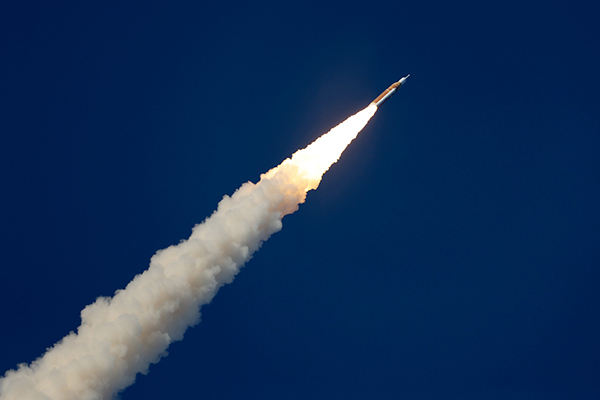
The mission launched April 1 from Kennedy Space Center in Florida and marked the first crewed lunar mission since the Apollo era.
Among the astronauts aboard is Victor Glover, who was born in Pomona, attended Ontario High School and graduated from Cal Poly San Luis Obispo. Serving as pilot of the Orion spacecraft, he is the first person of color to take part in a lunar mission.
Glover spent more than five months aboard the International Space Station in 2020-21, traveling there aboard SpaceX’s first full crew rotation flight by a U.S. commercial spacecraft. That work made him the first Black crew member to ever serve on the space station.
He also has extensive ties to Southern California beyond his upbringing, having served as a test pilot at Naval Air Weapons Station China Lake in the Mojave Desert and earning a master’s degree from Air University at Edwards Air Force Base.
Commander Reid Wiseman, and mission specialists Christina Hammock Koch and Jeremy Hansen complete the four-person crew.
On April 3, NASA released high-resolution images of Earth captured by the crew after the spacecraft completed a key engine burn placing it on a trajectory toward the moon.
Astronauts said they were “glued to the windows” taking photos of Earth as it receded into the distance, with Hansen describing “a beautiful view of the dark side of the Earth, lit by the moon.”
Wiseman later contacted mission control to ask how to clean the spacecraft windows after the crew’s viewing left them smudged. Wiseman also said photographing Earth from deep space proved challenging.
“It’s like walking out back at your house, trying to take a picture of the moon,” he told mission control. “That’s what it feels like right now.”
Communications are being handled in part by NASA’s Deep Space Network, which is managed by the Jet Propulsion Laboratory in Pasadena.
The mission is part of NASA’s Artemis program, which aims to return humans to the moon for the first time since the Apollo era and eventually establish a sustained presence there, ultimately serving as a base assisting in the effort to send humans to Mars.
Artemis II is expected to provide NASA with a wealth of scientific data, assisting in planning for an anticipated landing on the moon in a few years. That data is expected to include information about the effects of deep space travel on the body and mind, along with photographs and geologic analysis about the far side of the moon that is always facing away from Earth.
The current program schedule calls for the Artemis III launch sometime next year, testing lunar landers being developed by Hawthorne-based SpaceX and Jeff Bezos’ Blue Origin. Artemis IV is expected to launch in early 2028, marking the return of astronauts to the lunar surface using a lunar lander.
Artemis V, another lunar surface mission, is expected to occur in late 2028, with additional missions planned roughly once a year after that.