Wave Wire Services
BOYLE HEIGHTS — The owner of a burned-out cold-storage warehouse has announced that nearly half of the food waste from the site has been “cleared, sealed in deodorized containers and is being transported offsite.”
“Today we will begin scraping and power washing the concrete slab, and we expect demolition and cleanup of the remaining burned structure to be largely complete in the coming days,” Lineage Logistics said in a statement July 25.
“We want to be transparent about what’s coming next,” the company continued. “This weekend, we are beginning the process of removing the wall separating the burned and unburned sections of the building to accelerate cleanup of the unburned structure, which has already begun.
“That process includes installing plastic sheeting where the wall used to be to help mitigate odors. The installation may take up to three days and may result in a temporary increase in odors. We are adding three more high-powered carbon filters on the Union Pacific side of the building to help minimize any potential impact,” the statement continued. “We are moving as fast and as safely as we can.”
The announcement came a day after Los Angeles County health officials said they issued an administrative citation against Lineage for creating unsanitary and nuisance conditions at the site.
Investigators with the L.A. County Department of Public Health assessed and inspected the warehouse after the June fire that left tons of rotting food that has attracted rats and bugs.
County officials issued the citation July 23, fining Lineage the maximum $500 per day until the violations are corrected. Additional citation may be issued if compliance is not obtained as identified on subsequent inspections.
Department of Public Health investigators reviewed the warehouse on July 15. The official inspection report identified violations that remained outstanding after a re-inspection earlier this week.
Inspectors found an accumulation of decaying organic waste, waste water, and food residue in two different freezers, as well as live and dead flies in various locations of the warehouse. They also found 20 or more fly larvae on the exterior plastic sheeting along the northern perimeter wall, nearby sidewalk and street along Union Pacific Avenue.
The county has ordered Lineage to do the following:
• Remove and properly dispose of all fire-damaged food, putrescible waste, and other decomposing organic materials from the property in accordance with all applicable laws and regulations.
• Eliminate all actual and potential fly breeding sources, including accumulations of organic debris, contaminated liquids, and any other materials capable of supporting fly development.
• Thoroughly clean and sanitize all affected areas to remove residues that may attract or support flies and other vectors.
• Implement effective vector control measures, including treatment of active breeding areas by a licensed pest control operator.
• And take all necessary measures to prevent flies originating from the property from migrating to neighboring properties or creating an ongoing public health nuisance.
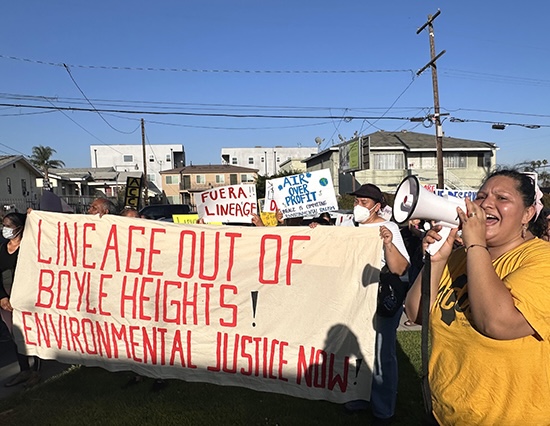
More than 80% of Boyle Heights residents surveyed by public health officials after the June warehouse fire reported persistent, strong odors from the site, while nearly three-quarters expressed concerns about health symptoms.
The Department of Public Health said it conducted door-to-door outreach July 15-16 in the neighborhood surrounding the warehouse.
Of the 240 households that completed the survey, 82% reported very strong odors over the previous week, while 90% said the odors were constant. Nearly 60% said the odors lasted more than 12 hours at a time.
According to the survey, 85% of respondents expressed concerns about air quality, 74% reported concerns about health symptoms and 31% were worried about access to medical care.
Residents also reported a noticeable increase in pests, with 84% reporting more pests overall, including 76% who cited an increase in flies, 40% who reported more mosquitoes and 35% who reported more rodents.
Public health workers visited 650 households in the affected area, distributing 298 air purifiers, 3,880 N95 masks and resource packets to more than 600 households. Officials said 119 households requested follow-up assistance.
The survey was conducted after the Department of Public Health issued a June 29 directive requiring Lineage Logistics to implement odor mitigation, pest control and temporary relocation assistance for affected residents.
Health officials said they were monitoring corrective actions and conducting regular inspections to verify compliance.

The department also issued a directive to Lineage on June 29 that requires mitigation efforts in the impacted communities.
Lineage submitted its odor-mitigation plans to the South Coast Air Quality Management District. The measures include odor-control sprayers being installed around the warehouse, application of odor-neutralizer to the waste multiple times per day, and wrapping the building where possible to control odors.
Other steps include:
• Attaching carbon filters to portions of the building.
• Daily washing of areas with runoff and loading areas.
• Emptying and washing of drains used to collect runoff.
• Transporting food waste in sealed containers.
• Washing truck tires before they leave the property.
• And immediate sealing of loaded trucks, with no loaded trucks remaining on the property for more than 12 hours.
The fire broke out June 17 at the warehouse at 1400 S. Los Palos St.,sending thick smoke into the air and prompting officials to warn nearby residents to remain indoors. The city, county and state issued local emergency declarations in the days that followed. It took more than a week to fully douse the fire.
The cause of the fire remains under investigation, although Lineage officials have said they believe it started while a subcontractor for Altus Power, which owns the rooftop solar array, was testing the system. Altus Power has said the cause has not been determined, and its primary concern remains the surrounding community.