By Joe W. Bowers Jr.
Contributing Writer
LOS ANGELES — A town hall meeting on immigration took on broader urgency as speakers warned that encounters with U.S. Immigration and Customs Enforcement agents are not limited to immigrants and can also affect African Americans, underscoring shared concerns across Black communities.
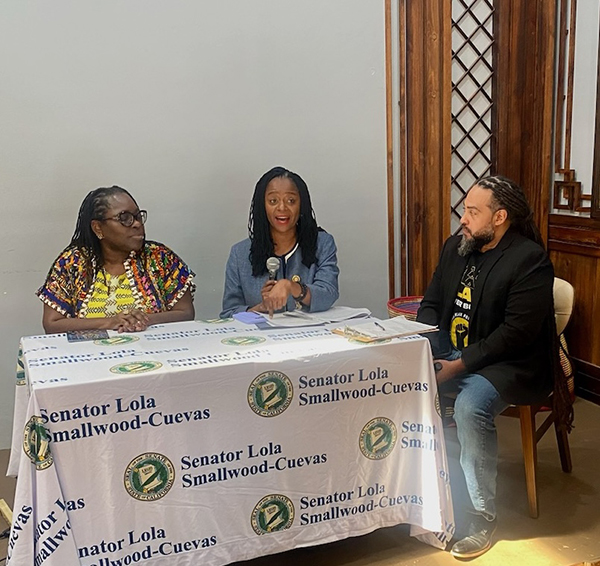
The Black Migrant Town Hall, convened March 13 by state Sen. Lola Smallwood-Cuevas, D-Los Angeles, brought together residents, advocates and organizers at Messob Ethiopian Restaurant, located in the heart of the Little Ethiopia neighborhood, to discuss how federal immigration policies are impacting Black Californians — both immigrants and citizens.
“When they see us, they see a Black person,” said Nana Gyamfi, executive director of the Black Alliancce for Just Immigration and a human rights and criminal defense attorney. “Everything that happens to Black people in this country happens to us.”
Los Angeles County has the largest Black immigrant population in California, with nearly 75,000 residents from across Africa and the Caribbean contributing to the region’s workforce, culture and economy. Statewide, about 218,000 Black immigrants make up about 8% of California’s Black population.
Smallwood-Cuevas, a member of the California Legislative Black Caucus, opened the forum by highlighting the diversity of the 28th state Senate District she represents, which stretches from Ladera Heights and Mar Vista through South Los Angeles to downtown.
“We are the most diverse district in the state, with the highest density of Black people than any other district in the state,” she said. “Black immigrants are part of the growing edge of that population here in Los Angeles.”
The main discussion featured Smallwood-Cuevas and Gyamfi, moderated by Kevin Cosney of the California Black Power Network.
“We need to understand how these policies are showing up in our communities,” Cosney said, framing the discussion.
During her opening remarks, Smallwood-Cuevas said federal policies under President Donald Trump are affecting immigrant and low-income communities in California.
“We are stepping back from the promises of health care for all,” she said, referring to policy changes that could affect programs such as Medi-Cal.
She also described legislative efforts aimed at strengthening worker protections and limiting cooperation with federal immigration enforcement, including proposals to prevent state resources from supporting detention facilities.
“The state of California should not fund detention centers,” Smallwood-Cuevas said.
She added that the California Legislative Black Caucus is positioned to support policies that address the needs of Black communities, including Black immigrants, describing the caucus as a “willing partner” in advancing those efforts.
During the question-and-answer session, one attendee described a case involving a family member with an approved I-130 petition whose immigration process has stalled because of a deportation order. The I-130 is a federal form used to establish that a U.S. citizen or lawful permanent resident has a qualifying family relationship with a foreign relative seeking to immigrate to the United States.
Asked if her office could help, Smallwood-Cuevas said her staff works with state agencies and legal advocates to help constituents navigate immigration challenges and access resources.
She pointed to efforts by California Attorney General Rob Bonta’s office, which has filed multiple legal challenges to federal immigration policies, and said her office can connect residents with staff handling deportation-related cases.
“We have a point person that we can call,” Smallwood-Cuevas said. “Use us to help make those connections.
During the panel discussion, Cosney asked how immigration enforcement policies affect Black communities.
Gyamfi said immigration enforcement often begins with assumptions based on appearance, meaning Black immigrants and African Americans can be treated the same during enforcement encounters.
“We are getting dragged away. … We are being denied health benefits,” she said.
She explained that although ICE does not have authority over U.S. citizens, encounters can occur when officers are trying to determine a person’s immigration status.
Because citizens are not required to carry proof of citizenship, individuals may be temporarily detained if they cannot immediately provide documentation such as a passport, birth certificate or naturalization certificate.
Gyamfi said Black residents should be aware of those risks and stay vigilant during enforcement encounters, noting that being a citizen is not the same as being able to immediately prove it.
Smallwood-Cuevas said community awareness is critical as immigration enforcement policies continue to evolve.
“Closed mouths don’t get fed,” she said. “If we are not linking up and joining forces together to demand dignity, respect and services for our communities, no one else will.”
The discussion also addressed immigration detention and the experiences of Black immigrants held in federal facilities.
Gyamfi said Black immigrants are often hit harder than other groups by detention and deportation systems, with disparities tied in part to how immigration enforcement intersects with the criminal legal system.
She added that organizers and volunteers who visit the Adelanto ICE Processing Center in San Bernardino County have observed an increase in the number of Black detainees during enforcement surges.
According to Gyamfi, Black migrants often face higher bond amounts, limited access to legal representation and language barriers, all of which can reduce their chances of release or of successfully fighting deportation.
Cosney asked the panel what communities can do in response.
Gyamfi said stronger connections between African Americans and Black immigrants are essential.
“As Black people, we are only going to get free if we connect and do things together,” Gyamfi said.
Smallwood-Cuevas emphasized continued engagement and collective action, telling attendees, “Your voices are incredibly important. We have to stay connected and build the power we need to protect each other.”
Joe W. Bowers Jr. is an editor for California Black Media.