Wave Wire Services
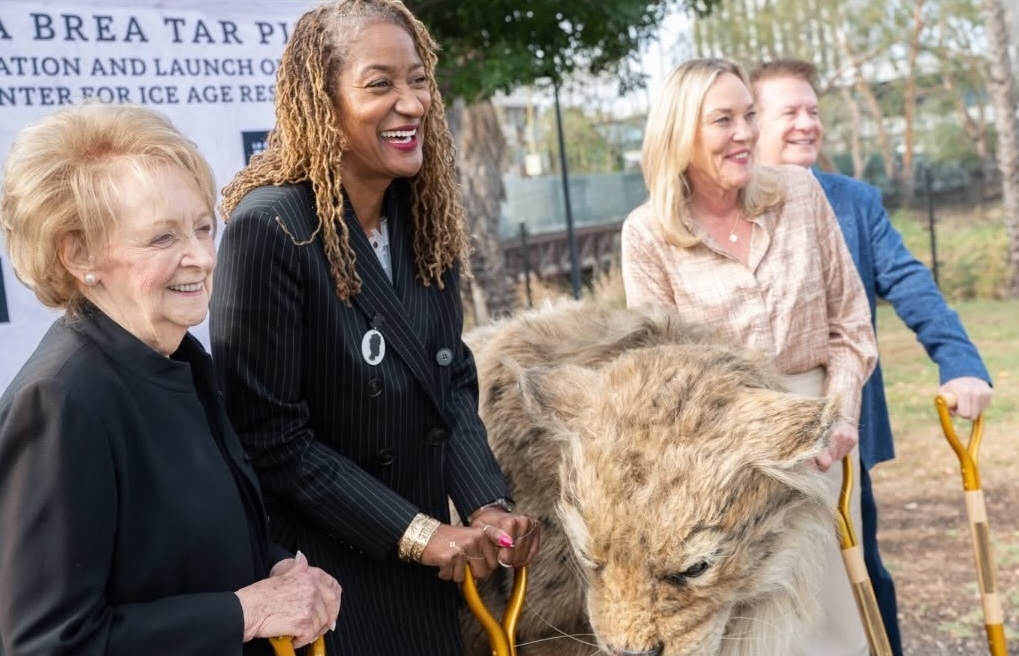
HANCOCK PARK — The Natural History Museums of Los Angeles County broke ground Oct. 29 on a major renovation of La Brea Tar Pits and its 13-acre campus.
The ceremony marked the start of a transformation that will include renovations to the George C. Page Museum and the creation of the Samuel Oschin Global Center for Ice Age Research.
During the event, Megan McGowan Epstein, president of the Natural History Museum Board of Trustees, announced that La Brea Tar Pits has raised more than $155 million toward its $240 million capital campaign, reaching 65% of its goal.
The fundraising includes three new major gifts, $10 million from the Ahmanson Foundation to support a new fossil lab, $5 million from the W. M. Keck Foundation to support a new amphitheater and $5 million from Vera Campbell to support the Science Education Gallery.
Earlier this year, the Mr. and Mrs. Samuel Oschin Family Foundation made a landmark pledge, described as the largest-ever donation in the Natural History Museums of Los Angeles County’s history. The gift will support development of the Samuel Oschin Global Center for Ice Age Research, according to the museum.
Natural History Museums President and Director Lori Bettison-Varga said the transformation would expand public understanding of the site.
“Today marks an exciting milestone for La Brea Tar Pits and for everyone who believes in the impact of this place, one of the most important geological sites on Earth for learning about the connections between climate change and the natural world,” Bettison-Varga said.
Lynda Oschin said the new research center would connect local work to broader scientific collaboration.
“Science has the power to connect past, present, and future in ways that are deeply relevant to the challenges we face today,” Oschin said.
Los Angeles County Supervisor Holly Mitchell said the project would give Angelenos greater access to scientific research.
As we endure the effects of a changing planet, there has seldom been a more important time to expand opportunities to discover our natural world,” Mitchell said.
The project will bring research, fossil excavation, scientific analysis and collections work into the visitor experience. Plans call for visible research laboratories, new exhibition spaces and collections storage, an immersive theater and a rooftop terrace. A new pedestrian loop will connect excavation sites, research and exhibition areas, gardens and open space across the campus.
The Page Museum closed to the public in July for its first major renovation since opening in 1977. The surrounding park remains open, and researchers continue excavating fossils and conducting scientific work.
Educational programs, tours and visits by the La Brea Tar Pits Mobile Museum are also continuing, according to the museum.
The reimagined campus is expected to reopen in 2028, ahead of the Los Angeles Olympic and Paralympic Games.
La Brea Tar Pits is an active fossil site where asphalt seeps have preserved remains of Ice Age plants and animals. The site has yielded millions of fossils, including saber-toothed cats, dire wolves and mammoths, the museum said.