Wave Wire Services
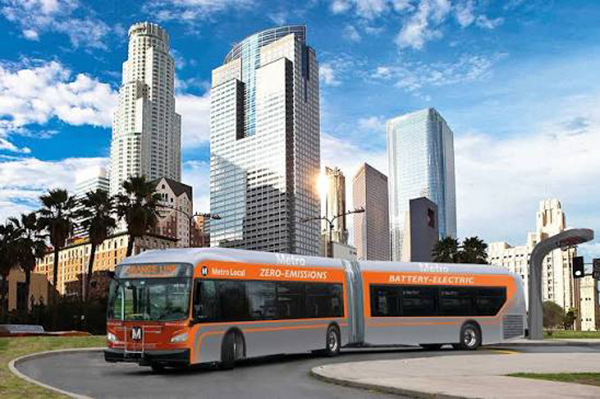
LOS ANGELES — The Metropolitan Transportation Authority Board’s Board of Directors has approved nearly $338 million for the manufacturing and delivery of 220 battery-powered electric buses to transition to zero-emission vehicles and prepare the region for the 2028 Olympic Games.
On a 10-1 vote, the board authorized staff to enter a contract with ElDorado National Inc. for the electric buses in the amount of $337,698,728. The total contract with the company will be $382,355,185, with an additional cost of $52 million for professional and technical support, internal labor and contingencies. The MTA is expected to spend $434,355,185 million for the total life of project, according to an expenditure plan from the agency.
Deputy Chief of Vehicle Maintenance and Engineering Matthew Dake said the agency needs the new electric buses to support their goals for zero emissions, and to replace aging buses that exceeded their lifespan. Dake noted that grant funding will be used for the acquisition, and if the board did not authorize the expenditure, the agency would risk losing $168 million in state funding.
Additionally, the directors approved an amendment introduced by Board Chair and Los Angeles Mayor Karen Bass to include a provision for the option to purchase an additional 1,600 electric buses in the future in increments not to exceed 300 buses at a time.
The board reserves the right not to exercise any option and to re-bid the option, and any subsequent options presented, according to the motion.
Director and L.A. City Councilwoman Katy Yaroslavsky said the vote represented a significant market signal for North America, and “edges us closer to our friends in Latin America, where they’ve crossed the 10,000 zero-emission bus mark in operations, and other parts of the globe where those numbers are even higher.”
Director and L.A. County Supervisor Janice Hahn opposed the contract, raising concerns about signing an agreement with a non-union company that has only built 16 electric buses.
“I know that Metro can’t legally require to bid this as union, but it’s still disappointing to me because if we’re anything in L.A. County, if we’re anything in L.A., we are very union-friendly, and that’s kind of what we’ve built our reputation on,” Hahn said.
The MTA had received bids from New Flyer of America and RIDE Mobility as well. The agency scored each of the three bidders based on project management experience, experience and past performance, price, technical compliance, availability framework and U.S. employment program. The agency said the Riverside-based company ElDorado National scored the highest.
MTA officials noted that ElDorado has been in business since 1975, and has manufactured more than 10,000 transit vehicles.
Hahn argued that they should hire locally, noting that New Flyer has its facility based in Torrance.

Robert Ankerman, a member and organzier with United Auto Workers Region 6, said the union supports the MTA’s transition to zero-emission buses but emphasized the agency must ensure high labor standards.
“Raising incomes for workers is a material and political necessity to achieving decarbonization goals,” Ankerman said. “We support this initial contract going to El Dorado to create more jobs in Southern California. However, we have significant concerns about working conditions in the plant. I’ve spoken with workers, and wages and benefits are low when compared to UAW facilities in the area.
“We urge [the MTA] to fix its scoring process so that bids are fairly evaluated, including appropriate support for collective bargaining agreements. A pro-worker green economy must include the right for workers to have a voice through a labor organization of their choosing,” Ankerman added.
John Lozano, president of UAW Mountain Bay to Local 509 in Petrovera, encouraged the MTA to approve the contract.
“We want clean air and a healthy environment and know that global warming threatens everyone’s way of life,” Lozano said. “It is imperative that we use every opportunity to build a labor movement while protecting our environment.”
The Sierra Club, one of America’s largest grassroots environmental organizations, issued a statement supporting the MTA’s purchase, noting it more than doubles the number of electric buses in the fleet.
“The approval of 220 battery-electric buses is a major win for cleaner air, healthier communities and an electric transportation future,” Sierra Club Clean Transportation for All Campaign Organizer Jennifer Cardenas said in a statement. “We applaud [the MTA] for taking this important step toward delivering on its zero-emission bus commitment. Zero-emission transit is a smart investment as families look for cleaner, more affordable ways to get around.”