By Darlene Donloe
Contributing Writer
LOS ANGELES — He learned to draw upside down. It wasn’t a party trick. It was survival — and strategy — and a quiet act of genius.
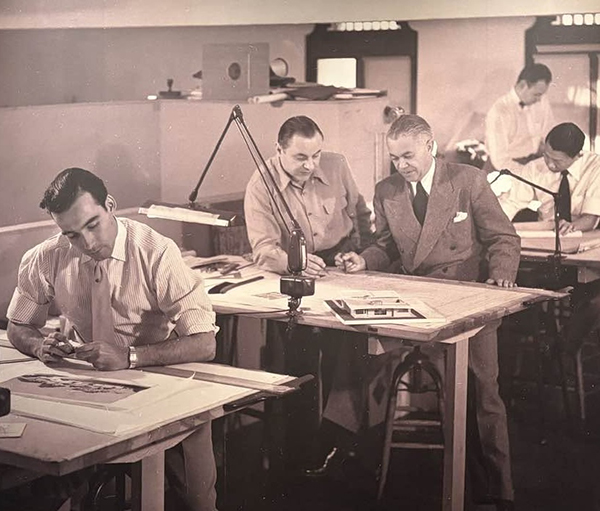
Paul R. Williams, the most prominent Black American architect of his generation, taught himself to sketch from across the table so his white clients would never have to sit beside him.
He did not want them to feel uncomfortable. He wanted the commission. He wanted the house built. He wanted Los Angeles built.
Now, more than four decades after his death, Los Angeles is finally looking at him straight on.
“Paul R. Williams: Architect for Living,” now on view at the Los Angeles County Museum of Art through May 23, is not a polite retrospective. It is a reclamation.
Curated by Staci Steinberger, the museum’s curator of decorative arts and design since 2009, and Sarah Locke, the exhibition pulls never-before-exhibited drawings and photographs from the Paul R. Williams archive and asks a deceptively simple question: What would Los Angeles be without him?
The answer is everywhere you look.
Williams was born in Los Angeles in 1894 and orphaned at a young age. He helped shape his native city during its most explosive growth, from the 1920s through the early 1970s, a career spanning nearly six decades and more than 3,000 projects.
He was the first Black architect licensed west of the Mississippi. The first Black member of the American Institute of Architects nationwide. The first Black architect to receive the AIA’s highest honor, the Gold Medal, awarded posthumously in 2017.
He earned the moniker architect to the stars, and the exhibition proves he was much more.
“This exhibition is marking a season of celebrating and shedding new light on this singular figure of American architecture,” Steinberger said at a recent press preview. “He earned the moniker, architect to the stars. This exhibition demonstrates that he was much more. Studying his work forces us to reckon with both the beauties and inequities of the spaces we inhabit, making his work a subject that grows simultaneously timely and well overdue.”
“Paul R. Williams made an indelible impact on Los Angeles,” said Michael Govan, CEO and Wallis Annenberg Director of the Los Angeles County Museum of Art. “We are lucky to be able to celebrate his legacy, not just as LACMA, but in partnership with the Getty Research Institute, USC School of Architecture and the USC Fisher Museum of Art.”
That partnership is a story in itself. From last August through next July, three major Los Angeles art institutions are presenting a landmark, multi-site series honoring Williams.
Getty will presents “Paul R. Williams: Architecture Across the Color Line” from Dec. 15 through July 18. LACMA presents “Architect for Living.”
USC Fisher Museum of Art presents “Paul R. Williams: An Architect Considered” through March 13.
Each has a different aspect. Together, they draw from the Paul R. Williams Archive, jointly acquired in 2020 by the Getty Research Institute and the USC School of Architecture, with architectural drawings, photographs, plans and memorabilia, many on view for the first time.
“These exhibits are very important,” said Diana Magaloni, senior deputy director overseeing exhibitions, curatorial and conservation. “Los Angeles is a city that was shaped by Paul Williams. You can actually see it everywhere you look, from Beverly Hills to the airport, to the churches, too.”
Walk into the LACMA installation, designed by Studio Barnes, the Miami-based firm that incorporated details and colors inspired by Williams’s work, and the breadth hits you first.
Williams brought innovation and rigor to stylistically diverse residential, civic, commercial, religious and hospitality projects that ranged from ambitious public housing to iconic hotels in Southern California, Las Vegas and Latin America.
He designed for the Beverly Hills Hotel and the U.S. Navy. He designed extravagant homes for Hollywood stars such as Frank Sinatra and Lucille Ball.
Equally significant was his work for and with Los Angeles’s Black community, including First African Methodist Episcopal Church, Second Baptist Church, and the Golden State Mutual Life Insurance Company, buildings that fostered communal strength and financial opportunity during an era of racialized segregation and exclusion.
Organized thematically, the exhibition opens with “America’s Ace Architect,” centered on Williams’s 1952 “dream house,” a stylish modern residence built in a neighborhood once barred to Black homeowners.
“Launching a Practice in the 1920s” traces his versatile first decade, while “Expanding Visions in the 1930s” follows his growth through World War II into larger commercial and hospitality work.
“The Creator of Livable Homes” highlights his commitment to moderately priced, livable houses.
“Mid-Century Dreamscapes” covers his hospitality design and decades-long role shaping the Las Vegas Strip, including his push for inclusive casinos.
“Keeping Pace with Progress” looks at his urbanist work on the Los Angeles Civic Center and Los Angeles International Airport.
“Sacred Spaces” covers about three dozen religious structures he designed from the 1920s through the 1960s, many as spiritual and political anchors for Black congregations.
The show closes with his legacy and the continuing life of his buildings.
The county Museum of Art will also launch a dedicated website designed by Folder Studios to augment the exhibition, mapping projects across Southern California and providing additional documentation.
Karen E. Hudson, an author who is Williams’s granddaughter, was in attendance at the press preview.
She has spent years protecting his archive and his story. Asked if there was anything in the archive she learned about her grandfather that she did not know, she paused.
Her grandfather never told her or her brother to be architects, only to “use your imagination to create a problem-solving.”
She did not understand it as a child, but later realized that was his lesson.
“And so it’s not exactly learning something new, but I can tell you that anytime I’m having a terrifically dramatic, bad day, I just remember it’s nothing compared to what he went through,” Hudson said. “That’s the one thing I learned.”
Hudson remembers his strength, his quiet and understated elegance.
He never raised his voice. For almost 10 years, she and her brother were the only two grandchildren.
“So spoiled does not begin to explain it,” she said. “We were very close to my grandparents. He was a better grandfather than he was an architect. He showed up.”
Williams also was known for his elegant attire.
“You have never seen a picture of my grandfather when he was not correct,” Hudson said. “If he were practicing today, he still would not have on jeans. Everyone who worked for him had to dress well because he realized that everybody who goes out from his office is representing him.”
That discipline was not vanity. It was armor. In a profession that tried to keep him out, Williams understood that excellence had to be visible before it could be undeniable.
And yet, for decades, he was under-recognized in the canon of global modern architecture, even as his buildings defined the city.
He did not just design beautiful rooms. He designed access. To homeownership. To worship. To work. To leisure in Las Vegas casinos that welcomed Black patrons when others would not. To civic life in a downtown that was meant to belong to everyone.
To see his drawings up close, in LACMA’s galleries, is to see a man solving problems with his imagination, for nearly 60 years, in a city that often made the problems harder than they needed to be.
He drew upside down so others could see the drawing right side up.
Now it is our turn to look.
Darlene Donloe is a freelance reporter for Wave Newspapers who covers South Los Angeles. She can be reached at ddonloe@gmail.com.