SPORTS DIGEST
By Don Wanlass
Contributing Writer
The Rams are playing in the second best division in the National Football League as the league heads into the 11th week of the 2020 season.
The four teams in the NFC West have combined for 22 wins thus far, one behind the AFC North.
The Rams, Seattle Seahawks and Arizona Cardinals are tied for the division lead with 6-3 records as the Rams head into a Monday night clash with the Tampa Bay Buccaneers Nov. 23.
It will be the Rams fifth game on the East Coast this season. So far the Rams are 2-2 in the Eastern Time Zone, defeating the New York Giants and Washington in the weak NFC East and losing to Buffalo and Miami in the much tougher AFC East.
After this week the Rams don’t have to do much traveling in the last five weeks. They have two relatively short trips to division rivals Arizona and Seattle. They also host the 49ers, the New York Jets and the New England Patriots.
The 2020 Rams have become a defensive-minded team. That was evident in their 23-16 win over the Seahawks Nov. 15 at SoFi Stadium.
The Seahawks came into the game averaging 34.25 points a game. The Rams held them to less than half that.
All-pro cornerback Jalen Ramsey shut down DK Metcalf, holding him to only two catches for 28 yards. Seahawk quarterback Russell Wilson threw for 248 yards, but was intercepted twice (a third interception was erased by an offsides penalty) and sacked six times. He also led his team in rushing with 60 yards in eight carries, but the Rams shut down the rest of the Seattle running game.
On offense, the Rams scored 23 points in the first three quarters and then eased off the gas.
Quarterback Jared Goff outplayed Wilson, throwing for 302 yards, but neither threw a touchdown pass, a rarity in today’s pass-happy NFL. The Rams scored all three touchdowns on the ground, but none of their three running backs had a very productive game.
Rookie Cam Akers was the busiest, carrying the ball 10 times, but he only gained 38 yards. Malcolm Brown averaged 5.5 yards on a carry and scored twice but he only carried the ball six times. Darrell Henderson gained 28 yards in seven carries.
But it was defensively, where the Rams shined.
Linebacker Micah Kiser had 10 tackles and two assists. Safety John Johnson had eight tackles.
Outside rusher Leonard Floyd had three of the team’s six sacks and linebacker Terrell had two. Darious Williams had both interceptions. He had a third, which he returned for a touchdown, only to have it nullified by a penalty.
The defense gets tested this week on national television against Tom Brady and the Buccaneers, who are 7-3 on the year and a half-game behind the New Orleans Saints in the NFC South Division.
The Bucs are coming off a 46-23 win over the Carolina Panthers that featured Brady throwing for three touchdowns and former USC running back Ronald Jones II gaining 192 yards on 23 carries, which included a 98-yard touchdown run.
The Rams are in the midst of the playoff race 11 weeks into the season, which is all you can ask for at this point.
If the offense starts clicking like the defense, they can be dangerous down the stretch.
As a historic footnote, the Rams-Buccaneers game will mark the first time in NFL history that an all-black officiating crew will work a game. The crew will consist of referee Jerome Boger, umpire Barry Anderson, down judge Julian Mapp, line judge Carl Johnson, side judge Dale Shaw, field judge Anthony Jeffries and back judge Greg Steed.
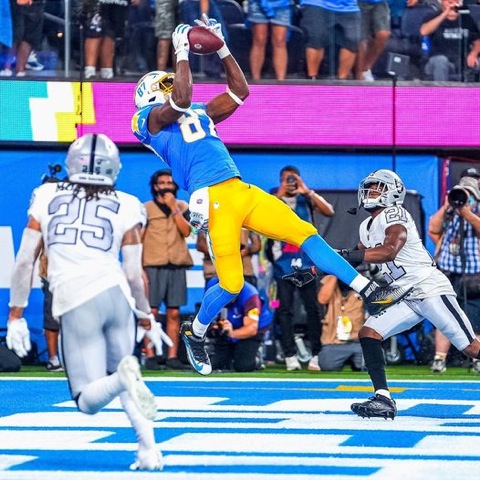
LOOKING FORWARD: The Los Angeles Chargers have lost six out of seven games since they defeated the Cincinnati Bengals in the season opener. This week, they get a chance to win their third game when they face the 0-9 New York Jets at SoFi Stadium.
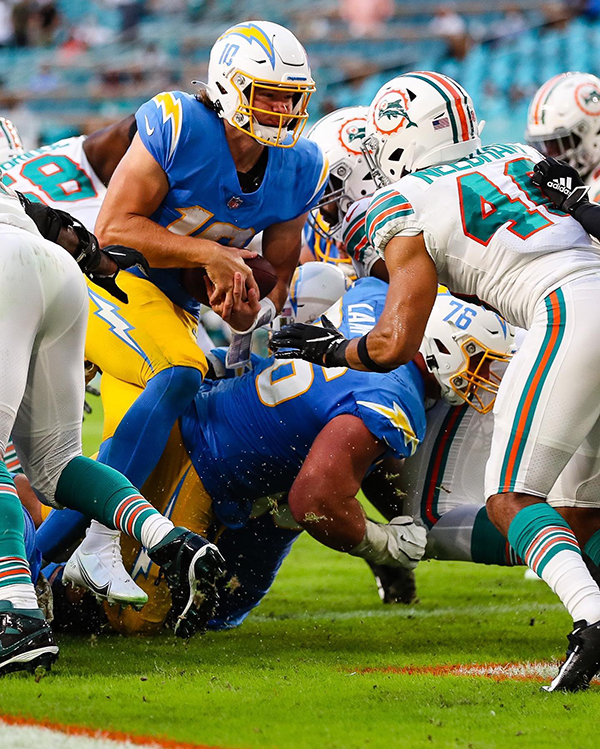
The Chargers are coming off their third straight loss, this one to the Miami Dolphins, 29-21, as Tua Tagovailoa outdueled Justin Herbert in a battle of rookie quarterbacks.
Herbert threw for only 187 yards against the tough Dolphins defense, which intercepted him once and sacked him twice.
Tagovailoa threw for 169 yards and matched Herbert’s two touchdown throws.
The Chargers may be playing for head coach Anthony Lynn’s job in the last seven weeks. After the Jets, they face the Buffalo Bills, New England Patriots and Atlanta Falcons before closing the season against division foes Las Vegas, Denver and Kansas City.
BOFFO BRUINS: Who were those imposters in the Rose Bowl Nov. 15 wearing UCLA blue and gold?
The Bruins beat up a California team that missed its season opener because of the coronavirus and didn’t find out they were playing the Bruins until less than 48 hours before a Sunday morning kickoff at 9 a.m. The Golden Bears had a built-in excuse for losing to UCLA, which will gladly take the 34-10 win.
Bruins quarterback Dorian Thompson-Robinson is starting to show signs of becoming the quarterback UCLA thought they were getting three years ago when they recruited him out of Las Vegas.
Against Cal, he completed 14 of 26 passes for 196 yards and three touchdowns. He gained another 52 yards running the football and added a touchdown.
Demetric Felton, now a full-time running back, gained 107 yards in 25 carries as the Bruins evened their record at 1-1.
The Bruins get no break from the schedule this week, facing the University of Oregon Nov. 21 at noon in Eugene.
Coach Chip Kelly would like nothing better than knocking off his former team, but I don’t think the Bruins have the personnel to keep up with the Ducks.
KARDIAC KIDS: Back in 1969, the USC Trojans were nicknamed the Cardiac Kids for their ability to snatch victory from the jaws of defeat.
Fifty-one years later, the Trojans have another version of the Cardiac Kids after the Trojans won their second game of the season in the last minute.
In the season opener, the Trojans scored two touchdowns in the last four minutes of the game to edge the Arizona State Sun Devils, 28-27.
On Nov. 14, the Trojans again needed last-minute magic from quarterback Kedon Slovis to defeat the Arizona Wildcats, 34-30.
The Trojans had to come from behind twice in the last four minutes to pull out their second win of the season.
Slovis hit tight end Erik Krommenhoek with a 6-yard touchdown pass with 3:30 to play in the fourth quarter to give the Trojans a 27-23 lead.
The Wildcats then marched down the field to regain the lead 30-23 with 1:35 to play in the game.
That proved to be plenty of time for Slovis, who drove the Trojans down the field again. Running back Vavae Malepeai scored the game-winning touchdown on a tough 8-yard run with less than a minute to go.
The Trojans hope to have an easier game this week, facing a Utah team that hasn’t played a game yet because of the coronavirus. As of Nov. 18, the game was still on schedule for a 7:30 p.m. start Nov. 21 in Salt Lake City.