By Michael Blood and
Nicholas Riccardi
Contributing Writers
LOS ANGELES (AP) — The U.S. attorney’s office in Los Angeles said June 5 it has opened “multiple election fraud investigations” related to California’s elections and sent a prosecutor to the county’s vote-counting center.
The developments came a day after President Donald Trump made baseless claims of mass fraud in California’s drawn-out vote count from the June 2 primary. Late-tallied Democratic-leaning mail ballots were continuing to eat into the vote totals for the president’s preferred candidates for governor and Los Angeles mayor.
The announcement by U.S. Attorney Bill Essayli, Trump’s appointee as the top federal prosecutor in Los Angeles, and the visit to Los Angeles County’s ballot tabulation center marked an escalation in the president’s campaign against the Democratic-dominated state, whose notoriously prolonged vote count has been a magnet for election conspiracy theories. Trump weighed in again June 5 while participating in a roundtable discussion in Chippewa Falls, Wisconsin, claiming without evidence that Democrats were rigging the election.
“You look at what’s happening — it’s getting tighter and tighter and tighter,” he said. “And the people who were supposed to win, bad things are happening. It’s a crooked state.”
Trump has often said that changes to vote totals as late ballots are counted are a sign of fraud, when they’re merely a reflection of more ballots being counted.
On June 4, Trump said his Department of Justice was investigating the California count. By the next morning, Essayli posted on X about ongoing investigations without providing details, saying only that California’s elections have “serious structural vulnerabilities.”
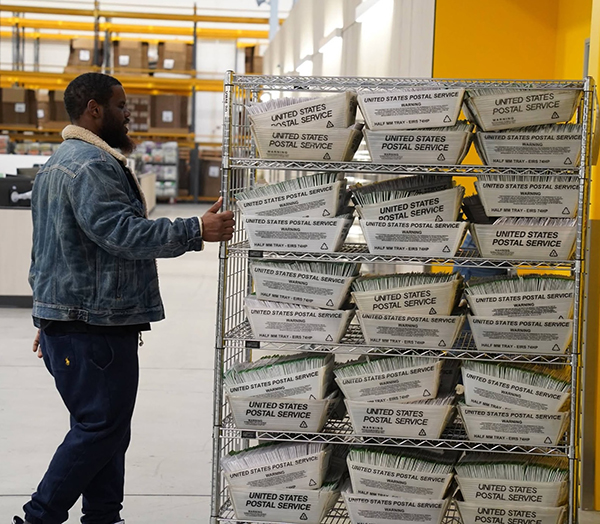
An assistant U.S. attorney came to the main ballot processing center June 5, according to a statement from Mike Sanchez, a spokesman for Los Angeles County’s Registrar-Recorder. The prosecutor “was provided an overview of the public observation program, and participated in a walkthrough of the ballot processing operations,” Sanchez said.
He added that “election officials routinely host observers representing a wide range of interests.”
It was not the first time Trump’s Justice Department has taken an interest in California’s elections. Last fall, it sent observers to monitor polling sites in five counties, including Los Angeles, during the special election asking voters to change California’s congressional map.
Also June 5, Republican Steve Hilton, who is Trump’s favored candidate for governor, called for a sweeping overhaul in California’s election laws to limit mail ballots to only those who request them, rather than being sent to all registered voters. He also called for an Election Day deadline to accept them rather than the seven-day grace period the state currently allows as long as they are postmarked by the final day of voting.
Hilton said in an interview that the U.S. attorney’s office might know more than his campaign does, but noted his team has been monitoring the count and has seen nothing that seems illegal.
“We certainly haven’t seen anything of that nature that would warrant legal action,” Hilton said.
Still, Hilton said the sluggish count has made California “a national and international laughingstock.” He proposed the state government send an emergency detachment of state workers to California’s 58 counties to speed up the vote count.
Jesse Salinas, president of the California Association of Clerks and Election Officers, said he welcomed Hilton’s eagerness to help but the proposal would do no good.
“It’d be more disruptive than helpful at this point,” said Salinas, who’s also the clerk and registrar for Yolo County.
Anyone who handles a ballot or machine used in the vote-counting process would have to be trained by the very people working feverishly to tally mail ballots that poured in June 2. And, added Salinas, his own vote-counting facility is already full, with no more room for any additional staff.
Hilton, who has been endorsed by Trump, is battling two Democrats for one of two slots on the November ballot. Reality television star Spencer Pratt, another candidate backed by Trump, is likewise competing with City Councilwoman Nithya Raman for the chance to face Mayor Karen Bass in the November election.
Because Democrats usually vote by mail, and held onto their ballots unusually late in the crowded primary, their votes are often tallied after those of more Republican-leaning voters who might have cast ballots early. The net effect is that Republican candidates appear at their high water marks in the first batch of returns on election night, only to see their leads whittled away in the days or weeks that follow, when election workers complete the lengthy process of tallying late-arriving mail ballots.
Michael Blood and Nicholas Riccardi write for the Associated Press.