By Jack Ross
Contributing Writer
LOS ANGELES — Behind every door was a chance to make money.
It was 2020, and Matt DeBoth and Angel Escobar were canvassing Koreatown, Highland Park and other gentrifying Los Angeles neighborhoods, trying to get tenants, mostly working-class immigrants, to give up some of the city’s most affordable apartments. Each time a tenant agreed, DeBoth later said in a deposition, he and Escobar could get a bonus of up to $1,000.
They worked for K3 Holdings LLC, a landlord based in Beverly Hills, which was rapidly acquiring dozens of rent-controlled properties across L.A. The company’s plan was to pay the longtime tenants to leave their homes — usually tens of thousands of dollars — and then raise the rent substantially for the next occupants, according to internal K3 records reviewed by Capital & Main.
In spreadsheets, DeBoth and Escobar tracked tenants’ rent — and how much K3 could likely increase it if they left. A “notes” column recorded the company’s progress:
“Roof collapsed- extremely obese man and sister … should be an easy buyout.”
“Recently diagnosed with cancer, so he’s saying no at the moment.”
“Matt got tenant to move out for free by telling him lease was expired.”
The spreadsheets and other K3 records were among a trove of internal emails, reports and other company documents produced through discovery in a 2022 federal housing discrimination lawsuit filed against K3 and its affiliates by 16 low-income tenants who alleged the company “targeted” them as Latinos. The records offer a rare, inside look at how a large landlord executed a “cash for keys” operation, a widespread strategy that has reshaped gentrifying neighborhoods across California as the state grapples with a severe housing crisis.
Landlords continue to favor the strategy because it is one of the fastest ways to dramatically increase the value of a real estate investment.
Cash for keys deals — in which landlords pay tenants to vacate their apartments without being evicted — are legal as long as they are voluntary agreements. But if a landlord uses deception or coercive tactics to pressure tenants into signing, the deals can be illegal under L.A.’s Tenant Anti-Harassment Ordinance.
The documents produced through discovery for the federal case also show K3 employees writing about ways to get tenants to leave their units without paying them and discussing what DeBoth described as “the narrative” that their buildings — which are standing and occupied today — would be demolished. Using “intentional misrepresentation” to persuade tenants to relinquish their leases is prohibited under the city’s ordinance.
K3 Holdings was founded by Nathan and Michael Kadisha, well-connected twin brothers in their early 30s who have positioned themselves as affordable housing champions. They are the nephews of billionaire Neil Kadisha, who co-founded Omninet Capital, a real estate investment firm that has acquired roughly 13,000 residential rental units and about 9 million square feet of commercial space across 11 states.
The Kadishas established K3 in 2016 and purchased 36 rent-controlled properties in just seven years, according to a report from the city’s Housing Department. Between 2018 and 2023, they acquired nearly 900 rent-stabilized units, making K3 Holdings the fastest-growing owner of rent-controlled apartments in Los Angeles during that period, the report said.
Landlords have used cash for keys-style buyouts for decades in Los Angeles and in other cities with rent control, such as New York. But according to a Capital & Main analysis of city data, the Kadishas stand out for the scale and pace at which they executed the strategy in Los Angeles, when K3 bought out hundreds of tenants in just a few years and replaced them with higher-paying renters.
Tenant plaintiffs and activists with the Los Angeles Tenants Union, which organized renters in dozens of K3 properties, said K3 was only able to work that quickly by illegally harassing tenants into moving out.
Under California’s Costa-Hawkins Rental Housing Act, if a tenant vacates a rent-controlled apartment, the owner is allowed to raise the unit’s rent to market rates, setting a new benchmark for future regulated increases. And that can easily amount to many hundreds of dollars or more each month for a single apartment.
Capital & Main sent detailed questions to K3 founder and principal Nathan Kadisha. The company responded through attorney Oren A. Lazar, who, in a five-page letter, denied allegations of tenant harassment and threatened to sue for defamation.
Those allegations “were litigated by capable plaintiffs’ counsel for nearly two years in federal court. No court ever found K3 or the Kadishas liable for any of them. K3 denied those allegations then, publicly and consistently, and denies them now,” he wrote.
According to documents produced through discovery for the federal lawsuit, to persuade residents to vacate, K3 Holdings deployed DeBoth, the company’s asset manager, and Escobar, an employee described by tenants in interviews as a young man who sometimes used a pseudonym — and whose temper flared when residents refused his money.
Three current or former K3 tenants told Capital & Main that Escobar or other company employees threatened them with deportation after they didn’t sign buyout agreements, an allegation DeBoth called “absolutely bull—-” when tenant attorneys deposed him in the eviction lawsuits. (Two of those allegations were made in 2022; the third was in 2026.)
DeBoth declined to respond to questions from Capital & Main through his lawyer, Ranojoy Guha. Escobar — who no longer works for K3 Holdings — also declined to respond to questions when reached by phone.
“I have nothing to say,” Escobar said.
K3, through its attorney, denied that employees “threatened tenants with deportation or other immigration consequences.”
In the federal housing discrimination lawsuit, tenants also alleged that K3 employed a variety of illegal tactics to coerce them into taking cash payouts, including threatening them with eviction, failing to provide them with Spanish language documents, and allowing conditions to deteriorate so that the aging buildings were simply too miserable to live in. They accused the company of “targeting Latino families” with its buyouts, then renovating their empty units and advertising them to a “whiter” and “younger” clientele.
K3 settled the federal housing discrimination lawsuit in 2023 for $2.2 million and assurances that it would take numerous actions to encourage a diverse tenant base. The company did not acknowledge any wrongdoing.
But in a separate lawsuit scheduled for trial this month, tenants in a Koreatown property accused K3 of violating state and city housing laws. Among the laws K3 is accused of violating is the Los Angeles Tenant Anti-Harassment Ordinance, which bars the city’s landlords from threatening tenants with deportation, refusing repairs and maintenance, tricking them into leaving and more.
For years, K3 tenants have protested have unsafe living conditions in its properties, citing mold outbreaks and rodent and insect infestations they said resulted from poor building maintenance. They also said the company’s aggressive remodels left apartment units vulnerable to flooding.
In an email in the documents produced through discovery, a K3 employee said renovations of an empty unit led to flooding of an occupied apartment on the floor below.
“Can we manage to hold off on telling [the tenant] that this was caused by an outside vendor during a unit turn if they don’t already know?” director of property management Rita Qatami said in the 2022 email. “I don’t want them to say anything to the tenant union.”
K3, through its attorney, denied that it “deliberately neglected its properties to coerce buyouts.”
“We’re responsive,” asset manager DeBoth said in his deposition in the 2023 eviction cases. “We are well staffed. We are appropriate.”
DeBoth left the company later that year. In 2025, he filed his own lawsuit against K3 Holdings and the Kadishas that accused the company of “systematically failing” to address an “alarming number” of tenant complaints, conducting unpermitted construction and potentially exposing him to “mold, asbestos, lead, or other deadly substances.”
In interviews, several tenants said the buyouts were initially tempting — but they quickly learned that the below-market amounts they’d been paying for years in their rent-controlled apartments were impossible to replicate in the city’s stratospheric rental market. Accepting the cash would leave them in even worse financial shape, they said.
“In my country, I had never seen that kind of money,” said Ester Castro, a former K3 tenant from Guatemala who accepted a $30,000 buyout to leave the studio apartment she shared with her two children and who spoke to Capital & Main in Spanish through an interpreter.
“You might have this idea that it’s going to last long, that you can use it to build something better or find a better apartment. But you realize that is an illusion,” Castro said.
The family now lives in Georgia.
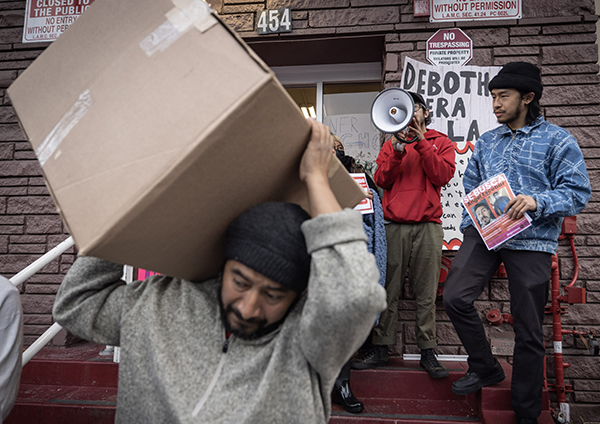
K3’s wide-ranging buyout campaign triggered a similarly wide-ranging response from its residents, who formed a tenant union that spanned nearly 40 of K3’s buildings and involved dozens of volunteer organizers at its peak. Under the umbrella of the Los Angeles Tenants Union, the K3 Tenant Council successfully prevented some of the buyouts in the K3 buildings where they organized, creating hubs of tenant power in those properties that endure to this day.
For some tenants, the union arrived too late. Organizers described knocking on doors in nearly empty properties where immigrant families had recently lived but hastily vacated, some of them leaving their belongings still piled on the street outside.

K3 Holdings stands out in city data for the scale and pace with which it pursued tenant buyouts in recent years.
Between January 2019 and July 2025, Los Angeles landlords spent more than $148 million on nearly 6,000 cash for keys buyouts, according to data analyzed by L.A. City Controller Kenneth Mejia.
A Capital & Main analysis of Mejia’s data found that K3 Holdings completed the most buyouts of any landlord in the city during that time period.
Of the top 20 buildings where landlords reported the most buyouts to the Los Angeles Housing Department, nine belonged to K3 Holdings. (The landlord in second place, Yaacov Brenenson of Moriah Capital, owned three properties.)
K3’s tally is likely an undercount. At least one K3 property in Koreatown, where the company recorded completing 51 buyouts in its own spreadsheets, is missing from the city data.
Sharon Sandow, a spokesperson for the Los Angeles Housing Department, confirmed in an email that K3 did not report completing any buyouts at that address.
Through its attorney, K3 denied that it concealed buyouts from the city.
In the now-settled federal housing discrimination lawsuit, tenants alleged that in pursuing its “gentrification strategy,” K3 set out to target “L.A’s most vulnerable tenants for displacement” in communities “where the racial turnover of tenants generates the most profits with the least resistance.”
Castro — the former tenant from Guatemala — said that a K3 agent calling himself “Jacobo” pressed her to accept a $30,000 buyout in the fall of 2021.
But Castro said she believes “Jacobo” was actually Escobar. She identified Escobar in a picture as the Jacobo she knew.
Castro spoke only Spanish, but the contract Jacobo presented, she said, was written in English. Still, Castro said she turned the offer down because she could not find another affordable apartment. Her job at a pizzeria paid her in cash, so she had no pay stubs to show the next landlord.
Jacobo told her the building would be demolished, too, Castro said, because it was built on an underground lake and was sinking.
“If you don’t want to sign that’s fine, but we’re going to come at you with something more aggressive,” she said Jacobo told her.
Soon, Jacobo and another K3 employee, who identified herself as “Johanna,” began asking about her immigration status, Castro said.
“They would kind of ask in this suggesting way, like, ‘Oh, well, do you have papers?’” she said in Spanish. “‘Do you have documents?’
Castro said she grew tired of living in an empty building and of Jacobo’s relentless visits.
She moved her family to Atlanta, where her money ran out within a year.
“We were comfortable in Los Angeles,” Castro said, “and we arrived in Atlanta in tears.”
Jack Ross writes for Capital & Main, a Los Angeles-based nonprofit publication focused on inequality. It is published here with permission.