THE HUTCHINSON REPORT: Raman has reasons to question LAPD Chief McDonnell

By Earl Ofari Hutchinson
Contributing Writer
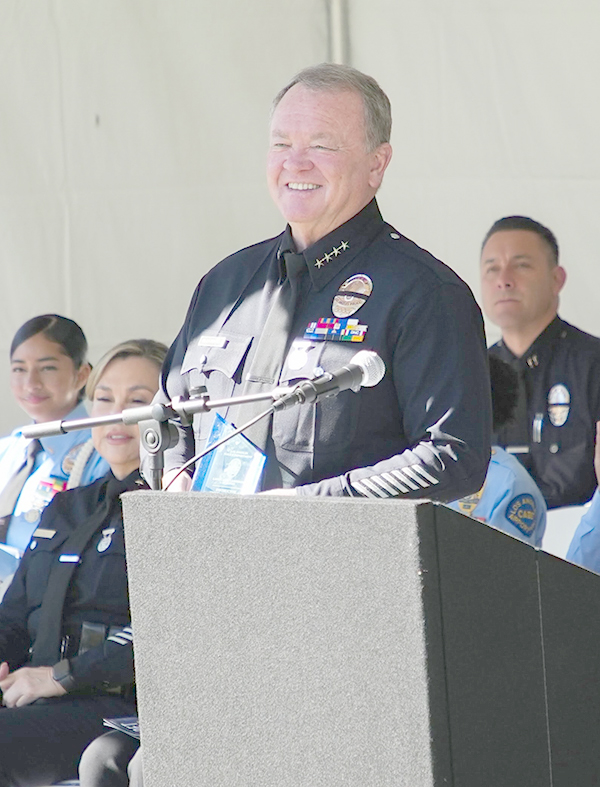
During the mayoral campaign, now Mayor-Elect Nithya Raman said she would fire Los Angeles Police Chief Jim McDonnell. She may or may not keep that pledge.
McDonnell, anyway, doesn’t seem to think so. He expressed optimism that he would stay on after a “cordial” meeting with her.
Whether Raman acts or not, she still must take a hard look at McDonnell and the LAPD and that goes far beyond the dispute over what LAPD did or didn’t do to cooperate with federal immigration agents. The problem is the continuing troubling policies and practices of the LAPD on his watch.
First there’s racial profiling. A recent crosstown survey found that despite endless denials, promises and investigations, the LAPD still engages in blatant racial profiling. The prime target remains Blacks.
They account for one out of four traffic stops. Though they make up less than 10% of the city’s population. That is not an aberration. Year in, year out Blacks consistently are the runaway leader in being subjected to unwarranted stops.
Next, there’s the issue of abuse complaints. There are lots of them filed yearly against the Los Angeles Police Department for various and sundry problems, actions, encounters but especially abuse. The overwhelming majority of the non-acted on complaints are by Blacks and Hispanics.
Researchers cited one internal LAPD investigation as typical. It found an “overwhelming pattern of intentional policy violations.” They also found countless numbers of stops in which there was little or no documentation.
In a number of those stops, officers either turned on their body cams and dashboard cameras late, or worse, never bothered to turn them on at all.
The California Department of Justice, in a separate study, found that nearly 5,000 bias complaints were lodged against the LAPD between 2016 and 2025. A grand total of three were upheld.
There was no indication what, if any, action was taken against the officer or officers that were found in violation of department regulations on the handling of stops.
The real issue is the age-old problem that has bedeviled the LAPD for decades. That is the issue of racial profiling, the target almost exclusively being African Americans or Hispanics, but especially African Americans.
The alleged profiling almost always involves a traffic stop. In 2025, more than one-third of those stopped under dubious circumstances were African Americans, even though African Americans make up less than 10% of the city’s population. Hispanic motorists likewise are subject to a disproportionate number of questionable stops. In almost all cases, LAPD officers do not find guns, drugs, or any other criminal offense.
The refusal to admit that racial profiling exists by many public officials and many in law enforcement has done much to torpedo nearly every effort by local and national civil rights and civil liberties groups to get law enforcement and federal agencies not only to admit that racial profiling happens but to do something about it.
A perennial federal bill served up by House Democrats to get federal agencies to collect stats and do reports on racial profiling hasn’t gotten to first base. California legislators have done better. They mandate that law enforcement agencies compile racial stats on traffic stops. Nationally, more than 40 states collect data either voluntarily or compelled by state law on unwarranted pedestrian contacts and traffic stops.
Police officials loudly contend that good police work is about the business of catching criminals and reducing crime, not about profiling Blacks and Latinos. If more Black and Latino men are stopped, it’s not because they’re Black or Latino but because they commit more crimes.
The even more problematic tact used to debunk racial profiling is the few statistics that have been compiled on unwarranted stops, not by police agencies but based on citizen responses.
In two surveys, the Federal Bureau of Justice Statistics took a hard look at racial profiling using information that it got from citizens. Both times, the agency found that while whites are stopped, searched and arrested far less than Blacks or Latinos, there was no hard proof that the stops had anything to do with race.
That has done even more to damp down a public outcry to get police agencies and legislators to admit that racial profiling is a fact on many city streets and highways and then to take firm action to eliminate it. That is certainly the case with the LAPD. And Raman needs to take a hard look at that, too.
Then there’s the issue of dubious police shootings. The LAPD annually leads the nation’s police departments in use of deadly force by officers. Despite, directives to the department to stress deescalation in encounters, the high number of shootings continue. As in department’s profiling and the lax handling of complaints, the overwhelming majority of those cut down by police bullets are young Blacks and Hispanics.
These are crisis problems that have screamed for attention and action by McDonnell and the Los Angeles Police Commission. The jury is way out on just what he’s done about these problems. That’s why again Raman must take a hard look at McDonnell as chief.
Earl Ofari Hutchinson is an author and political analyst. He hosts the weekly news and issues commentary radio show “The Hutchinson Report” Tuesdays at 4 p.m. on KPFK-Pacifica Radio 90.7 FM, streamed at kpfk.org.