By Darlene Donloe
Contributing Writer
LOS ANGELES — For the past year, on a hill above Sepulveda Boulevard, 30 to 50 people have been gathering once a month at the Skirball Cultural Center to do something that has become uncommon in Los Angeles: stay in the same room.
They are Black and Jewish Angelenos — artists, organizers, rabbis, educators, neighbors who had not, in many cases, been neighbors for a long time.
They sat at the same tables every month. They broke bread. They learned how to breathe when a conversation tightened in the chest.
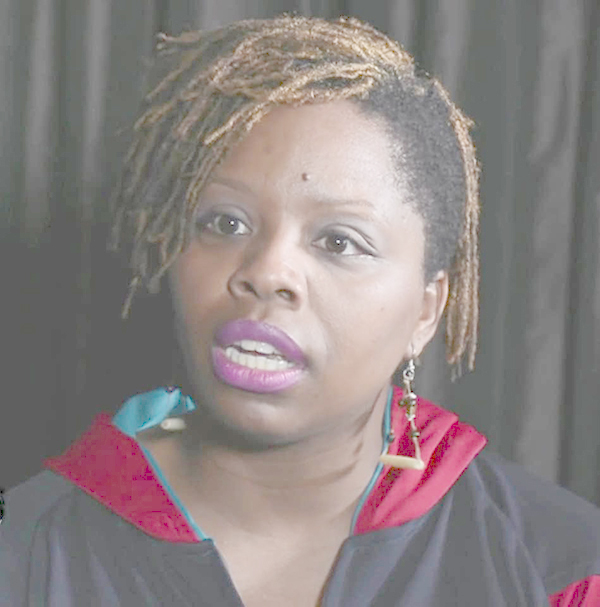
“I had to do a lot of work before people could be curious,” Patrisse Cullors said.
On Oct. 22, Cullors will debut three new works at the Skirball that give that year of work a physical shape.
The exhibition, “Wishes Made Material,” organized by the Skirball and curated by Jideofor Chikeruba, community connections research fellow, is not a retrospective of Black-Jewish relations, nor is it a statement exhibition.
It is the after-image of a yearlong practice called Bridging Histories: Black–Jewish Dialogues for Peace and Unity, which ran throughout 2025 and was led by Avriel Epps, bringing together leaders across the Black and Jewish diasporas in Los Angeles.
“Wishes Made Material began as a question I kept returning to: what do our communities dream toward when we are safe enough to dream,” Cullors said.
“After October 7 (the Hamas-led assault on southern Israel in 2023), Patrisse reached out in solidarity and proposed gatherings at the Skirball,” said Skirball President and CEO Jessie Kornberg. “Beginning Passover 2024, a group reconvened monthly for a year, despite discomfort and challenging circumstances. I’m so grateful for Patrisse’s leadership and grace, and for each participant’s dedication.”
Cullors, 42, a Los Angeles native, is known publicly as an artist, educator, author and abolitionist, and as a co-founder of Black Lives Matter.
Her artistic biography includes exhibits at The Broad, the Geffen Contemporary at MOCA, the Hammer Museum, the Fowler Museum at UCLA, Crystal Bridges, Frieze Los Angeles, the Crenshaw Dairy Mart — which she co-founded — and Prescott College, where she founded the Social and Environmental Arts Practice Masters of Fine Arts program. She also founded the Center for Art and Abolition.
Her current framework, which she calls Abolitionist Aesthetics, asks how artists and cultural workers can imagine, rehearse and build more liberatory futures. At the Skirball, that future is not imagined in isolation.
“Bridging Histories” did not begin with a supper. It began with research.
“Avriel Epps and I met with almost 200 people to see if they’d be interested in participating in a series like this, and then we interviewed over 75 people as part of the study,” Cullors said.
She wanted to know what people carried into the room before they entered it.
The questions were intimate and direct: What is your identity? How do you feel about Blackness? About Jewishness? What were you taught as a child, and what do you think now? How would you feel about being in community in this way?
Each monthly gathering at the Skirball included a set of questions, speakers, and what Cullors calls “experientials.”
Cullors said one dialogue was held at the California African American Museum with writer Eric Ward and Rabbi Susan Goldberg, tracing histories of convergence and conflict and how those conflicts have been navigated.
But the first six months, Cullors said, were not about conflict at all.
“It took a long time for us to get into hard conversations,” she said. “The first six months was just getting to know each other, sitting … we organized it by tables, people had the same table every month. They got to know each other, they got to talk to each other. It was a real process to get to where we are today — to connectivity, to being connected.”
Participants were taught somatic practices — mind-body techniques that focus on internal physical sensations — to learn how to regulate their nervous systems when activated, so that response did not come from activation.
They were asked to notice what was coming up for them in sessions and to take the risk of a more courageous conversation inside the room itself.
Cullors printed packets — poetry, lyrics, history — and they read aloud together.
The provocation that anchored the year: What becomes possible when we move toward one another rather than away, and when the histories we carry are held not in isolation, but in company?
Los Angeles has its own geography to this story.
There was a time when Black and Jewish communities lived in the same neighborhoods — Boyle Heights, South Los Angeles, Fairfax — sharing streets, schools, storefronts.
“Lots of Jewish communities often left Black communities for more affluent communities,” Cullors said. “So the proximity doesn’t exist in the same way. So we have to figure out different places to be in proximity. And this became that.”
What filled the distance, she found, were assumptions.

“There was a lot of assumptions we made about each other’s communities,” she said. “A lot of assumptions that had negative impact on some of our shared goals, especially domestically.”
For Cullors herself, the year demanded its own reckoning.
“I feel like the Black community was being asked to support things that we don’t historically support. We don’t support war,” she said. “Our community has a long-standing history of being anti-war. And so, what does that mean when one community was attacked by another, and then it goes to war? Where do Black people stand? What are our values? What are our ethics?”
It pushed her into a deeper study.
“I did a deep dive into what is anti-Semitism,” she said. “What does it look like? I know anti-Black racism very well. I know its nuances. I know where it’s hiding. I know what’s a dog whistle. I didn’t know that for antisemitism, and I’m still learning.”
What emerged, for her, was not equivalence but entanglement.
“I came out of this experience with a deep understanding that if we don’t see antisemitism and anti-Black racism as part of the same racial justice movement, that we are going to be further and further pitted against each other,” she said. “That is also a call for the Jewish community as well — that antisemitism is a part of the racial justice movement, and that we need to be working together to stop both.”
“Wishes Made Material” begins where those suppers ended.
Drawing on photography and recorded conversations, Cullors carries participants’ memories into the gallery.
On opposing walls, two textile works incorporate screen-printed photographs that emerge from and recede into their surfaces — images half-remembered, half-withheld, the way a conversation stays in the body after the words are gone.
Overhead, a single-channel video, co-developed and co-created by Cullors and TURL, is projected across multiple screens. A musical score and dialogue between the artist and participants form the soundscape, co-produced by Tairiq and Garfield Bright.
Together, the works form an intimate multimedia installation where listening becomes part of healing, and repair is understood not as resolution but as the sustained practice of staying present.
“What you see and hear is an offering — an invitation to be tender, to be curious, to imagine the kind of connection we have not yet been allowed,” Cullors said.
It is a notable turn for an artist whose public life has often been read through the lens of protest. Here, the work is not about spectacle but about staying. The question is not what is demanded, but what is dreamed when people feel safe enough to dream — and whether they can build a room sturdy enough to hold it.
“Patrisse Cullors: Wishes Made Material” opens Oct. 22 at the Skirball Cultural Center, 2701 N. Sepulveda Blvd. General admission is $20 general, $15 for seniors, full-time students with ID and children 2-17.
Darlene Donloe is a freelance reporter for Wave Newspapers who covers South Los Angeles. She can be reached at ddonloe@gmail.com.