Wave Staff and Wire Reports
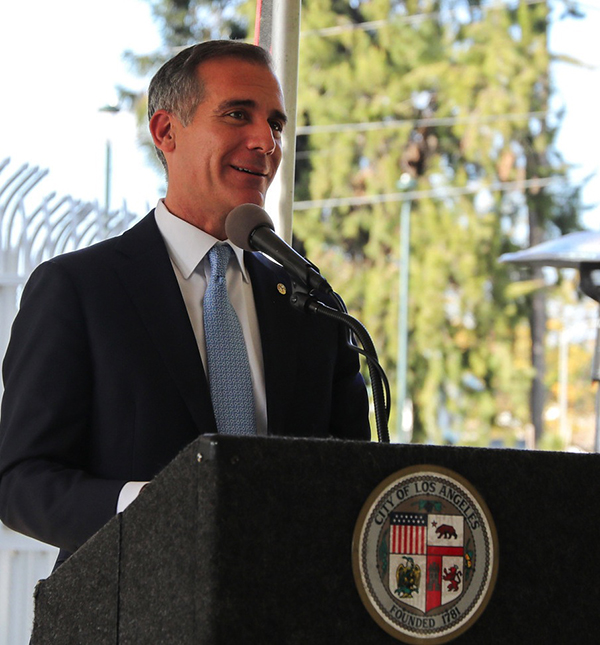
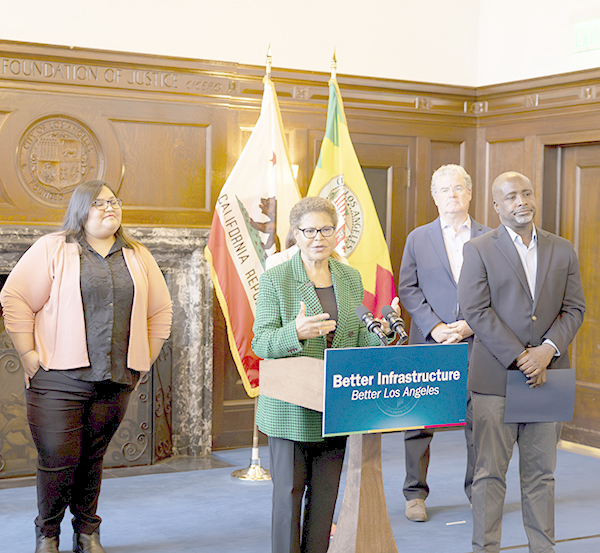
LOS ANGELES — Mayor Karen Bass unveiled the city’s first capital infrastructure program to build and maintain roads, sidewalks, parks, curb ramps and other public buildings.
During a news conference, Bass said every large city in the country has a capital infrastructure program, but Los Angeles has never had one until now. The program will serve as a roadmap for the city to improve the way it maintains and builds new infrastructure, she said.
The program also outlines 10 recommendations to achieve that goal by updating city processes and the City Charter, implementing measures such as establishing a director of public works and giving the Bureau of Engineering the authority to lead the program. It also calls for more transparency on how and where the city addresses infrastructure needs with the use of data.
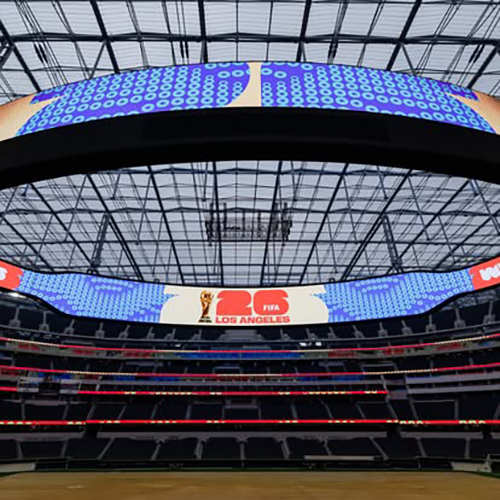
Through the program, Bass called for the construction of 29 related Olympic and Paralympic legacy projects, which aim to prepare the city for the 2028 Games. Sixteen of the projects are currently funded in the mayor’s proposed $14.89 billion budget for fiscal year 2026-27.
Working alongside the City Council, the mayor’s office will look to secure long-term funding and planning for the proposed projects.
“I ran for mayor to break away from the city’s broken system that has left us with deteriorating streets and repair backlogs that piled up for years,” Bass said. “With my capital infrastructure program, we are forging a new path together to better design, maintain, and deliver — on time and budget — the infrastructure that Angelenos deserve,”
The program calls for a complete list of all capital projects and initiatives for current and future year funding, and to improve communication about funding needed to complete, maintain, and build existing or new infrastructure projects.
Council President Marqueece Harris-Dawson described the program as a “long-overdue modernization” of city services.
“While other cities have had infrastructure plans for a long time, few carry the weight and load that Los Angeles does,” Harris-Dawson said. “With over 7,500 miles of streets and enough sidewalk mileage to reach Paris and back, we are finally investing in the community’s collective backbone at the scale it requires.”
City Councilwoman Eunisses Hernandez said the program can help transform how Los Angeles plans, invests and takes care of the services people rely on.
“By making this shift, we can transform how Los Angeles plans, invests, and takes care of the services people rely on every single day,” Hernandez said. “As chair of the Public Works Committee, I look forward to working with Mayor Bass to ensure this program leads to real, visible improvements in people’s daily lives.”
Council members Katy Yaroslavsky and Tim McOsker also attended the news conference.
“Los Angeles has a lot to fix, but fixing what is broken cannot mean rebuilding the same system we inherited,” Yaroslavsky said. “Much of our infrastructure was designed decades ago for a different Los Angeles, one built around cars first.
“Los Angeles has changed, and our infrastructure has to change with it, by repairing what has failed while building streets that are safer, cooler, more accessible, and better connected to the way people live now,” she added.
McOsker said the city has operated without an adopted, clear, coordinated infrastructure program for too long. He said a formal infrastructure program would “deliver a framework on the agreed priorities for maintenance and new construction, how we’re going to approach the work, and how we will hold City Hall decision-makers and budgets accountable over time.
“Transparency and consistency are what L.A. residents expect, and this proposal is an important step toward being responsive to residents’ needs and delivering the basic, safe infrastructure that people rely on every day,” he added.
Jessica Meaney, executive director of Investing in Place, an organization that advocates for infrastructure improvements, also attended the news conference.
She called the infrastructure program “an important step toward building the systems we need to plan for and take care of our sidewalks, streets, and parks over time.”
“It reflects a shared understanding of the places Angelenos rely on every day and the importance of caring for them consistently in every neighborhood,” she added.