By Darlene Donloe
Contributing Writer
LOS ANGELES — DIY Girls, a nonprofit organization founded in 2012 by current U.S. Rep. Luz Rivas, runs a continuous pathway of education in science, technology, engineering, arts and math for at-risk girls from fifth grade through high school graduation.
DIY Girls — “Do-It-Yourself” — teaches young women to explore those subjects and others through hands-on workshops and mentorship.
The program is designed to provide engagement with technology, build capacity, and continue serving the girls until they finish high school.
Through monthly workshops and mentorship from women in tech, DIY Girls builds self-confidence and keeps girls on track for technical careers.
Programs include “Creative Electronics,” “Tech & Arts,” and “Invent Girls.”
Rivas started the nonprofit after realizing she was often the only woman — and often the only Latina — in science, technology, engineering and mathematics classrooms.
Fourteen years later, Executive Director Cristina Gutierrez Medina, who took the role six months ago, continues the organization’s mission: teaching young women to code, solder circuits, and design products with tools like three-dimensional printers, to make sure they see technical careers as possible options and not mysteries.
Medina, 38, is now tasked with guiding the organization through its next decade, at a moment when 3D printers and open-source hardware are moving out of engineering labs and into classrooms.
“This organization is important to me because I grew up in this community,” said Medina, who spent nearly nine years at DIY Girls as senior director of programs and partnerships before becoming executive director. “I always felt that I was good in math and science. … But one thing that I think dissuaded me from furthering my education in STEM was that I didn’t get to do a lot of hands-on activities.”
Medina said STEM seemed “really fun in theory,” but she never got to touch it.
“I felt that maybe if I had done some of the things that we do with our students in the program, maybe that would have helped me lean more on the strengths that I felt that I had in STEM,” she said.
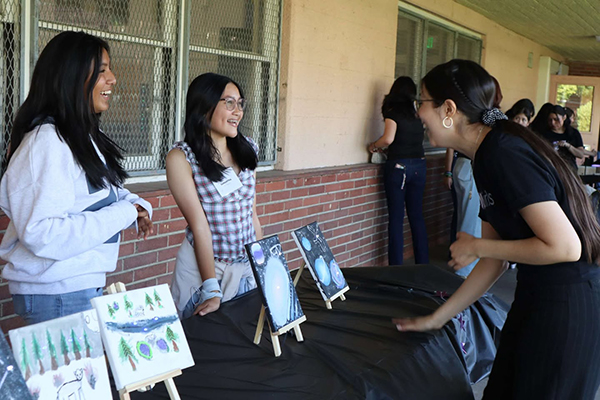
On any given after-school workshop day at DIY Girls’ makerspace, a group of students can be found hunched over circuit boards, with soldering irons glowing.
One student frowned while repositioning a wire before trying again. When the light finally blinks to life, she doesn’t cheer. She nods, like she expected it all along.
That small nod, that expectation, is what Medina wants for all of the girls who participate.
“Now that I have been in this role, there have been so many things that I’ve been exposed to that I had never been exposed to in my life because I didn’t go into a STEM major when I was in college,” said Medina, who studied Spanish literature and education at UC Santa Barbara. “I never got an opportunity to learn what coding was or how to solder, or how to build a circuit. So a lot of the things that I now know how to do, I learned as the director of programs in DIY Girls.”
Medina said she loves the fact that the organization is able to provide those opportunities to girls.
“I want to make sure that they know what opportunities are out there for them, so that when they grow up, if they choose not to go into STEM, it isn’t because they didn’t know,” she said.
Since its inception, DIY Girls, which partners with local schools, has served 8,000 girls through the program.
Every year, 400 to 500 students participate in the program, which has a cap of 25 for the year at high schools. Participation is first-come, first-served. Families apply online, and spots are filled in order of submission.
“There are no pre-requisites and we don’t look at grades,” Medina said.
She said she can’t help but be proud of the girls and of what DIY Girls provides to its participants.
“So the first cohort that we served was 32 fifth-grade girls,” Medina said. “Statistics show that if you don’t get in there early, it’s very easy for the students to lose interest, especially in middle school, because there are so many other social factors that play into their interests.
“The earlier you can get in, and if you can sustain that interest, the better it’ll be for the students,” she added.
“I’m really proud that we’ve been able to honor that commitment to working with the young girls, but we’ve also expanded to also serve girls while they’re in middle school and while they’re in high school and even while they’re in college,” she said.
DIY Girls now runs a continuous pathway from fifth grade through high school graduation, with college support added recently. Girls get monthly workshops, mentorship from women in tech, and projects that move from paper circuits to full products. The goal: engagement, capacity, and retention until high school ends, for at-risk girls who might otherwise be filtered out.
Medina believes diversity in tech isn’t optional. She frames the stakes beyond representation and talks about who gets to design the technologies that will govern the next 30 years.
“I think as a young Latina, daughter of immigrants, first-generation, I feel that there’s a lot of diversity in our stories, and I think those things should be highlighted,” she said. “When people talk about developing software technologies of the future, I think it’s really important that we have diverse voices. And for so long, those voices have looked the same. So then it doesn’t really give what the population needs.”
Currently, women represent just 34% of overall employed scientists and engineers in the United States, of which only 10% are represented by women of color.
About 94% of DIY Girls participants are youth of color: 85% are Latina, 2% are African American, 1% are Asian-Pacific Islander, and 6% are multiracial.
Medina also points to health care research historically based on male bodies.
“Who’s doing the research for women and some of the things that affect women?” she asked. The same question, she argues, applies to artificial intelligence, infrastructure and consumer products.
The future of technology, product development, as DIY Girls sees it, will be determined by people who design and build their own products.
Medina wants those people to look like her students.
“I think it’s really important to just make sure that young girls know that they can be in those spaces and that they can impact the technology that will guide the future,” she said.
“The future needs more voices, and it starts with letting girls get their hands dirty.”
Darlene Donloe is a freelance reporter for Wave Newspapers who covers South Los Angeles. She can be reached at ddonloe@gmail.com.