By Teresa Moore
Contributing Writer
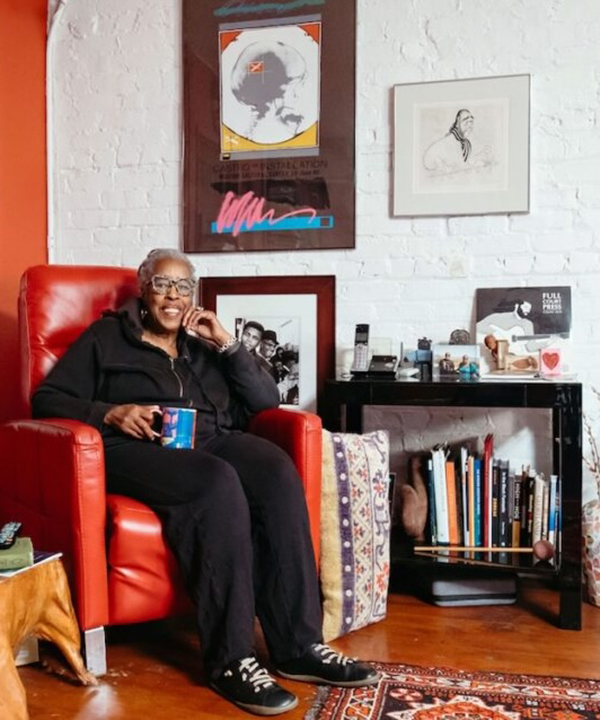
OAKLAND — It’s been ten years since the U.S. Treasury secretary announced that Harriet Tubman would replace Andrew Jackson on the $20 bill. While it appears unlikely that Brigadier Gen. Tubman will grace our pockets anytime soon, from June 12 to Oct. 18, near the entrance to the Oakland Museum of California, one can see a Black woman gazing from the center of an image of a $100 bill the size of a twin XL mattress.
This is a blown-up version of the actual altered currency on display inside “Mildred Howard: Poetics of Memory,” the first major survey of the acclaimed Bay Area artist’s nearly six-decade career.
In 1975, Howard put herself in the oval on the front of the hundred and replaced the engraving of Independence Hall in Philadelphia on the back with a photo of her alma mater, the College of Alameda.
According to the exhibition label, “This is the earliest known example of her use of found material, collage, self-portraiture, photography and printmaking.”
According to my notes, it’s also a wonderful example of a young artist making the leap from “What if…?” to “Why not?”
Howard’s art can astonish, amuse, provoke and intrigue. Her materials include bronze, glass, paper, textiles and film, but just about anything at hand could inspire her.
“Pocketbook in Flight” (2023) came about when she put a pair of bird wings in her mother’s alligator purse and imagined how it would look in bronze. It’s an elegant, surreal object but also a relatable joke.
“Because money’s always flying out the door!” Howard said.
Sometimes her earlier work will seem just the tonic for the present moment. A pair of thick books open on pedestals look as if someone has shot neat holes through the pages.
Made in 2007, the work is titled “Volume I & II: History of the United States with a Few Missing Parts.” Also from 2007, “What Came First” shows a giant chicken head rising out of a model of the U.S. Capitol Building.
At the press preview, jazz pianist Bill Evans’s “Peace Piece” played in the galleries and Howard talked about the silences between the notes.
“He gives time to think about the music and the space,” she said. “This show is space so that you can see the work.”
Looking at a bronze kitten-heeled pump jutting from a bronze hat form mounted on a garden hoe, 2024’s “Another Hook with a Ho,” my mind fills the spaces in the sculpture to see a Jazz Age dancer swinging her foot above her cloche hat. A great pleasure of Howard’s art is how she can juice the viewer’s own impressions, memories and ideas.
“Objects have history and they have meaning,” Howard has said. “But how do you take something that’s used for one thing and repurpose it into an artwork of an entirely different meaning? How can you expand your imagination and create a different way of looking?”
A lifelong immersion in the arts and community engagement informs her work. The youngest of 10 children, she became the first native Californian in the family when she was born in San Francisco in 1945.
Her parents Rolly and Mable “Mama” Howard were part of the Black great migration, moving from Texas to San Francisco for jobs and opportunities during World War II. Mable was the first Black woman to join the painters’ union in California, opening the door for others to follow.
At a very early age Mable enrolled Mildred in dance classes and later, art classes.
“I was performing by the time I was 5, in fact, in front of Oakland City Hall,” she said at the June 11 opening reception. “I can remember performing for union groups and things like that.”
Howard has 16 works of permanent, public art — an unusually high number for a woman artist, let alone a Black woman artist. Located throughout the San Francisco Bay Area, they include “Salty Peanuts,” a 16-by-25-inch assemblage of saxophones sandwiched between the opening stanzas of Dizzy Gillespie’s “Salt Peanuts” in the San Francisco Airport’s international terminal; an ornate 20-inch picture frame straddling a walkway near the site of the former naval shipyard in Hunters Point; and “Three Shades of Blue,” a Quincy Troupe poem etched in blue glass on a Fillmore Street overpass walkway bridging Japantown and the Western Addition, historically Japanese and Black neighborhoods.
“Delivered, Mable’s Promissory Note,” a bronze sculpture at the Ashby BART station, honors her mother, a people’s rights activist who, in the 1960s, led the successful movement to keep an above ground BART station from fracturing a Black neighborhood in South Berkeley.
These public works, some of which are in a video in the exhibition, reflect on Black culture, American history, justice and community. Whether you know the back stories or not, they make you look, think and sometimes laugh. But unlike works that hang on walls, it’s rare for the public to know the name of the artist behind public art.
Something surprising happened on my way to the press preview. I got turned around outside Lake Merritt BART and asked a trio of women for directions to the museum. They appeared to be in their 60sand were wearing lanyard photo IDs. They pointed me the right way and asked what was going on there.
Before I could answer, another woman behind me said, “Mildred Howard!” and my three guides fizzed with excitement. I wish I’d had time to ask them how they knew about Mildred Howard, but I was running late. It struck me as remarkable, though, that any living artist would have that kind of sidewalk name recognition.
When I shared this encounter with Howard’s grandson Mylez Brown, he laughed. “She’s made a hell of an impact on a lot of people,” he said. “More than she actually knows.”
Brown, who is an artist, musician and filmmaker, grew up with his grandmother and shares a studio with her.
“A lot of times when people speak about her artwork, they separate the art and the artist … Yes, she creates these monuments and things like that, but the reality of it is creativity IS her. She is her creativity in every facet.”
Brown recently completed a documentary, “Mildred Howard: Memories in Motion.”
“In the documentary she said it’s important to be generous with time, with the way you treat people. … I think a lot of the stuff she does – the community, the ties, the mentorship, it’s all about bridging the gap between what has happened before and what happened after and presenting that to people.”
He talked about the Berkeley neighborhood where his grandmother, his mother and uncle and he all grew up.
“There’s an extreme amount of familial history within that specific area,” he said. “Within those four blocks I met a new cousin every day of my life.”
Sadly, they’ve lost their hold on the neighborhood Mama Mable fought to save. In 2017, the landlord doubled the rent on Howard’s Berkeley home studio. Brown said that two years ago, the last family house in Berkeley was sold. Today Howard lives and works in a loft in West Oakland.
Despite being scattered from their Berkeley home base, four generations of Mildred Howard’s family — nearly two dozen relatives gathered in the largest gallery, a darkened room glowing with red sculptures and installations, for family photos. Nearby, “Moving Stills,” a 2026 museum commission, played against the longest wall.
Scenes from layered screens of Super 8 footage Mildred shot when she was 14 bloomed and melted behind a white scrim woven with leaves: Mildred’s classmates. Her “first trip to the South to visit great aunts who were born in the late 1800s.” Her mother in an aqua knit top.
Howard found the film in her late mother’s alligator purse.
“Ideas are always there,” she said. “You just have to look deeply.”
“Mildred Howard: Poetics of Memory” is on display at the Oakland Museum of California through Oct. 18.
Teresa Moore writer for American Community Media.