THE HUTCHINSON REPORT: Homeless surge brings more headache for L.A. officials

By Earl Ofari Hutchinson
Contributing Columnist
Los Angeles Mayor Karen Bass pulled no punches. She was blunt and to the point in whom she blamed for the new surge in homelessness in Los Angeles.
“The Trump administration has driven up the cost of gas, groceries, and rent — pushing more families to the edge — and slashed critical safety net funding,” Bass said.
It wasn’t hard for her to point the blame finger at President Donald Trump. His relentless and ruthless much publicized slash of tens of millions of dollars in aid and assistance funding to fight homelessness has been well publicized. The nearly 8% jump in homelessness in 2026 was no small number.
But even more embarrassing, it comes after reported drops in homelessness in recent years and the shelling out of an estimated $3 billion in federal, state and local funding to combat homelessness. The homelessness surge also comes amid a hotly contested L.A. mayoral election. There is little doubt that the city’s chronic homeless crisis will be the front and center issue in the race.
Bass can rightly take credit for the drop in homelessness in prior years. But as is the case in politics, when things go right an elected official is hailed, when they go wrong, they are blamed — rightly or wrongly. The homeless issue is no exception to that rule in politics.
But no matter who holds the top post in City Hall come this November, it won’t change a harsh reality. That is that homelessness will be with us for a long time to come.
There are no quick fixes. It’s a bitter pill to swallow. But the blunt fact is there are crucial, near-intractable reasons why that is.
It’s a deep, structural problem. It’s fueled in large part by unchecked, unaffordable, high-end development. Los Angeles is a magnet for thousands of people with challenges, who are from other states.
It’s about more than providing housing. It entails meeting the full range of social and human service problems. It’s a problem linked directly to poverty, race, gender and social disconnect and dispossession.
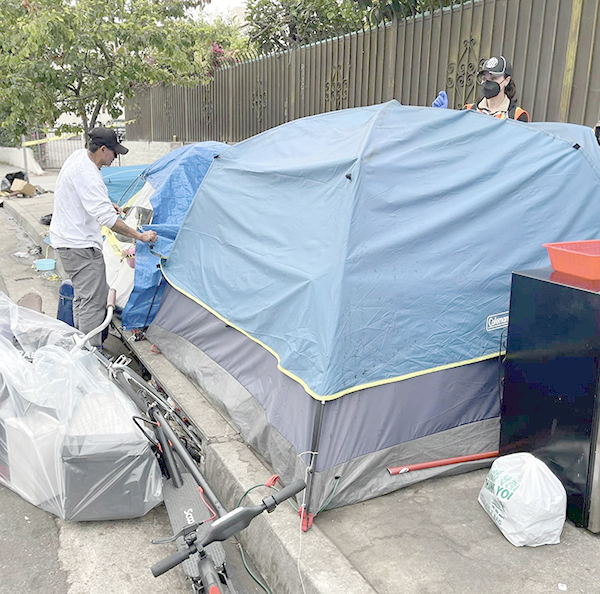
Homelessness has been the runaway, number one public policy worry of L.A. officials for almost two decades. Every mayor and every city official has wrung their hands with promises and projected solutions to get rid of the tent encampments that are tantamount to a city of the dispossessed within Los Angeles.
Mayor Bass has spent nearly all of her first term in office proposing solutions, big funding increases and implementing some initial action efforts to get more people off the streets. But even before she took office, city officials spent tens of millions of taxpayer dollars, tossed up a few encampments and makeshift housing here and there, and repeatedly demanded taxpayers cough up millions on the pledge that these dollars would be used to end homelessness. All the while, many of L.A.’s streets, parks, freeway sidings and underpasses have looked like Kolkata, India.
Bass’ public pledges to tackle the crisis have taken a realistic and comprehensive approach to the problem. It is not a matter of simply putting a roof over the heads of thousands of people on L.A.’s streets or, merely kicking out, not millions, but billions toward fighting homelessness with little to nothing to show for it.
It requires equal investment in drug and alcohol counseling, job and placement, skills training and retraining, child care, nutrition and the ongoing monitoring of service programs to ensure effectiveness.
This is a long, hard, uphill process. Bass understands that.
It will take a mix of ramped-up approaches — strategic spending, land-use changes, housing subsidies and the expansion of support services — to dent the problem.
The homeless crisis does not exist in a vacuum. It has a nefarious twin that is virtually unchecked, even worse in L.A. That is the lack of anything that remotely resembles affordable living spaces. That has done much to further swell the homeless numbers.
There’s one more problem that simply can’t be ignored or minimized. A lot of the dollars that are budgeted and have been spent on combatting homeless have been wasted, or worse, misappropriated. The worst part of this is that often no one knows or will say where the money went and why it was spent the way it was. This is an issue of transparency and accountability.
One homeless advocacy organization has been so enraged by the issue of lax accountability by the Los Angeles Homeless Services Authority that it has filed suit. A spokesperson for the group noted, “If there was a competent agency dedicated to outcomes, transparency, and accountability for the billions spent every year, we may have a glimpse at what should be done to solve this humanitarian crisis.”
That is what the homeless issue is. A humanitarian crisis. It is just that. It must be confronted as such.
That is if city officials do not want to continue to see the city’s homeless numbers march steadily upward.
Earl Ofari Hutchinson is an author and political analyst. His forthcoming book is “Trump’s Obama Obsession” (Middle Passage Press). He also is the publisher of thehutchinsonreport.net.