Wave Staff and Wire Reports
LOS ANGELES — Despite concerns from some hospitals about a possible loss of funding, the county Board of Supervisors voted Aug. 4 to review the way the county allocates revenue from a 2002 parcel tax to area medical centers in light of federal cuts to such facilities and the anticipated loss of Medi-Cal coverage for thousands of residents.
The board unanimously approved a motion by Supervisor Holly Mitchell calling for the hiring of a consultant to review the current formula for allocating funds from Measure B, a voter-approved parcel tax designed to boost funding for trauma hospitals and emergency medical services.
According to Mitchell’s motion, the tax generated nearly $340.6 million in the 2024-25 fiscal year. Through a county formula, the money is allocated annually to county hospitals and medical centers with trauma centers. Any excess funds are then doled out to other private hospitals without trauma centers.
Mitchell contends in her motion, however, that given changing circumstances of federal funding cuts and policies impacting Medi-Cal eligibility, possibly causing a loss of coverage for up to 1.1 million county residents, “it is critically important that Measure B funds be allocated wisely and equitably reflecting the increased pressure on hospital trauma centers and emergency rooms that serve larger populations of Medi-Cal patients and those who lost Medi-Cal eligibility under H.R. 1 (the federal budget bill).”
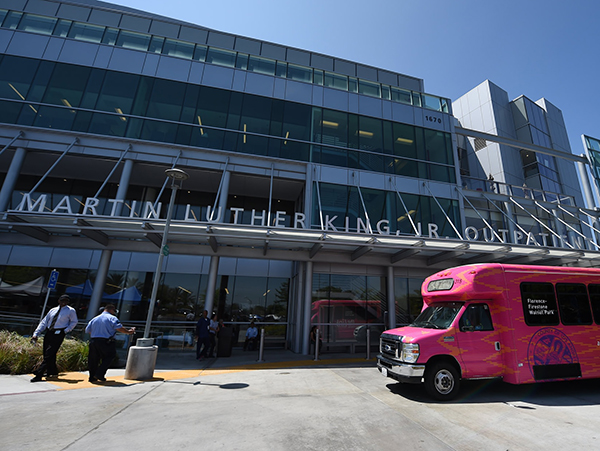
Of particular concern to Mitchell is Martin Luther King Jr. Community Hospital in Willowbrook, a non-trauma center private hospital that has traditionally been left to collect a portion of excess Measure B funds not already allocated to other facilities.
Mitchell spoke at a rally Aug. 4 with representatives and supporters of MLK and other hospitals facing increasing financial pressures.
The supervisor noted the review would the first in more than 25 years.
“We know now that many hospitals with the least amount of funding and resources are currently serving the highest number of emergency room and uninsured patients,” Mitchell said in her remarks. “So, asking for a study is about accountability to the voters who passed Measure B in the first place, and to the millions of us who want to trust that we have access to care when we need it.”
Mitchell emphasized the independent study is to see whether there’s a more appropriate distribution formula to meet the needs of every county resident.
MLK Community Hospital CEO Elaine Batchlor said the facility runs one of the busiest emergency departments in the country, and about 95% of patients are on public insurance or uninsured.
“For these patients, it costs more for us to care for them than we are repaid by insurance, if we’re paid at all,” Batchlor said. “In fact, insurance payments cover less than half of our budget. This creates a structural deficit — one made worse when the federal government passed massive cuts to Medicaid.”
Batchlor urged the county to study Measure B’s allocation formula, warning that if MLK hospital closes the impact will strain other hospitals in the region.
“Now, emergency departments like ours, and Pacifica, and Catalina are in crisis again. The solution, once again, is to think of this as a system, and the path to making it work is an independent study to make sure that those Measure B dollars that were designed to support our hospitals in crisis are going where they are needed most,” Batchlor said.
Community activist Earl Ofari Hutchinson didn’t think the Board of Supervisors’ action Aug. 4 went far enough.
He called the supervisors’ refusal to immediately fund trauma and emergency services at MLK “gross health care irresponsibility.”
The president of the Los Angeles Urban Policy Roundtable, Hutchinson pointed out that Cedars-Sinai Medical Center just outside Beverly Hills receives millions of dollars a year from Measure B funding as part of the county’s trauma network. MLK Hospital receives a percentage of any funds leftover after trauma network hospitals are funded.
“Cedars-Sanai handles an estimated 1,000 trauma cases yearly. King Hospital handles more than 1,500 cases yearly,” Hutchinson said. “Yet Cedars, one of the wealthiest hospitals in the nation, receives tens of millions of county funds for these services. King has received no funding for the same this year.”
Cedars-Sinai received $9.4 million in Measure B funds last year.
“If the supervisors can approve public funds for a wealthy private hospital like Cedars to handle trauma and emergency services but not a nickel for King this can only be called shameful health care irresponsibility,” Hutchinson added. “This puts the lives of hundreds of low-income Black and Hispanic victims in the Watts-Willowbrook area at grave risk.”
Juan Muñoz, a political coordinator with Unite Here Local 11, a hospitality union representing thousands of workers in California and Arizona, told City News Service his union entered a partnership with MLK Community Hospital for health care.
“We cannot afford to lose that hospital … and we think that it’s fair that Measure B be studied, and that we actually look,” Muñoz said. “We got to make sure that taxpayers are getting the most, and we just know that frontline communities need more investment.”
According to Mitchell’s motion, a report by the county CEO in April concluded that the county could consider three options surrounding Measure B funding — maintaining the current formula; allocate increases in ongoing Measure B funding using “needs-based criteria;” or allocate one-time funding using needs-based criteria.
Mitchell’s motion calling for a review of the funding formula sparked opposition from various hospital officials across the area, with most fearing a potential loss of the annual ongoing funding they receive from the measure.
“Ultimately, we believe Measure B funds are already being put to their highest and best use,” Children’s Hospital Los Angeles President/CEO Paul S. Viviano wrote in a letter to the board. “These investments support lifesaving trauma services, sustain specialized capabilities and ensure access to care for some of the county’s most vulnerable patients.”
Mitchell and other board members stressed Aug. 4 that the motion called only for a consultant study of possible adjustments to the funding formula. And they also insisted it was not a signal that hospitals would have their normal funding threatened.
The proposal “does not take resources away from trauma hospitals,” Mitchell said.
Supervisor Kathryn Barger said she was “frustrated” that some hospitals were fearing a loss of funding, insisting that was “not the intent of the motion.”
“I think it is an opportunity for us to hit the reset button and take a look at how we’re allocating” resources, she said.
Supervisor Janice Hahn agreed, saying, “We want to make sure (trauma hospitals) are all healthy and stabilized.”
The motion calls for a report back in 180 days.