By Stephen Oduntan
Contributing Writer
LOS ANGELES — Angelmarie Taylor is trying to finish college without spending much time alone on the campus where she has studied for years.
She coordinates schedules with friends, limits the days she is on campus and prefers knowing someone else is nearby.
It is not how Taylor imagined the final stretch of college at Cal State Channel Islands in Ventura County.
But after years of student activism, disciplinary investigations and encounters with campus police that Taylor says left her feeling watched and unsafe, she has changed how she moves through the university.
“I don’t want to say it’s ruined my life,” Taylor said, before reconsidering. “It has destroyed my life in a lot of ways.”
Taylor’s allegations come amid a broader fight over political expression at California’s public universities — where administrators may draw the line around protests, when police should become involved and whether rules designed to be neutral are experienced equally by the students subjected to them.
For Taylor, a business major who hopes to graduate next spring, the trouble intensified after she became politically active.
As a member of Students for Quality Education, she advocated for affordable tuition and greater resources for Black students and became involved in demonstrations involving survivor rights, labor issues and Palestine.
During one investigation, Taylor said administrators compiled a lengthy report documenting the activities of Black students, including where they walked and what they said.
After another late campus meeting, Taylor said campus police followed her and another Black student organizer as they drove off campus. Fearing officers would learn where they lived, she said they changed their route.
“That was honestly terrifying,” Taylor said.
The encounter Taylor considers the clearest example of being singled out occurred during a labor rally over university budget cuts and possible layoffs. She said officers approached her while she addressed the crowd and warned her about possible arrest, while other speakers were not approached.
For nearly two weeks afterward, she said, she largely stayed away from campus.
Black students account for roughly 2% of enrollment at Cal State Channel Islands. Taylor said students have created “pockets of community,” but outside them the campus can feel “very alienating.”
Mikayla Ellis, a San Francisco State University student and co-chair of the Black Organizing Network Defense for Education who previously organized at Cal State Channel Islands, said Taylor’s experience affected other students as well.
Ellis said university administrators contacted faculty advisers before a Hands Off Students demonstration supporting Taylor, asking whether the event was approved and whether organizers planned to use amplified sound. She also said organizers came to believe administrators were monitoring the Black Student Union’s social media.
In an emailed response to The Wave, Cal State Channel Islands said it does not subject students to heightened scrutiny based on race, viewpoint, organizational affiliation or participation in protected activity.
“The university does not monitor student organizations or social media based on political viewpoint,” university officials said. “Publicly available information may be reviewed, and faculty advisers may be contacted, when necessary for event coordination, operational planning, or campus safety.”
But Ellis said some Black students became nervous about participating in demonstrations because they feared jeopardizing their education.
The dispute comes as the California State University system faces scrutiny over its Time, Place and Manner rules governing campus demonstrations.
CSU says the rules protect lawful expression while allowing campuses to maintain safety and prevent disruptions. The system says restrictions must be content- and viewpoint-neutral and that students have wide latitude to exercise free-expression rights.
Cal State Channel Islands said its Time, Place and Manner requirements also include oversight by a University Response Team intended to ensure enforcement is content- and viewpoint-neutral and applied without regard to race, identity, organization or political perspective.
Critics contend enforcement can have a chilling effect.
Rev. Dr. James Thomas, a professor of Pan-African Studies at Cal State Los Angeles and co-founder of Clergy for Black Lives, said that effect can extend beyond students who actually face discipline.
“The typical Black student just doesn’t want the drama,” Thomas said.
“The thought of being surveilled — even if you are not being surveilled, you think you are,” he said. “That’s just as bad.”
The controversy has reached Sacramento.
Assembly Bill 2551, which cleared the Legislature, would expand reporting on student-conduct violations arising from campus protests and require additional opportunities for students to provide feedback on Time, Place and Manner restrictions and their enforcement.
Melina Abdullah, a professor, longtime organizer and co-founder of Black Lives Matter Los Angeles, testified in support of the legislation this summer, describing it as “a first step towards ending time, place, and manner restrictions that are repressive and harmful to our students.”
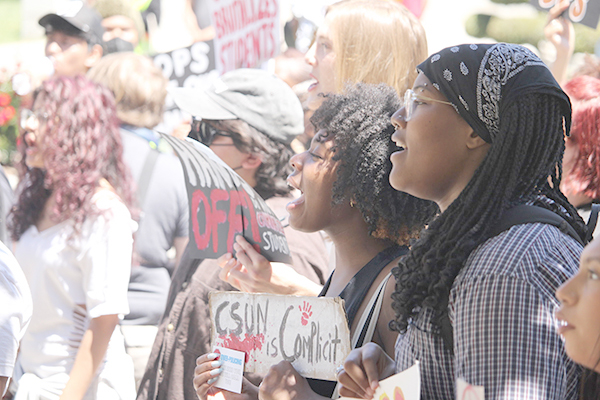
Abdullah was among activists who rallied around Taylor’s case. In April 2025, more than 150 students, faculty and community supporters gathered at Cal State Channel Islands as part of the Hands Off Students campaign, according to the California Faculty Association.
Taylor said repeated investigations affected her academics, employment and ability to participate fully in campus life.
“If I were not politically active,” she said, “I would have graduated already.”
Cal State Channel Islands said students who believe they have been treated unfairly are encouraged to report their concerns through the university’s appropriate review process.
Yet Taylor has not stopped organizing.
Thomas said students challenging institutions should understand that resistance can follow.
“There’s nothing wrong with fighting power,” he said. “But you need to understand that power fights back. Power doesn’t roll over.”
Taylor still hopes to graduate next spring and remain involved in social justice work.
For now, she arranges her schedule around friends, minimizes her time on campus and tries not to be there alone.
The institution she once considered a home away from home has become a place she is trying to get through — and then, finally, leave.
Stephen Oduntan is a freelance writer for Wave Newspapers.