By Stephen Oduntan
Contributing Writer
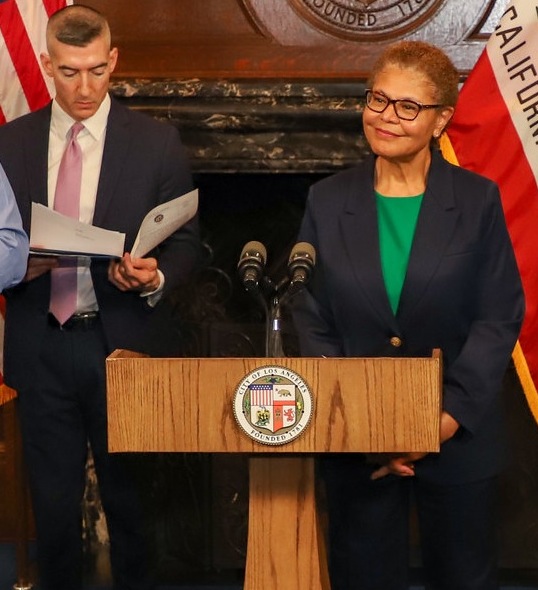
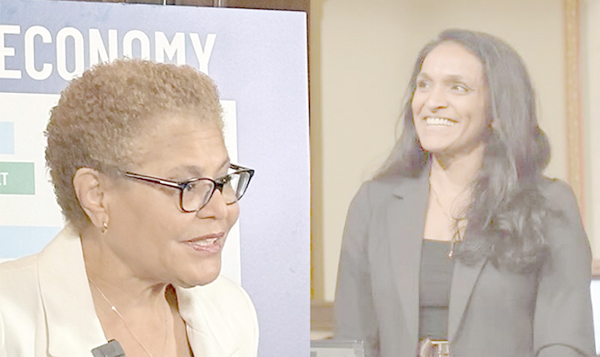
LOS ANGELES — Black community leaders who challenged Los Angeles’ mayoral candidates to put their promises in writing now have something they can measure against the next administration’s record: written commitments from both Mayor Karen Bass and challenger Nithya Raman.
The responses mark a significant development for the L.A. Black Agenda Coalition, which sought more than election-season assurances on homelessness, housing, employment and economic opportunity.
“We thank both candidates for responding to the L.A. Black Agenda,” said Najee Ali, the coalition’s founder.
Bass submitted a six-page letter defending her administration’s record and outlining future commitments. Raman published a nine-page Black Agenda addressing housing, homelessness, reparations, economic opportunity and police accountability.
The responses followed an Oct. 23 deadline set by the coalition, whose eight-page proposal outlined 10 priorities for 2026 through 2030, the end of the next mayoral term. Organizers requested measurable targets for reducing Black homelessness, expanding homeownership and preventing displacement, along with funding plans, implementation deadlines and annual public reporting.
The stakes are considerable. Black residents represent roughly 8% of Los Angeles’ population but approximately one-third of its homeless population.
Bass, the city’s first Black woman mayor, presented her response as an extension of her longstanding activism.
“For me, this work is not new. It is my life’s work. I am the Black agenda,” she wrote.
Her letter cited administration figures indicating that Black workers accounted for 26% of hires through city programs and Black-owned businesses represented more than 17% of businesses winning contracts through ProcureLA.
Bass also pledged to end major homeless encampments by 2030 and to expand opportunities for homeownership through starter homes, accessory dwelling units and other housing initiatives.
One of her most specific commitments is an annual Black L.A. Report Card beginning in December 2027, tracking outcomes by race and ethnicity and identifying initiatives as completed, on track or behind schedule.
That promise addresses a central concern raised by coalition members, including Earl Ofari Hutchinson, president of the Los Angeles Urban Policy Roundtable, who previously called for grading elected officials on their performance.
But Bass did not provide specific numerical targets for reducing Black homelessness or increasing Black homeownership by 2030.
In written responses to The Wave, Jasmyne Cannick, a senior adviser to the Bass campaign, said such targets must be grounded in reliable data, available funding, implementation capacity and cooperation among government agencies.
“Providing a precise figure without that foundation would be misleading,” Cannick said.
She emphasized that the administration remains committed to reducing Black homelessness and disparities, with measurable progress and transparent reporting.
“Accountability requires explaining how a number would be reached, not simply supplying one,” she said.
The campaign identified Measure A, Measure ULA and government grants as potential funding sources, while acknowledging that spending restrictions and decisions by other agencies affect what City Hall can deliver.
Raman’s agenda proposes first-time homebuyer assistance, affordable housing development, protections against displacement and expanded contracting opportunities for Black-owned businesses.
It also addresses reparations, environmental justice, unarmed crisis response and police accountability.
On homelessness, Raman proposes cutting encampments in half before the 2028 Olympics, expanding prevention programs and auditing spending. She has cited a substantial reduction in street homelessness in her council district as evidence of her approach.
Her agenda does not specify how many Black Angelenos would be moved out of homelessness or how many additional Black households would become homeowners by 2030. It also lacks comprehensive funding allocations and an annual Black-specific report-card commitment.

Liz Garcia, a spokesperson for Raman’s campaign, directed The Wave to the candidate’s published Black Agenda, which outlines proposals addressing the coalition’s priorities. The campaign did not provide further on-the-record answers to questions about Black-specific numerical targets, funding allocations and annual reporting before press time.
Hutchinson, who reviewed both candidates’ responses, said their proposals substantially embraced the coalition’s priorities.
“Bass and Raman are in lockstep on one part of the Black Agenda. They endorsed it,” he told The Wave.
He said both cover issues ranging from Black unemployment to homelessness, with relatively minor differences in their stated support.
For Ali, securing Raman’s written commitments was especially important because Bass already has a longstanding relationship with Black Los Angeles.
He praised Bass’s history of activism and said the coalition wanted an agenda on record should Raman become mayor. Ali emphasized that the coalition is not endorsing either candidate.
Asked about the absence of specific numerical targets, Ali described the omission as insignificant at this stage, arguing that achieving results requires cooperation among City Hall, the City Council and community organizations.
He identified Black homelessness as the coalition’s most urgent priority.
Hutchinson, meanwhile, said written promises are only the beginning.
“The problem is fulfillment and a timetable for fulfillment and tangible proof of fulfillment,” he said.
He called for regular meetings, town halls and detailed progress reports from the mayor’s office, monitored by Black community organizations.
“In the end, the burden and the job to hold Mayor Bass or Mayor Raman accountable must fall to the leaders and organizations that put forth the agenda.”
Stephen Oduntan is a freelance writer for Wave Newspapers.