By Steve Appleford
Contributing Writer
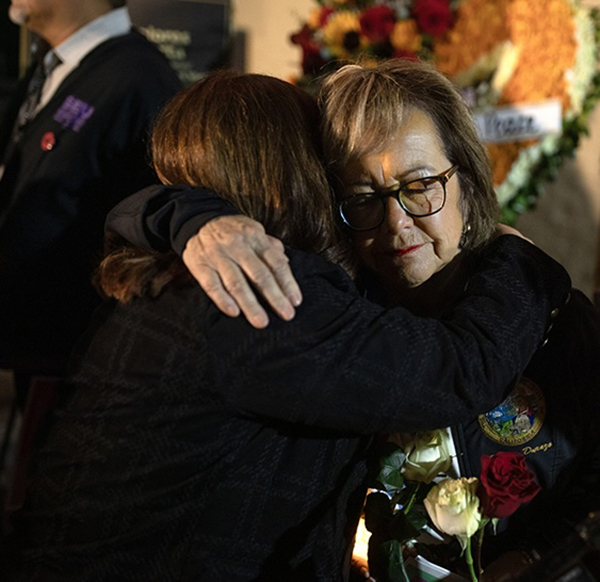
LOS ANGELES — At a vigil in downtown Oct. 28 for Dolores Huerta, mourners gathered to remember the veteran labor organizer and civil rights activist with affection and awe. Behind the small crowd of dignitaries loomed a seven-story mural depicting Huerta as a young organizer, arms crossed, her face composed with quiet strength.
There were tears and speeches from politicians and activists, along with repeated chants of the slogan Huerta popularized decades ago: “¡Sí, se puede!” (“Yes, we can!”).
In the early evening dusk, hours after her death at age 96 from cancer, speakers recalled her role as a founding leader of what became the United Farm Workers union, and her decades of work advocating for immigrants’ rights, women’s rights and reproductive freedom.
During the speeches, one biographical detail kept coming up: her size.
At 5 feet tall, Huerta became a vibrant symbol of the power of an individual to make meaningful change.
“She didn’t rely on her size. She relied on her inner strength,” her friend, state Sen. María Elena Durazo, D-Los Angeles, said in an interview a few days later. “How else do you convince farmworkers to take on agribusiness? She convinced them by showing them that they had power they never thought they had.”
Huerta and César Chávez founded the National Farm Workers Association in 1962, seeking to organize California’s migrant farmworkers, who often labored in brutal conditions for extremely low wages. In 1965, the association joined Filipino farmworkers who had launched a strike in the grape-growing town of Delano. The ensuing strike and nationwide consumer boycott helped bring the plight of farmworkers to national attention and led to the creation of the UFW.
“She was very good at getting people to think critically about the issues and enabling them to find their own agency in trying to affect change,” said Veronica Terriquez, director of the UCLA Chicano Studies Research Center. “She was an organizer, a strategist, and she also played a role in negotiating the contract. She will be known as one of the greatest civil rights leaders in United States history.”
During her decades of protests, picket lines and labor actions, Huerta was arrested 22 times, and physically attacked by law enforcement and strikebreakers.
Filmmaker and playwright Luis Valdez, who was on the front line of the movement in the 1960s, saw Huerta thrown off a Los Angeles loading dock and fall hard to the ground.
“I thought she was hurt, but she popped up, climbed up on the dock and confronted her attackers,” Valdez said.
In that first decade of organizing in the 1960s, the stakes were high for workers in the fields and orchards. It was backbreaking work amid the elements and toxic pesticides, often with no easy access to water and other basic needs.
“Women were out there with no bathrooms in the fields,” Valdez said. “They had to squat behind the cars in order to do their business. That kind of disrespect already was endemic to the farmworkers’ life and agribusiness in general.”
Lesser known was Huerta’s interest in the arts and how they might help the movement. She was instrumental in bringing Valdez’s El Teatro Campesino into the union in 1965, where it performed political sketches for workers in the fields and on the picket line, helping to communicate its message more effectively.
“She saw right away the value of what theater could do for people,” said David Alvarado, director of the documentary “American Pachuco: The Legend of Luis Valdez,” released this year, which included an interview with Huerta. “Some of these farmworkers couldn’t read or write, so pamphlets and intellectual stump speeches about the value of political pressure could only go so far.”
Valdez noted that Huerta was a listener to jazz records by John Coltrane and Miles Davis, and was a dancer and majorette early in life.
“To some extent, those qualities remained part of her life — she was very much a majorette in that sense,” Valdez said, “the leader of the pack, the one who continued to stoke the fires of the movement.”
The mural of Huerta, unveiled in April in time for Huerta’s 96th birthday and titled “Walking Into History,” was painted by Robert Vargas, who attended the Oct. 28 vigil. Vargas has painted multiple murals around the city, depicting cultural heroes like pitcher Fernando Valenzuela with a trio of images overlooking Boyle Heights and rocker Eddie Van Halen in Hollywood.

But his tribute to Huerta near 4th and Main streets in downtown was especially personal. When she was in L.A., she would visit Vargas at the site, and they would have tacos together a few steps from the mural-in-progress.
“When she spoke and gave you a call to action, you were ready to march, right then and there,” he said with a laugh. “At the same time, there was a humanity, a softness to her. And I got to know that person as well.”
In March, generations of admirers of the UFW were shaken by revelations, reported by the New York Times, that Chávez had sexually abused underage girls and women, including Huerta. The article documented multiple accusations of rape, and reported that Huerta bore two children from the assaults. Huerta was interviewed and quoted about the assaults, and said she had remained quiet to protect the movement.
“She called me before the news broke,” Valdez said. “She wanted to let me know that this was coming out in the New York Times and that some of the allegations were true. It was a shock to me. She said it was going to be tough, but ‘I’ll have to face the music.’ She didn’t shy away.”
One of Huerta’s later public appearances was at the Los Angeles premiere of “American Pachuco” in July. Just before the screening, she told Capital & Main of her work, “The whole idea about organizing was to get them to have the stamina and the courage to stand up for themselves.”
Huerta taught that lesson to generations of activists, including Durazo, who first met the UFW founder while an organizer with UNITE HERE Local 11.
They became close over the years, and occasionally differed in their opinions.
“A good friend means that you have disagreements, and I had lots of disagreements with her,” Durazo said. “She would scold me and then a month later we’d be dancing on the floor at a wedding together.”
Steve Appleford writes for Capital & Main, a Los Angeles-based nonprofit publication focused on inequality. It is published here with permission.