By Erin Aubry Kaplan
Guest Columnist
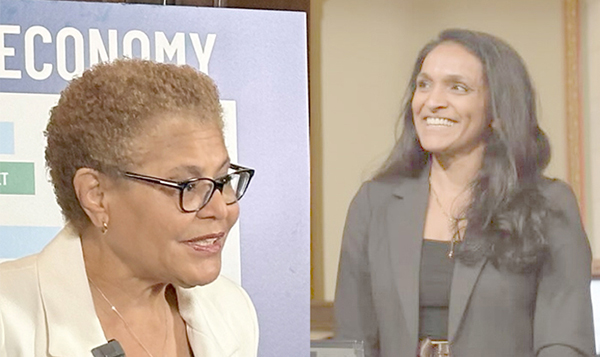
On a recent hot afternoon in the Crenshaw district, at an intimate African-themed community center that dates back to the 1960s, a group of seasoned Black activists and concerned citizens met to discuss the mayoral race in L.A., a showdown between incumbent Karen Bass and challenger Nithya Raman that is now in its final weeks. Bass had been flagging in the polls, and the conversation was about how she might regain momentum at this late date.
The unspoken consensus at the meeting was that Bass is Black L.A.’s candidate, reflected in part by the mayor’s endorsements by a long list of noted Black organizations, ministers, elected officials and grassroots leaders. Nonetheless, as the meeting progressed, a bigger question surfaced, almost as a side note: Does Bass deserve Black support?
After a pause, a few people acknowledged Bass has not been as attentive to the concerns of Black communities as they would have hoped. The comments hung in the air and then the main discussion resumed. There seemed to be little appetite at this point to try and square any criticism of Bass with the desire to see the city’s first Black female mayor win a second term and, as Bass puts it, finish the job. While people freely acknowledged dissatisfaction, they also wanted to stay the course.
Not staying the course has been a frequent theme of this mayoral campaign, painted by Bass detractors as an electorate fed up with the declining quality of life in an impossibly expensive city looking for a new way forward. Media outlets from the New York Times to the Guardian have focused on Bass’ opponent and former ally, Nithya Raman, and the latter’s affiliation with the Democratic Socialists of America, raising the prospect that she could replicate in L.A. what Zohran Mamdani did in the New York City mayor’s race last year.
Mamdani, who is of Indian descent and Muslim, won by creating a coalition advocating for affordability and services across racial and political lines.
Raman, who is also of Indian descent, is trying to do something similar by pitching herself as the candidate attuned to urgent citywide problems that people want addressed, now. The twist is that her opponent is another woman of color whose political agenda mostly overlaps with Raman’s but who is nonetheless lagging in the polls — unusual for an incumbent.
That’s the surface story. The deeper narrative — about the racial dynamic that helped put Bass in office four years ago as the city’s first Black and first woman mayor — is less sexy, but still important.
Four years ago, with the country still in the tailwinds of the George Floyd racial justice movement, Bass made history by defeating Rick Caruso, the white, wealthy Republican and independent-turned-Democrat businessman and civic figure who outspent her five to one. Though Bass never lagged in the polls, the victory was still seen as David beating Goliath, and a boost for Black equity.
The guarded euphoria of Bass’ Black supporters in 2022 has since cooled to staying the course. But that’s typical.
Historically, Black people have often had to weigh a full slate of ideals against the reality of a candidate actually fulfilling them; in measuring success they tend to look at percentages, not ideological purity. Bass is no exception. And in 2026, retaining a Black mayor is more than relevant in a city where the Black population is shrinking — down to about 8% today from a peak of 18% in 1970 — and losing local representation.
Case in point is the race for a City Council seat in the 9th district in South L.A., a longstanding Black electoral stronghold that will not have a Black council member for the first time in more than 60 years. In that sense, Bass looms even larger now than she did four years ago.
At the same time, Bass, by virtue of being mayor, has become part of a larger fight against the anti-blackness of Donald Trump, who has continually disparaged Black Democrats and the cities they lead, Black women and California leaders and elected officials in particular. Bass checks all three boxes, not to mention she represents the largest number of constituents among all Black-led cities in the country.
So overt is this denigration that Trump recently suggested, less than half-jokingly, that if Iran wanted to attack the U.S., “They can take out a city. Let them take out L.A. Let them take out San Diego.” (Though he walked back the comments later, it was hardly a mea culpa.)
The recent Justice Department raid of the home of Somali-American U.S. Rep. Ilhan Omar of Minnesota speaks volumes about the contempt in which Trump holds Black women, especially those in elected office who dare to criticize him. He has repeatedly insulted Omar’s African heritage, last year calling Somali Americans “garbage.”
It’s part of a pattern of Trump impugning high-profile Black women he sees as enemies, from Federal Reserve governor Lisa Cook to Fulton County, Georgia, D.A. Fani Willis. Vice President J.D. Vance recently said that Angie Nixon, a Black Democrat running for U.S. Senate in Florida, is a radical who should leave the country because “she doesn’t belong in America.”
Things didn’t start off this way. Back in 2023, new mayor Bass told PBS that she had decided to run after seeing up close the devastation of the crack epidemic of the 1990s. She said she wanted to head off another growing Black-centered crisis — homelessness — that would be criminalized instead of treated as a problem to be solved.
She worried about normalizing the fact that Black people were a third of unhoused people in Los Angeles despite being less than 10% of its population, and pointed out factors contributing to that statistic, such as the staggering loss of Black wealth during the home ownership meltdown of the Great Recession.
And then the political picture changed drastically. In 2023, the Biden administration was interested in helping to address homelessness; since Trump’s return, the GOP has moved in the opposite direction by normalizing, if not actually criminalizing, homelessness — exactly what Bass feared. An executive order in July 2025 replaced Biden’s expansive approach with a vision of quashing homelessness by “Ending Crime and Disorder on America’s Streets.”
While many Black Angelenos think Bass has been unfairly blamed for problems and events beyond her control, notably the Palisades fire, there is nonetheless discontent about what’s seen as her executive inefficiency and her inability to carry out priorities.
“Management and oversight has been a complete failure,” said Mike Guynn, a longtime South Los Angeles resident and board member of the L.A. chapter of the New Frontier Democratic Club, a Black Democratic organization. “Not enough structure and controls.”
He also thinks her initial push for big social change around homelessness, though admirable, was unrealistic.
“She had a vision, but she got so consumed with it she neglected other things,” he said.
As for Raman, Guynn believes she offers an alternative but “talks too much about what Karen hasn’t done” while being guilty of neglecting her own council responsibilities.
Beyond that dissatisfaction, concern over the larger picture of anti-Blackness in the country and Bass’ role in standing up to it may be why Black voters don’t appear to be shifting, at least in any public or vocal way, in great numbers toward Nithya Raman. Recent polling shows Raman has gained significant support from Latinos, but public polling on the views of Black Angelenos has been scarce, making it hard to tell which candidate might be successful in building the kind of multicultural coalition that propelled Mamdani to victory in New York.
On Pct. 25, Raman announced her endorsement by the Black Los Angeles Young Democrats and the release of her campaign’s Black agenda that promises to address gentrification and bolster Black businesses, among other things. It comes in the aftermath of controversial remarks Raman made during a recent mayoral debate about former Police Chief Daryl Gates, whom she credited with instituting “the gold standard in terms of noncooperation with immigration enforcement.”
Anger erupted among many Black leaders who see Gates’ legacy as one of entrenched racist policing that ultimately failed the city. Raman later apologized.

It’s useful to remember that L.A. and New York, though similarly diverse, are not the same place and that building durable coalitions here is tough, sometimes unrewarding work that requires patience. As Jim Newton recently observed in a CalMatters opinion piece, Bass does well with older migrant communities — communities that Councilman Marqueece Harris-Dawson says includes Black folks who migrated here from the South who equated L.A. and its promise of single-family homes and more personal freedoms with what the piece described as “liberty itself.” In contrast, Raman does better with younger people, many of whom are newer arrivals (this includes Raman, who moved here in 2013) who don’t mind denser housing and who aren’t wedded to more traditional concepts of the California Dream.
But ethnic constituencies in L.A. do matter, and no one seems more aware of this than Bass. While those constituencies can become a political coalition, as the Black and Jewish communities did in the 1960s and ’70s during Tom Bradley’s heyday, they can also fray over time.
At a candidate interview last month sponsored by Jewish groups in the San Fernando Valley, Bass declared, “I will always protect the Jewish community.” Last summer, she stood up for embattled Latino immigrants during the ICE invasions.
While tackling homelessness she has taken on an entrenched problem that disproportionately affects Angelenos who are Black, some observers say Bass has not been as present in Black communities as she has been in others — ironic considering that she began her coalition-building career as an organizer in the early 1990s in the heart of what was then very Black South Central L.A.
Observers also point to Bass’ and Raman’s divergent views on political issues that go beyond Los Angeles but are increasingly important to Black voters, like Israel and Palestine. At the Valley event, Raman stood firm in calling Israel’s war in Gaza a genocide, while Bass rejected the term.
Still, it remains unclear whether Raman and her supporters have built the kind of multiethnic coalition necessary to win. Black ties with the Democratic Socialists of America actually go back decades. Co-founder Michael Harrington met Martin Luther King Jr. in the 1960s, as King was moving closer to outright socialism in his calls for poor people of all colors to prioritize domestic spending over war. Harrington, author of “The Other America” — a popular treatise on the poor — advised King on his Poor People’s Campaign, the last and most ambitious campaign of King’s life.
But maybe embracing socialism isn’t really a useful way to gauge the desire for change among people of color. In its analysis of New York City’s 2025 mayoral election, the Manhattan Institute noted that “Mamdani’s large margins with Latino and Black New Yorkers do not make those communities ‘socialist.’ Rather, their support signals a profound alienation from local politics, a sense of being unheard on issues such as rent, wages, transit and groceries.”
Guynn, with the New Frontier Democratic Club, points to one big-picture reality that doesn’t work in Bass’ favor: The 73-year-old mayor is part of the ongoing struggle among Democrats to reinvent the party at a watershed moment.
“Karen has her own progressive ways, but she’s still entrenched with the old Democratic Party,” Guynn said. “She represents the problem with the party at large — caught between what it needs to be now and what it’s traditionally been.”
That problem is most critical for Black people, the backbone of the party who’ve had to watch Democrats’ mostly ineffectual response to the GOP’s open assault on diversity and civil rights.
Guynn expects a victory for Bass nonetheless, though with a small ‘v.’
“She’ll pull it off, but it won’t be a mandate,” he said.
Not the stuff of euphoria. But nobody, especially Black Angelenos, expects that anymore.
Erin Aubry Kaplan examines the persistent barriers to racial justice and opportunities for progress in an era of receding Black presence in Los Angeles and California for Capital & Main, a nonprofit publication focused on inequality. It is published here with permission.