By Stephen Oduntan
Contributing Writer
CRENSHAW — A coalition of Crenshaw Corridor residents, business owners and community leaders has formally demanded that Destination Crenshaw be completed within a year, calling on Los Angeles City Council President Marqueece Harris-Dawson to establish a public construction timeline and provide financial relief for businesses and residents affected by years of delays.
Those demands, outlined in a letter delivered Aug. 5 to Harris-Dawson, come less than a week after hundreds of residents packed a town hall at Bethesda Temple Church, where business owners, educators, clergy and community advocates described how prolonged construction has disrupted daily life, hurt businesses, reduced school enrollment and eroded trust in one of South Los Angeles’ most ambitious public art and infrastructure projects.
Among the coalition’s requests is the creation of a Business Interruption Relief Fund for merchants, churches, entrepreneurs and property owners who say they have suffered economic losses during construction, along with a Residents Relief Fund for people living along the corridor who have experienced restricted access, property impacts and other disruptions.
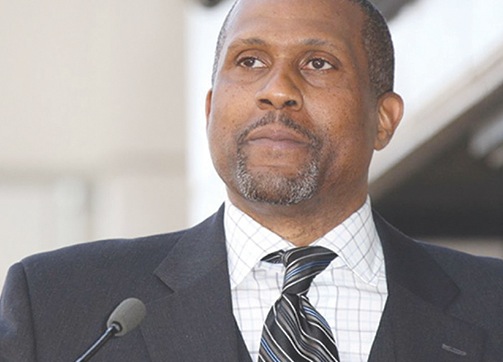
“The Crenshaw Corridor community is angry, organized, and demands immediate action,” Tavis Smiley, who moderated the July 30 town hall and helped organize the coalition, said in a statement. “Now is not the time for more excuses or empty promises. We need real leadership to resolve this deeply troubling issue.”
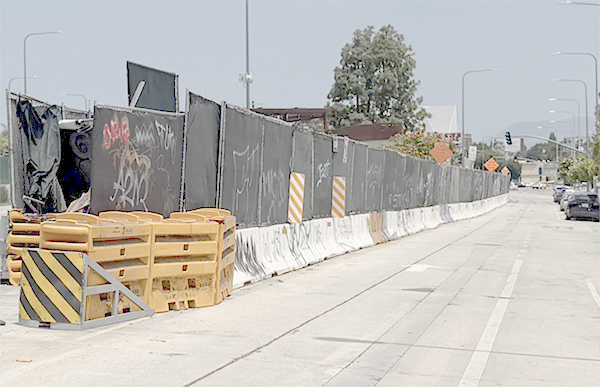
According to the letter, businesses have closed, residents have struggled to access their homes, seniors have been forced to walk longer distances because of parking restrictions, and neighborhoods have been left coping with unfinished construction and deteriorating conditions for years.
Those concerns mirror what Pastor Kyron Shorter of Bethesda Temple Church heard from residents during last week’s town hall, which his church hosted. He said the community is no longer satisfied with general assurances that the project is moving forward.
“We’re owed more than the same old talking points,” Shorter said. “Accountability means some concrete timelines — start and completion dates … some transparency on the funding. Where is the money? What needs to be done to reach these next steps? Where’s the communication strategy?”
Shorter said Bethesda Temple Church has spent years trying to operate around barricades, parking restrictions and limited access. Although Destination Crenshaw says construction has resumed at Sankofa Park, he said he has seen little evidence of meaningful change since the town hall.
“We’re not hating on Destination Crenshaw,” he said. “We’re for the beautification of Crenshaw, but we are also for accountability.”
He said the church has continued to attract new members despite the prolonged construction, but the project has limited its ability to fully serve the congregation through funerals, revivals and other community programs.
The effects of the prolonged construction have also been felt beyond churches and businesses.
For Jennette Parker, CEO of Today’s Fresh Start Charter School, the project’s greatest cost has not been traffic or parking — it has been its impact on education.
Parker said years of construction have contributed to the loss of hundreds of students as barricades, blocked visibility and restricted access made it increasingly difficult for families to find and reach the campus. The enrollment declines, she said, have forced reductions in staff and school programs.
“Good intentions don’t bake the whole cake,” Parker said. “The cake has to have certain ingredients. You’ve got to have a plan. You’ve got to have an actionable plan that other people participate in. … Whatever plan they have, it’s not working.”
She questioned whether the educational needs of neighborhood children were ever adequately considered during the project’s planning.
“They don’t even think about the children,” Parker said.
She said she hopes any discussion about Destination Crenshaw keeps the focus on what the project has meant for students.
For community organizer Sikivu Hutchinson, last week’s town hall represented the culmination of years of rallies, meetings and advocacy aimed at securing greater accountability.
Hutchinson said the Women’s Leadership Project has held rallies outside Harris-Dawson’s district office, met repeatedly with his staff, submitted proposals to Destination Crenshaw and advocated for youth programming along the corridor since 2023. Those efforts, she said, have produced little meaningful response.
“This kind of delay, this kind of inaction, this type of utter abdication of responsibility would not happen on the Westside,” Hutchinson said.
She said her organization initially sought investments in youth programming, workforce development and safe public spaces for Black girls and LGBT youth, but those priorities never materialized despite years of advocacy.
Hutchinson said residents deserve a clearer accounting of the project’s finances and a better understanding of what remains before construction can finally be completed.
“Where did the money go?” Hutchinson said. “That’s the unanswered question.”
Civil rights attorney and lifelong Leimert Park resident Kamilah Moore said she believes restoring public trust will require more than simply finishing the project.

Moore acknowledged that Destination Crenshaw began with broad community support and said unforeseen events — including the COVID-19 pandemic and the death of Nipsey Hussle, an early supporter — may have complicated the project’s progress. But she said those challenges make transparency and regular communication with residents even more important.
“I do have grace for the project because I do know … there was community input at the beginning stages,” Moore said. “But between 2016 and now … something happened.”
Moore said if Destination Crenshaw still needs additional fundraising to complete the project, leaders should communicate that openly instead of allowing residents to speculate.
“If that’s the ask, don’t just leave that in a social media comment,” Moore said. “Come to town halls and ask. Create your own town hall and make that formal ask. Create a formal campaign to get this over the finish line.”
She said residents are no longer looking for generic assurances that officials understand their concerns.
“It would be better if there was an action item with that statement,” Moore said. “We’re taking your concerns seriously, and this is how we’re taking them seriously.”
Five years after construction began, Moore said the community is still waiting for one basic answer.
“When will it finally be complete?”
In a statement provided to The Wave, Destination Crenshaw Chief of Staff Terrii Young said construction is continuing on the project’s remaining phases.
“Construction is moving forward and crews are on site to complete the final phase of work at Sankofa Park,” Young said. “We are also working hard to get construction at the Crenshaw Wall started.
“We hear the community’s frustration and are grateful to our neighbors for their patience, partnership, and continued support, despite the impact of an extended construction timeline,” Young added. “We remain committed to raising the funds needed to complete the remainder of the project and cement the history, identity and achievements of Black L.A. for generations to come.”
A spokesperson for City Council President Marqueece Harris-Dawson said the office was preparing a response to The Wave’s questions but was unable to provide it before the newspaper’s deadline.
Harris-Dawson did send an email to the news website The LA Local, saying “The concerns of businesses and residents in the Crenshaw District are critical, and my office will work with Destination Crenshaw to address them. This project started with several community meetings and community input, and to be successful, we need our neighbors to know and feel that this project is for them and to build a prosperous future.”
Stephen Oduntan is a freelance writer for Wave Newspapers.