By Robin Urevich
Contributing Writer
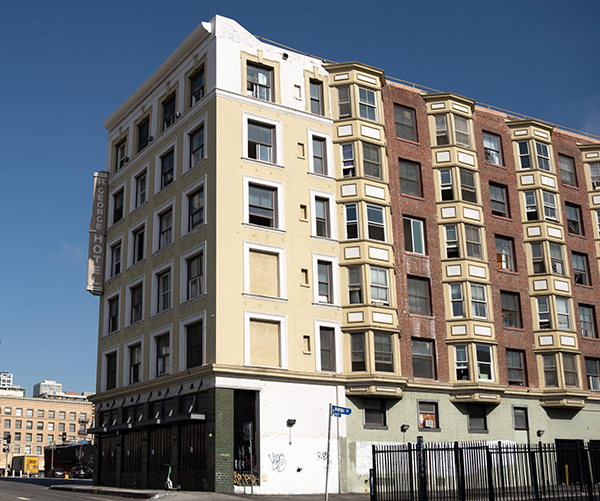
LOS ANGELES — In late July, city inspectors slapped a notice to vacate on the 120-year-old St. George Hotel, saying the property was “substandard, unsafe, unsanitary, and dangerous.”
The six-story Beaux Arts-style building just blocks from City Hall housed formerly homeless people, many of them older, disabled or with mental health issues. Fire doors were missing. Plumbing fixtures were clogged or absent. The property was dilapidated and improperly maintained, according to the notice.
Some former residents are now homeless after the building was vacated. The condition of the building — and the displacement of residents — has raised questions among tenants and housing activists about the St. George’s owners’ ability to manage their portfolio of more than 1,100 downtown residential hotel units and whether L.A. housing officials can effectively oversee them.
Two years ago, Beverly Hills developer Leonid Pustilnikov and several partners bought the St. George and 16 other run-down buildings previously owned by the failed Skid Row Housing Trust. That nonprofit organization had been lauded for renovating downtown L.A.’s dwindling supply of crumbling single room occupancy hotels beginning in the late 1980s. But three years ago, the trust announced that for years its operating costs had exceeded revenues and it could no longer afford to stay in business.
A year later, a court-appointed receiver organized the sale of the trust’s properties, and Pustilnikov and his partners stepped up. They formed Hope for an Affordable LA LP, a for-profit company to operate the buildings, and promised to make them clean and safe.
But they haven’t done so, records and interviews show.
Capital & Main interviewed six former St. George tenants who said conditions had worsened in the past two years. Los Angeles Housing Department records reviewed by Capital & Main show city inspectors thought the property had become more dilapidated under the company’s watch.
In a Sept. 23 email to the Legal Aid Foundation of Los Angeles’ Director of Housing Justice Barbara Schultz, which was viewed by Capital & Main, L.A. Housing Department Director of Enforcement Operations Robert Galardi said the St. George “has significantly deteriorated since the time of the receivership.”
Residents said bedbugs and roaches roamed freely and black mold appeared along the walls. Squatters and vandals entered the building at will, threatening residents’ safety, they said.
Hope for an Affordable LA’s Pustilnikov said he was unavailable to answer questions and referred Capital & Main to CEO Adam Kent.
Kent said in an interview that he was caught off guard by the city’s notice to vacate because he’d been working with inspectors to address code violations.
“We don’t want our building to burn down,” he said. “We don’t want to endanger lives. We’re not interested in hurting people.”
For months before the notice to vacate was issued, tenants said, managers pressured them to move, offering alternative housing or cash in exchange for voluntary agreements to vacate. Managers told the tenants they’d have to clear out soon anyway for a planned remodel for which Hope for an Affordable LA was awarded state tax credit financing last December.
Company records provided to the city and reviewed by Capital & Main show about a dozen tenants had moved by the time the notice to vacate was posted.
Still, the notice — which gave tenants 10 days to move out and was issued in late July and extended twice until Aug. 21 — touched off panic and confusion among the 17 tenants who remained at the St. George, many of whom had lived there for years.
The notice required Hope for an Affordable LA to either temporarily relocate tenants until they could return to the St. George or pay them relocation benefits.
“We were all freaking out,” said Rick Harker, who had lived in the building for nearly 20 years.
Some residents opted to move to other Hope for an Affordable LA buildings on Skid Row, where sidewalks are lined with people living outdoors in tents and makeshift shelters, the crime rate is high, and drug use on the streets is common.
Harker feared moving to the area, which is a few blocks from the St. George but louder and more dangerous.
“It’s like the apocalypse down there,” he said.
At least five of the St. George’s former residents — including Harker — are now homeless.
Now, tenants and housing activists worry about whether the St. George and the 16 other affordable buildings owned by Hope for an Affordable L.A. will be preserved for the low-income people who need them, especially amid the current housing shortage. Former residents pointed to the chaotic move-out, dangerous and unsanitary living conditions and what they described as disrespectful treatment by managers.
At stake are more than 1,100 units of critical housing for residents that might otherwise be on the streets. With more than 45,000 Angelenos living in tents, cars and shelters, the dwellings are a scarce resource for the city and its most vulnerable residents.
Addressing housing and homelessness has been one of Mayor Karen Bass’ top priorities. In 2023, she led efforts to save the former Skid Row Housing Trust properties after the trust could no longer operate, saying at the time their loss would be “devastating.”
A spokesperson for Bass didn’t respond to questions about city oversight of the St. George and the other Hope for an Affordable LA buildings. And a Housing Department spokesperson declined to answer detailed questions about the situation at the St. George and how the city handled it.
Kent said his company “worked hand in hand” with the Housing Department to relocate or compensate tenants.
“If the people are homeless, it’s a sad result,” he said, “and I think it’s a failure in the system. You know, and we are part of that system, but we can only do so much.”
Byron Wilkerson, 68, said he faced a difficult choice when he learned of the notice to vacate: Move to a Skid Row building where he didn’t feel safe or accept a $27,400 payout and forfeit his right to return to the St. George after it’s renovated.
“I told them on day one: I’m not moving back to Skid Row,” Wilkerson said. “I’m dealing with mental health issues.”
Jade Arellano, an organizer with the Skid Row tenants rights organization Los Angeles Community Action Network, said that on the day the notice to vacate was set to expire, city Housing Department officials promised no one would be forced out.
On Aug. 21, Housing Department General Manager Tiena Johnson Hall emailed LA CAN’s Director Pete White saying that tenants who had not yet selected a replacement unit or accepted relocation funding “will be moved to a hotel facility at the current owner’s expense” or “remain in temporary housing until they have selected a new unit or a relocation option,” according to correspondence reviewed by Capital & Main.
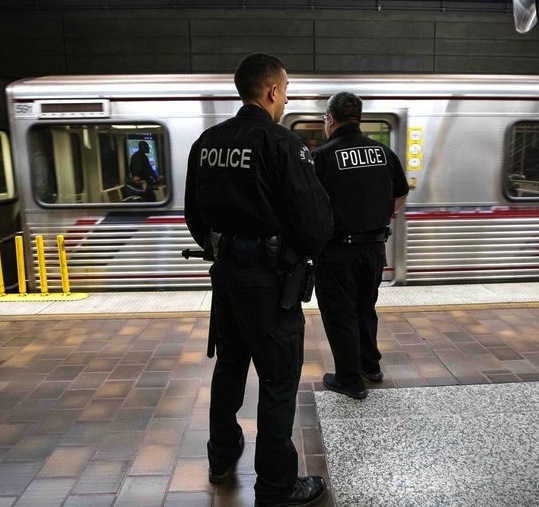
But the next day, Hope for an Affordable LA’s managers, accompanied by Los Angeles Police Department officers, demanded they leave, Arellano said.
Wilkerson said when he returned from an errand the next day, police officers refused to let him in his room. After Wilkerson said he needed medication, the officers finally allowed him to retrieve it.
“I have a gang of health issues,” Wilkerson said. He said he reluctantly accepted the relocation payment, even though he had nowhere else to go.
Housing Department General Manager Johnson Hall didn’t respond to Capital & Main’s questions about the treatment of St. George tenants.
LAPD spokesperson Alondra Garcia confirmed that officers responded to a report of four suspected trespassers at the building; she said they determined the call was “a civil matter” and made no report.
“We got treated bad,” Wilkerson said. “It was no respect at all. I was just lucky I went and got my medications.”
Wilkerson is now homeless and working with a social services agency to find a place to live.
Yvette Valenzuela, who said she lived at the St. George for seven years, is also homeless after she said officers insisted she leave the building on Aug. 22. Both the building owners and the Housing Department said she’d given up her tenancy the year before, but she said she did not.
Harker, for his part, accepted relocation funds before the move-out deadline. He used the money to buy a car so he could work as a food delivery driver, and now it’s his only shelter.

“I have $9 in my bank account,” Harker said.
The Legal Aid Foundation’s Schultz said in an email to Capital & Main that about a dozen tenants — including some who had moved in the months before the order to vacate — were not provided either a comparable unit or adequate relocation benefits.
Hope for Affordable LA CEO Kent said the company made “every effort” to find replacement housing for St. George tenants.
“In no way do we benefit from having more people on the streets and pushing out residents and getting, you know, bad PR from tenants’ rights groups and getting into fights with people,” Kent said.
Pustilnikov’s 17-building purchase included some of the most severely distressed properties the Skid Row Housing Trust had owned. Other developers had opted not to buy them. But Kent said Pustilnikov — who has previously invested in mostly market rate properties — wanted to purchase the Skid Row Housing Trust buildings because “he wants to bring a solution” to L.A.’s homelessness problem.
“I think he just likes complex problems,” Kent said, noting that he and his partners had secured state tax credit financing to renovate the St. George and three other buildings.
City housing officials agreed not to oppose the sale of the former Skid Row Housing Trust properties to Hope for an Affordable LA on the condition that Pustilnikov address longstanding code violations at five of the buildings, including the St. George. Under the agreement, the city can petition a court to place the buildings in receivership again if Pustilnikov fails to comply.
Kent said he and his partners have complied and blamed vandalism for some of the building’s unsafe conditions.
Housing Department spokesperson Sharon Sandow confirmed that at least one building code violation case that Pustilnikov committed to resolve at the St. George remained open at the time the building was declared unsafe for habitation.
Because of violations cited in that case — including damaged fire doors; missing smoke detectors; clogged plumbing; and damaged floors, doors and windows — the St. George remains in the city’s Rent Escrow Account Program, according to a September list released by the Housing Department. That program allows tenants to pay reduced rent to a city account until landlords bring their buildings up to code.
Meanwhile, dozens of additional complaints of building code violations have been reported since Pustilnikov purchased the St. George in September 2024. Of the nearly 100 complaints registered since 2007, about a third were made in the past two years, according to a Housing Department database.
In June and July, just before the Housing Department ordered the building vacated, inspectors found some tenants lacked running water while others had no hot water, city code enforcement records show.
Harker said the building was not safe: Intruders entered freely because the building’s new owners had discontinued security and didn’t employ a dedicated onsite manager, as state law requires. He said a neighbor was badly beaten when she asked a nontenant to leave the building.
In June, an inspector at the building noted that a janitor reported “a lady is walking through the building with a knife,” according to the records. A month later, another tenant told inspectors that people came in to steal copper piping, according to city code enforcement records.
Kent disputed Harker’s assertion that there was no security at the St. George. He said the company maintained some private security there, even though it discontinued the service at its other buildings. He said one manager covered the St. George and the nearby Boyd Hotel and that a janitor lived in the building.
State law requires a “responsible person,” which can be a manager or janitor, to be on site at residential buildings with 16 or more units.
An April 17 email from the Housing Department’s Galardi, to Assistant General Manager Anna Ortega, reviewed by Capital & Main, said that the St. George was among three Hope for an Affordable LA buildings, including the St. Mark’s and Crescent hotels, that should be shuttered.
“These 3 buildings are beyond repair and require major rehabilitation and must remain offline until such time,” Galardi said in the email.
Arellano at the L.A. Community Action Network questioned whether the city is taking effective action to hold the buildings’ owner accountable, given the condition of the properties.
“For this landlord, does [accountability] look like the city taking these properties back into receivership? Have there been penalties?” she asked. “These things aren’t clear to us, and there’s certainly questions that the tenants are asking.”
Kent said that he hopes to begin the renovation of the St. George in October.
Robin Urevich writes for Capital & Main, a Los Angeles-based nonprofit publication focused on inequality. It is published here with permission.