In search of justice
Supervisors stall proposal to track sheriff’s deputy gangs

Staff and Wire Reports
LOS ANGELES — County Supervisor Holly Mitchell is trying to address the issues of gangs within the Los Angeles County Sheriff’s Department.
On Sept. 15, her motion calling for county staff to take a series of steps toward identifying and cataloguing deputy gangs came before the board.
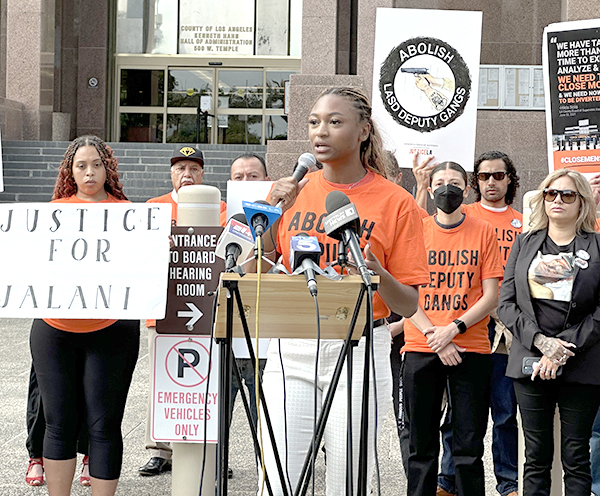
Prior to the board meeting. Justice LA and the Check the Sheriff Coalition joined Mitchell outside the county Hall of Administration for a press conference urging action on deputy gangs.
Her proposal was approved unanimously by the board, but after voting in favor of Mitchell’s motion, her board colleagues then voted to delay the consideration of the actual proposed directives until the CEO completes its initial report.
Mitchell was unhappy with the board’s action.
“For decades, Los Angeles County has talked about deputy gangs,” Mitchell said in a statement issued after the meeting. “We have had reports, investigations, hearings and lawsuits, and we have heard directly from community members and deputies about the harm they have experienced. Yet we continue to delay meaningful action.”
The Board of Supervisors directed its staff to review a series of proposed measures aimed at identifying and cataloguing alleged deputy gangs within sheriff’s department to see if any of the proposals would require discussions with the deputies’ union before they could move forward.
The board also directed the county CEO, in conjunction with the sheriff, county attorneys and employee relations officials, to review the proposals included in Mitchell’s motion aimed at detailing the extent of deputy gangs within the department.
County CEO Joe Nicchitta noted that much of Mitchell’s motion only asks for reports on the process for moving ahead with various issues. He said preparing such reports likely will not require the county to confer with the union, but once the county tries to implement actual directives, some might require union talks.
Overall, Mitchell’s motion calls on county staff to take a series of steps toward identifying and cataloguing deputy gangs, asking that they report in 120 days with a “comprehensive framework” for doing so. It also called on the sheriff and other county agencies to develop a process for publicly identifying deputy gangs, but to develop a confidential report to the board in 120 days listing all suspected gangs in the department, a summary of the status of pending investigation concerning allegations relating to gangs and an explanation of whether current investigations include a requirement for deputies to show tattoos on their arms and legs.
Among other measures, the motion also called for the development of a public accessible reporting system to document complaints and allegations of deputy gangs.
Mitchell acknowledged that there has been progress within the department addressing the issue, and “the goal of today’s motion is to keep that progress moving forward and to not only engage the sheriff’s department but other county departments as well.”
“This motion is about addressing the system that allows this problem to continue,” Mitchell said. “It seeks to determine what we know about deputy gangs, … how we identify these subgroups … and what options are available to this board to hold these groups responsible.
“It does not validate or invalidate every allegation, nor does it assume every group of deputies is a gang.”
Mitchell said her motion began its way through the county bureaucracy a month ago, giving the sheriff’s department, other board members and other departments identified in the motion time to review it and provide feedback prior to public consideration of the motion by the board.
She said the sheriff’s department was invited to provide input but the motion came before the board Sept. 15 without substantive comments from the department
“The directives in this motion are fundamentally about gathering information so that we can understand what we know about deputy gangs, cliques and secret subgroups; how we identify them; how allegations are investigated; and what options are available to this board to hold these groups accountable,” Mitchell said in a statement.
“These are information-gathering and accountability measures that are intended to help us determine the best way to move forward,” she added. “Continuing them again delays the very information we need to make informed decisions and take meaningful action.”
Sheriff Robert Luna did give a lengthy presentation to the board outlining what he called a series of measures taken during his administration to root out gangs within the department, saying he maintains a zero-tolerance policy.

He said he took issue with some of the wording in the motion, saying it could undermine public confidence in the agency by suggesting nothing was being done about the issue. He conceded that more work needed to be done, but tried to convince the board that significant progress has been made.
“I have set very clear expectations for department employees making any gang-like behavior unacceptable,” Luna said. “I have met with all supervisors on this topic repeatedly. I hold meetings with captains and above on this issue specifically to impress upon them their responsibility. No prior sheriff has done this.
“I meet with every new recruit class specifically to reinforce a zero-tolerance policy for participation in such groups and behavior,” Luna said, adding that all new recruits sign a pledge vowing not to join a law enforcement gang, while existing deputies sign an acknowledgement of department policies against such gangs, and department members seeking promotion to captain or above are questioned about whether they have participated in any such activity or if they have a group tattoo.
The sheriff suggested that the primary thrust of the motion — identifying the names of deputy gangs and tattoos — will not do anything to address the issue. He said investigations of deputy gangs need to focus on actual documented gang activity, not names and symbols.
The issue of alleged deputy gangs has long plagued the department.
Mitchell’s motion listed more than two dozen such gangs within the agency, and included some examples of instances of alleged deputy gang activity. The motion pointed to a 2024 report that multiple deputies at the Lakewood station shared a common tattoo, and another instance of deputies at the Norwalk station being involved in a gang using “Nazi-like imagery.”
“Deputy gangs are not a problem of the past, but a persistent issue that continues today,” Mitchell’s motion stated. “Notifications to LASD regarding alleged deputy gangs have been made as recently as June 2025, based on data provided to the (Office of Inspector General) in December 2025. If the existence of deputy gangs is not adequately addressed and resolved, this problem will continue to plague the county.”
“We have documented this problem for years,” Mitchell said. “This motion is about creating the infrastructure to meaningfully address it.”
The motion will return to the Board of Supervisors Nov. 10, Mitchell’s office said.