By Joe W. Bowers Jr.
Contributing Writer
WESTWOOD — Former Vice President Kamala Harris said traveling the country since the 2024 presidential campaign during her book tour gave her an opportunity to hear directly from Americans about the challenges they face every day, reinforcing her belief that many people feel unheard by Washington and increasingly look to state elected officials for solutions.
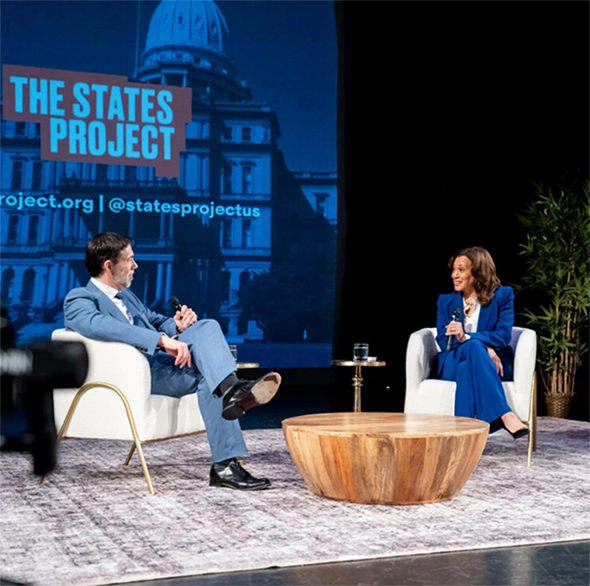
Speaking at UCLA on June 23 during a discussion hosted by The States Project, Harris said she deliberately used her travels to spend time listening to people rather than simply talking to them.
“After the election I needed to take a minute, but when that minute was over, I needed to listen,” Harris said.
One conversation that stayed with her was with a single mother of three in Jackson, Mississippi, who was attending cosmetology school while raising her children on a $150 weekly grocery budget. Harris said the woman also told her the tap water was sometimes too contaminated to bathe her children.
When Harris asked what she wanted others to understand about families like hers, the woman replied, “Don’t they see me?”
“There are a lot of people who feel that they are not interested, and that their everyday fears and worries and hopes aren’t being heard,” Harris said. “People are done with the status quo. They’re done. It’s not working for them.”
She said political leaders must focus on solving everyday problems while presenting a broader vision for the country’s future.
“It’s about having affordable housing, affordable health care. It is about having a tax code that works for working people,” Harris said.
Harris said those conversations reinforced her belief that state elected officials are often better positioned than Washington to understand the everyday challenges facing their constituents.
“I support The States Project because the folks here and the folks we are supporting — state elected officials — are on the ground seeing and hearing these stories every day,” Harris said.
The discussion was moderated by Daniel Squadron, co-founder of The States Project and author of “The Fourth Branch: How State Government Can Save Our Union.” The organization supports state legislative candidates in competitive states and advocates for greater investment in state legislative races.
Attending the event were legislators from states where The States Project is active, including North Carolina Senate Democratic Leader Sidney Batch and Maine Senate President Maddie Daughtry, who described how legislative majorities can shape policy on issues ranging from child welfare and childcare to paid family leave.
Batch, a child welfare attorney before entering public office, said she decided to run for office after representing a mother who nearly lost custody of her children because she could not afford child care or legal representation to obtain child support.
“I finally started realizing that every single day we have a legislature that is being run by individuals that have no sense of what’s happening to everyday North Carolinians,” Batch said. She said that despite serving in the Senate minority, she has worked with Republican colleagues to help enact North Carolina’s first major child welfare reforms in more than 50 years.
Daughtry said she entered politics after working four jobs without health insurance. She said Maine’s Democratic majority enacted paid family leave, with benefits beginning in May, and eliminated the state’s
childcare waiting list.
“When you have the majority, everything changes,” Daughtry said. “For the cost of one Senate race, we’ve transformed an entire state.”
Harris also addressed voting rights, saying recent court decisions and actions by some states have made access to the ballot more difficult.

She pointed to students at North Carolina A&T State University, where she said local election officials removed an early voting location from campus. Harris said the students later traveled to the state capitol to protest, where a Republican legislative leader told them, “You have five minutes, five minutes to leave.”
Harris said the episode illustrated how voting rights battles increasingly are playing out in state capitols.
Batch later described what she said were broader efforts by Republicans in North Carolina to reshape election administration, including moving oversight of the State Board of Elections under the Republican state auditor and removing early voting sites from college campuses. She recalled a Republican colleague opposing polling places on college campuses because, he said, “Those people don’t vote for us, they vote for you.”
Harris said protecting voting rights remains central to the broader civil rights movement.
“The fight for civil rights in America, born out of the struggle of Black Americans, has benefited so many groups,” she said. “But when we look at what’s happening across the country, the fight for justice, for equality, lives on.”
Looking beyond the current administration, Harris said Democrats must present voters with more than opposition to President Donald Trump.
“We’ve got to have a mindset and a purpose that is about the day after this administration leaves the White House,” Harris said. “The question is going to be, what are you going to do with the power if you get it?”
Harris closed by encouraging Americans to remain engaged in their communities and state government.
“I strongly believe nobody should be made to fight alone,” Harris said. “Especially at this moment in time.”
Joe W. Bowers Jr. writes for California Black Media.